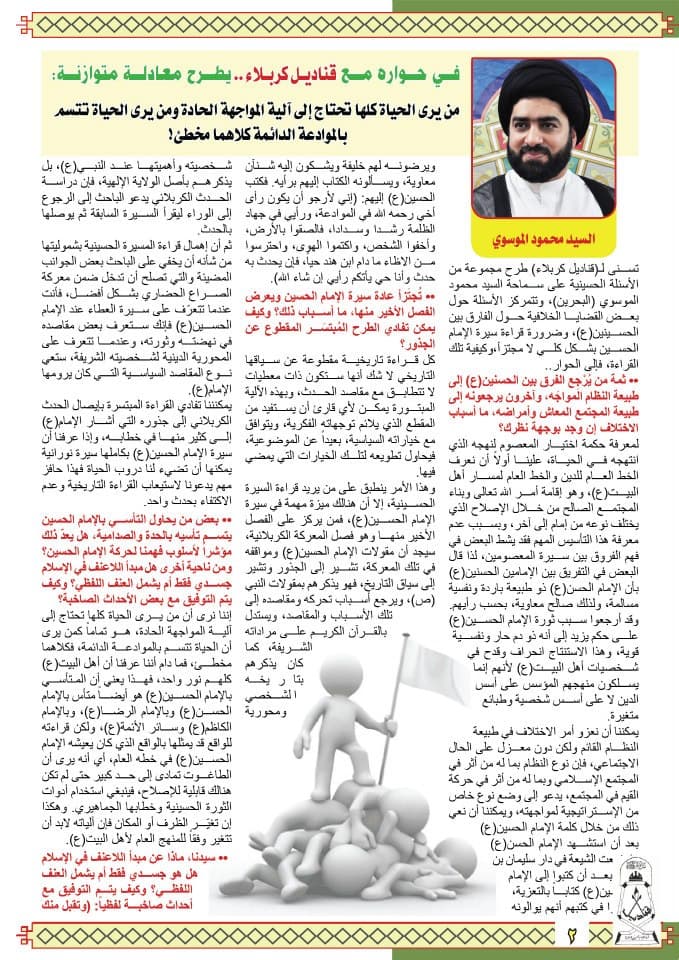
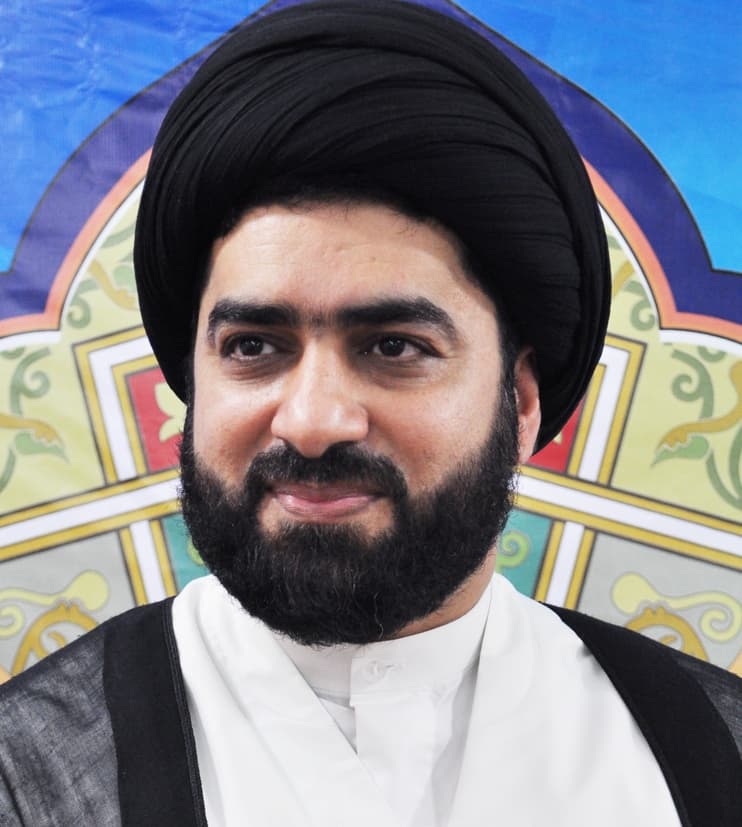
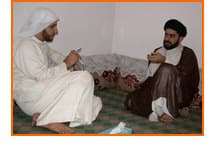
Sayed Mahmoud Al-Mosawi in a dialogue on the suckling infant and the Husayni cause .
· The suckling infant, like the calf of Salih’s she-camel, is a mercy for whoever reveres him, preserves his station and keeps his cause alive, and he is a retribution upon whoever violates his sanctity and makes light of his cause.
· When the engagement with the Husayni occasion deviates, the march deviates.
· We hope that the writings about al-Husayn by those who love him among non-Muslims will turn from feelings into torches.
· The woman whose thinking is shaped by the Husayni path must shape those in her care in the same way.
Interview conducted by:
The website of the Gate of Needs, the Martyr ʿAbd Allah al-Radiʿ (a).
Dr. ʿImad al-Khazʿali
1/ How did ʿAbd Allah al-Radiʿ (a) become one of the gates of needs to Allah, Glorified and Exalted is He?

Al-Mosawi: The Household of Prophethood are the place of the Message and the frequenting-place of the angels, and they are Allah’s mercy gifted to humanity. It is out of Allah’s vast mercy that He made the Ahl al-Bayt (a) gates to acts of obedience for us in this world and means of intercession in the Hereafter, because of the immense sacrifices they offered in the way of Allah the Exalted, and because of the depth of what they gave in the way of raising high the word of truth and the values of heaven. Joined to the Infallible Ahl al-Bayt (a) are their children and their followers in truth, who translated their godly life into human reality and who followed in their footsteps. The suckling infant, the son of Imam al-Husayn (a), is an offering on the path of martyrdom, and the tragedy of his killing was immense for the heart of Imam al-Husayn (a) and for his mother, indeed for all the Shiʿa. So it is not strange that Allah the Exalted should give him a praiseworthy station, so that he becomes one of the gates of Allah for people’s needs in this world and the Hereafter.
We find in the supplication of Imam al-Husayn (a) after the killing of ʿAbd Allah al-Radiʿ important meanings in this regard, for he said: (O Allah, let him not be of less account with You than the calf of Salih’s she-camel). The she-camel of the Prophet Salih and her calf were two of the signs of Allah and a mercy for the people of Salih; they were commanded to treat the two kindly so that they might obtain their blessings. The calf had a day of drinking, and all the people had another day of drinking, and Allah the Exalted warned them against touching her with harm lest the punishment befall them, for the Exalted said: “This she-camel of Allah is a sign for you. Let her alone to graze [freely] in Allah’s land, and do not cause her any harm, for then you shall be seized by a painful punishment” (Qurʾan 7:73). So their Lord brought destruction upon them and levelled the earth over them after they had hamstrung her. Thus, just as whoever touched the suckling infant with harm, and everyone who took part in killing him or was pleased with it, will have as their end the painful punishment in the Hereafter, as swift punishment came down upon his killers on that day, likewise ʿAbd Allah al-Radiʿ is the gate of mercy for whoever reveres him, preserves his station, keeps his cause alive and raises his standing.
2/ What is the role of the suckling infant (a) in the Husayni uprising?
Al-Mosawi: He is the witness to the hideousness of Umayyad oppression, and he is the irrefutable proof that awakens man’s mind and heart from his heedlessness of the path of truth and justice. The movement of Imam al-Husayn (a) is an uprising that rouses the spirit and gives it the resolve to support the truth on any day whatsoever; and it is a revolution, because it stirs up the buried treasures of minds and shakes the dust of heedlessness off those who hold back or who sympathize with the enemies of Allah and the enemies of the Ahl al-Bayt (a). Through the suckling infant and his painful martyrdom, the deepest and clearest meanings of revolution and uprising are realized.
3/ What is the role of the Husayni woman in raising the Husayni child?
Al-Mosawi: The woman whose thinking is shaped by the path of Imam al-Husayn (a) in his movement will have the role of shaping those in her care in the same way. Children are a responsibility before they are anything else, and the woman’s responsibility is, first, to open herself to Husayni culture, with its values, its counsels and its aims, and second, to pour those meanings into the child’s mind and heart, so that he is raised on the Husayni way.
That is because we are living through a fierce struggle over childhood. Everyone who wants to take control over the heads of the people, and everyone who wants to dominate nations, works to win over the child, because he will be the young man of the future, and he is the one on whom the reliance and the wager rest. The corrupt tendencies in the West and elsewhere work to make generations spineless, and to move them away from the culture of dignity, the culture of justice, the culture of rejecting oppression and the culture of purity, toward the culture of humiliation, of accepting oppression and of working in corruption; they make falsehood seem attractive to them and make the truth seem ugly to them, so that their choices always flow into falsehood without their realizing it.
There are two basic steps that the mother can take to achieve this aim, namely:
First: taking care to attend the rites together with the child, so that the child lives in Husayni atmospheres that are varied in what they give and multiple in their scenes, and so lives his belonging in practice. This social, cultural and spiritual environment that the commemoration of the occasions forms is among the most important factors of influence on all members of society, and on the child in particular.
Second: attending to the intellectual and cultural dimension of the child, for the kind of culture with which the child is nourished in his early years is what will determine his course and his way of thinking, and the Husayni cause is full of great values that can bring souls to life and contribute to the advancement of man.
4/ Each of those martyred among the companions of al-Husayn and his household had a particularity and a special distinction: among them there is a Companion, there is a young man, there is an old man, there is a woman, there is a Christian who embraced Islam, there is a black slave, and so on; but the strangest of all is that there is a suckling infant. What is the philosophy behind the presence of these groups, and in particular the suckling infant?
Al-Mosawi: The enemies’ intention was to get at Imam al-Husayn (a) even if he were clinging to the curtains of the Kaʿba. Their malice reached the point that they aspired to achieve their corrupt aims through killing and exemplary punishment, however far the matter went and at the expense of anything that could hinder their demand. They do not only kill the inviolable soul; rather, they pay no attention whatsoever to sanctities if these stand in the way of their will, and so they see nothing wrong in violating the Sacred House in order to achieve their ends. That is why Imam al-Husayn (a) indicated that they were seeking him even if he were clinging to the curtains of the Kaʿba.
Perhaps this matter might not be believed by the common people, especially those deceived by the Umayyads, at whose head stood Yazid at that time. Therefore Imam al-Husayn’s (a) step of bringing the children and the women had in it a kind of public exposure and an unmasking of the enemy’s baseness. The Imam gave the reason for this in his saying: (Allah has willed to see them as captives). This will of Allah the Exalted achieves several aims, among them showing the patience of the Household (a), and among them exposing the enemies who do not refrain from killing children and taking women captive. The tragedy of the killing of the suckling infant in Karbala showed that these people are the furthest of the sons of man from humanity, and the most hostile of them to religion.
As for the diversity of the martyrs of al-Taff in general, its distinction is that it realized a basic idea, namely that Imam al-Husayn (a) is for everyone and with everyone. These are the values of religion, which made people equal and made the measure of preference among them Godwariness, righteous deeds, and knowledge of guidance and truth, not material things and deceptive appearances. So every human being can attain success with al-Husayn and through al-Husayn (a).
5/ When the suckling infant was slaughtered, Imam al-Husayn raised him toward the sky, and as is reported in the maqtal books: “Then he took some of his pure blood in his palm and threw it toward the sky, and not a drop of it fell.” What is the meaning of this, and why did the Imam do it?
Al-Mosawi: It has been narrated from Imam al-Baqir (a) that he said that Imam al-Husayn (a) took the blood of the suckling infant after he was killed and threw it to the sky, and not a drop of it fell to the earth. This gives us the meaning that this blood has great importance, for it was the first thing that passed to the sky in Karbala; this speed in passing is matched by speed in acceptance, and indeed by the depth of that offering which Imam al-Husayn (a) gave. Therefore the Imam was supplicating with this supplication when he threw the blood toward the sky: (What has befallen me has been made light for me by its being in the sight of Allah). This great calamity was made light by the fact that it was in the sight of Allah; this self-giving of the Imam was received by Allah with immediate acceptance.
Moreover, the Imam’s (a) action may point to another aspect, connected with the order of creation and the intrinsic effect of what might have happened had the blood of this pure prophetic child flowed upon the earth of this world. So Imam al-Husayn (a), out of mercy for the servants, threw the blood to the sky; but he supplicated against his killers, saying: (O Allah, if You have withheld victory from us, then make it for what is better than it, take vengeance for us on the oppressors, and make what has befallen us in this immediate life a treasure for us in the life to come). Allah the Exalted answered the Imam’s supplication, and al-Mukhtar took vengeance for Imam al-Husayn (a) and killed the killers. Among them was Harmala ibn al-Kahil, who killed the suckling infant; he killed him in the worst manner of killing, after al-Mukhtar wept and said to him: “Woe to you! Was what you had done not enough for you, until you killed a small child and slaughtered him? O enemy of Allah, did you not know that he was a child of the Prophet?”
6/ Do you think that the Islamic Umma has truly benefited from the principles of the Husayni revolution and from the pure and generous blood shed by the sweet basil of the Messenger of Allah, Imam al-Husayn (a), and by his household and companions?
Al-Mosawi: If the assessment is to be in comparison with the sacrifices that Imam al-Husayn (a) offered, then there is no proportion between the two at all. But let us say: has the Islamic Umma benefited from the principles of the Husayni revolution as it should, and in what would set its affairs right?..
Looking at this dimension historically, if we trace the occasions of honor and dignity that the Muslims have passed through from the martyrdom of Imam al-Husayn (a) until our day, we will see that behind them stand Husayni thought and the immortal principles of the Husayni revolution. The unjust Umayyad rule did not fall except through the succession of movements and uprisings against that rule, until it weakened and collapsed; and likewise all the other challenges that the loyal Muslims have passed through, they overcame only through Husayni defiance. On the other side, any weakness and slackness that afflicts the Umma is only because of its moving away from that way.
The Islamic Umma is still in need of those values that Imam al-Husayn (a) made manifest through his blessed revolution, in order to triumph over its negative, unjust reality.
7/ The majority of Muslims know Imam al-Husayn (a) as religious rituals that begin on the first of Muharram and end on the twentieth of Safar. Do you think that this narrow knowledge is commensurate with the aims of the Husayni revolution?
Al-Mosawi: The foundation of the Husayni march is following the example of what the Imam presents and what the Imam says, for the sake of building the self and building reality, since he is an Imam whose obedience is obligatory and it is our duty to follow his example; and it is he who said: “And in me you have an example.” This is the foundation. When we say that our Husayni activity and our commemoration of the season of Imam al-Husayn (a) should proceed along two sides, namely “attention to the rites” and “attention to the values”, or, as His Eminence Ayatollah Sayed Hadi al-Modarresi says, “the cause of the squandered truth, and the cause of the dismembered body”, we say this only so that both directions serve the basic aim of realizing the idea of the Imamate and belief in the Imamate in our contemporary reality. When the engagement deviates, so that the side of the rites is made to prevail over the side of values, the march deviates; for the rites are important frameworks that carry the more important content. The importance of the rites lies in deepening the meaning and the content, so the values and meanings must always be kept present, so that our engagement is a moderate, balanced engagement.
8/ How do you assess the idea of dedicating a day to the suckling infant (a), under the title of the World Day for Commemorating the Wrong Done to the Suckling Infant, which “the World Assembly for Commemorating the Wrong Done to the Suckling Infant (a)” has set on the morning of the first Friday of ʿAshura (the morning of the first Friday of the sacred month of Muharram every year)?
Al-Mosawi: Dedicating a world day to commemorate the wrong done to the suckling infant and his martyrdom in Karbala is an important idea, because when we believe in the importance of something, that concern must appear in our reality. Commemorating that day and giving it attention is a manifestation of that great tragedy committed by the transgressing party, so that this occasion becomes an occasion for separating the line of truth and loyalty to it from the line of falsehood and rejection of it, and so that this occasion becomes an occasion for renewing the remembrance of childhood and its importance in building a sound society. This occasion is also one of the means of drawing near to Allah the Exalted, because it is consolation for the Ahl al-Bayt in their calamities, just as they commanded us to grieve for their grief. In this way the suckling infant and this occasion of his become a place where Allah’s mercy descends, and a place for drawing on the miraculous graces of the suckling infant in the fulfillment of needs in the affairs of this world and the Hereafter.
In our holding of this occasion at the Ahl al-Kisaʾ (a) Foundation, we have witnessed many women whose supplications were answered through the blessing of the suckling infant. We ask Allah the Exalted to perpetuate these occasions so that people may live with the life of the Ahl al-Bayt (a).
9/ How do you read the engagement of many non-Muslim poets and writers with the event of al-Taff, which took the form of composing poetry and writing books and slogans?
Al-Mosawi: The meanings that Imam al-Husayn (a) brought are the universal and humane meanings of Islam, to which sound innate nature responds and with which clean souls and free minds engage everywhere, of every nationality, race or religion, and in various languages. The whole world aspires to the value of dignity, freedom, defiance and justice, and the whole world stands in reverence and bows in veneration before the great Husayni sacrifices made for the sake of establishing truth, justice and freedom for the sake of man. Therefore it is not strange that poets, men of letters and thinkers should engage with this great march.
What we hope is that this engagement leads to guidance, that the engagement is translated into action, and that it moves from feelings to torches; for that admiration should lead to the important questions that led Imam al-Husayn (a), in his steps at Karbala, to offer all those immense sacrifices. The Imam had a message, and we ask Allah that they may reach it, just as some have come to believe and been guided through Imam al-Husayn (a) when they read of a struggle whose like they had not seen in history.
10/ Imam ʿAli (a) says: The occurrence of oppression means that the oppressed helps the oppressor against himself! While Gandhi says: (I learned from Imam al-Husayn how to be oppressed and yet triumph). How, I wonder, do you read the two statements? In other words, how can the oppressed triumph over the oppressor?
Al-Mosawi: The saying of Imam ʿAli (a) speaks of the reality of oppression that settles in societies and with which people are content. In this case, the oppressed, by his silence, his submissiveness and his contentment, helps the oppressor against himself and encourages him to persist in oppression, because the oppressor has seen people accept oppression. Thus the Imam has given us an important measure among the measures of responsibility, namely that when we find oppression in a place, the responsibility is general and includes all the people, and this means that there is a defect in that society.
As for Gandhi’s statement, it is merely a benefit drawn from his objective reading of the movement of Imam al-Husayn (a). He came to know that even if he was oppressed, he possessed the ability to triumph over his oppressor; for true victory is, on the one hand, the victory of values, and the oppressed can triumph if he knows how to manage the wrong done to him.
The words of the Commander of the Faithful (a) are without doubt deeper, because they give us a measure by which we assess reality; and the words of Gandhi, who was able to defeat colonialism in his country, are a spark from the light of Karbala and a benefit drawn from the movement of Imam al-Husayn (a) on the activist side.
————————
The interview was published in:
* Dhikra magazine — the Ahl al-Kisaʾ Foundation. Muharram 1431 AH issue
* The Iranian Arabic newspaper al-Wifaq, issue 3520 — 5 Muharram 1431 AH
* The website of the Gate of Needs, ʿAbd Allah al-Radiʿ