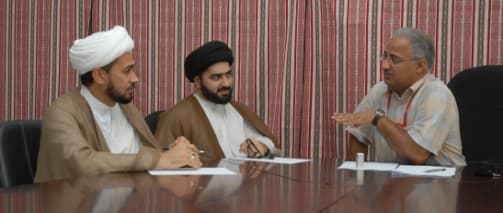
The studies journal al-Basaʾir publishes the dialogue presented by Sayed Mahmoud Al-Mosawi, which he prepared together with a group of scholars, and which was held with His Eminence the religious Marjaʿ, Grand Ayatollah, the Renewer, Sayed Muhammad Taqi al-Modarresi (may his shadow endure).. and which the Ahl al-Bayt (a) Channel broadcast at an earlier time.
The Value-Based School in Legislation and the Dimensions of Developing the Methods of Deduction
A dialogue with His Eminence the religious Marjaʿ Sayed Muhammad Taqi al-Modarresi – Part One
Introduction
Some like to regard the present structure of the methods of deduction (istinbāṭ) in Imami usul al-fiqh as the product of the school of al-ʿAllama al-Wahid al-Bihbahani: that school which was the result of nearly two centuries of heated dialogue between Usulism and Akhbarism, and whose outcome at the hands of al-Bihbahani was the activation of ijtihad on the basis of a triad—knowledge, conjecture and doubt—together with restoring regard for the ability of reason to understand the texts, and establishing the practical principles, in addition to ordering the sources of deduction, beginning with the Noble Qurʾan. The features of this school appear clearly in the “Faraʾid” of Shaykh al-Ansari at the level of usul, and in the “Jawahir” of al-ʿAllama al-Najafi at the level of fiqh. And despite the expansion of the discussions of usul and fiqh during the past two centuries—from the era of Shaykh al-Ansari to this day, and especially in the last century at the hands of the school of holy Najaf—the general framework of these expansive studies has remained revolving around the general axes of the school of al-ʿAllama al-Bihbahani.
But the changes that Shiʿi fiqh faced at the beginning of the twentieth century, during the Constitutional Revolution in Iran, and then in its seventies with the establishment of the first modern state that relies on Shiʿi fiqh in its administration—these changes brought the foundations of al-Bihbahani's school to a dead end; or, in other words, al-Bihbahani's school found itself to have exhausted its basic foundations, in usul and in fiqh, in the face of these deep transformations. The practical principles were no longer a solution for cases where a text is lacking, just as the particular texts were no longer able to address the changes without being connected to their purposive foundations and their fundamental aims. This, not to mention the necessities of developing the mechanism for understanding religious texts in the discussions of linguistic expressions (mabāḥith al-alfāẓ).
More than one Imami jurist and thinker has paid attention to the depth and level of this challenge, and numerous calls began for developing the methods of ijtihad in a way that suits the reality of today's changes. In fact, many attempts have been put forward: some of them were still trying to develop through the foundations of al-Bihbahani's school itself, while others tried to search for new theological and epistemological foundations for methods of deduction that suit the theological and epistemological development that has taken place in Imami thought.
His Eminence the Marjaʿ al-Modarresi has, for three decades, been making concentrated efforts for the project of developing the process of juristic deduction. Its beginning was a series of lessons delivered to the students of the Hawza of Imam al-Qaʾim (aj) in 1980 CE, revolving around “Islamic Civilization”, in which he dealt with the theological foundations and the epistemological backgrounds of the possibilities and horizons of development in usul. This was then followed by what later became known as the encyclopedia “Islamic Legislation: Its Methods and Objectives”, in which His Eminence began reconsidering the traditional tools of the process of deduction (al-Bihbahani's school), in an attempt to rearrange their internal structure and to determine the place of each tool of usul, in addition to reconsidering some of the limits of the authoritativeness (ḥujjiyya) of some of those tools. However, the matter did not stop at this point; rather, His Eminence the Sayed Marjaʿ went on to strive to merge the Islamic Imami debate in usul with the general contemporary human debate on issues of the philosophy of ethics and of law, the two of which are considered the “infrastructure” of any civilizational transformation and of any social order: on the basis of the philosophy of ethics the policies of the state are determined, and through the philosophy of law the courses of moral values are codified on the ground.
Here His Eminence the Marjaʿ al-Modarresi arrived at what he called “the Value-Based School in Legislation”, which builds the process of juristic deduction on the basis of the values of the Shariʿa. However, these values are not like the objectives (maqāṣid) of al-Shatibi and his mechanisms; rather, they are a new hierarchy of the system of Islamic values that constitutes the background of the legislating jurist. At the same time, they are not merely theoretical values but values connected with the reality of society and its transformations. Here His Eminence the Sayed Marjaʿ introduced the study of “the jurisprudence of reality” or “the jurisprudence of priorities” into the discussions of the science of usul—not in its traditional form, as in the discussions of “the more important and the important” and of conflict (tazāḥum), but within a deep social-scientific vision of the jurisprudence of priorities. In other words: in his project “Islamic Legislation”, the Marjaʿ al-Modarresi is attempting to come up with new usul foundations for the process of deduction that go beyond the impasses of “al-Bihbahani's school”, while at the same time drawing their principles and basic structure from the Book, the Sunna and reason.
The dialogue before us with His Eminence the Sayed Marjaʿ al-Modarresi—may his shadow endure—represents an attempt to bring to light some of the features of this new school of usul, undertaken by a number of the learned scholars of the Hawza in an extended dialogue about this course: beginning with the concerns of developing usul and its obstacles, and then turning toward some of the details of “the features of the Value-Based School in Legislation”, such as the relationship of the values to one another, their ranking among themselves, and the mechanism for determining which of them takes precedence on the ground. Nor was the dialogue devoid of touching upon the reality of the religious establishment, and the position of the jurist and of the elites of experts in embodying the values on the ground.
All this is in the first part of the dialogue; as for the second part, it will deal with the basic sources in the process of deduction and the vision of the Marjaʿ al-Modarresi regarding them, beginning with the Noble Qurʾan—the structure of values in it and its sensitive position in juristic deduction—then passing on to the purified Sunna—discussing its divisions and the dimensions of its authoritativeness, and how to distinguish its roots from its branches—and finally reason, its relationship with religion, and its role in the process of deduction.
Taking part in the dialogue were:
Shaykh Zakariyya Dawud:
A religious scholar, a researcher in Islamic affairs, a member of the advisory board of the studies journal al-Basaʾir; many intellectual studies and research papers of his have been published in several journals and newspapers. Among his published works: Reflections on Hadith among the Sunnis and the Shiʿa.
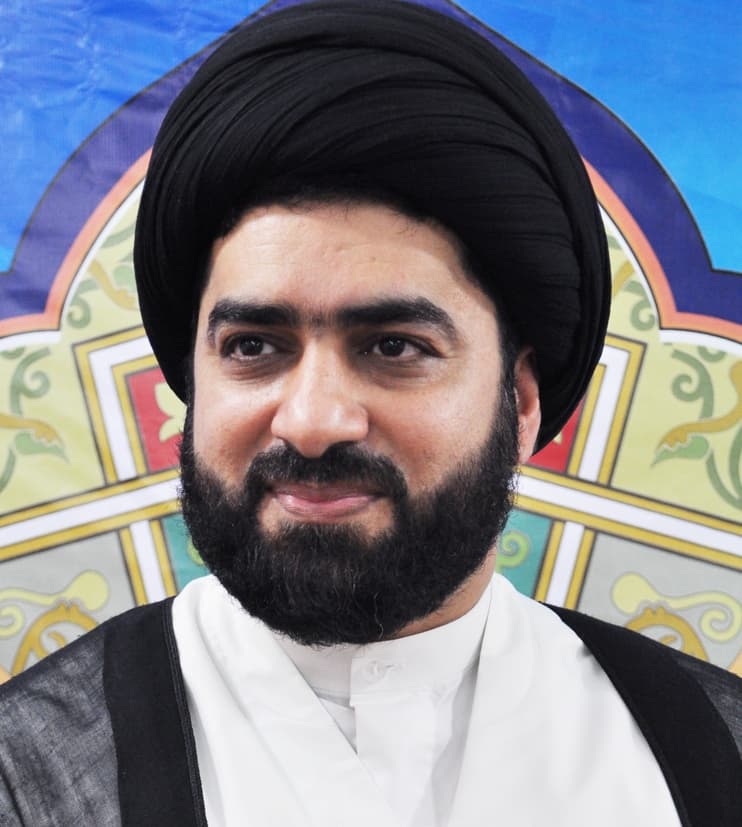
Sayed Mahmoud Al-Mosawi:
A religious scholar, a researcher in Islamic affairs, director of the Representative Office of the Marjaʿ al-Modarresi in Bahrain, a member of the editorial board of al-Basaʾir journal; many intellectual studies and research papers of his have been published. Among his published works: Globalization and Society: New Challenges and the Program of Tasks.
Shaykh Habib al-Jamri:
A religious scholar, writer, man of letters and poet, director general of al-Nabaʾ Islamic Society; many research papers and articles of his have been published in Bahraini journals and daily newspapers. He has a printed collection of poems entitled: The Departure to Karbala.
Shaykh Hamza al-Lami:
A religious scholar, an Islamic writer and researcher, the representative of al-Basaʾir journal in Baghdad, a social activist and a participant in cultural and intellectual forums in Iraq. Among his published works: The Map of the Path of the Mission.
The Horizons of Jurisprudential Development and Its Obstacles
Sayed Mahmoud Al-Mosawi:
“Whoever does not knock firmly on the doors of the future, the future will forcefully burst into his courtyard. The society that does not develop the means of its life condemns itself to perish. Development does not mean imitating others, but following a middle course by which it preserves its values and makes them the axis for developing the means. The divine laws were not abrogated in their foundations, but only in some details, owing to the wisdom of the need for change; and Islam is Allah's message that presides over all the other laws, with the values it contains and with a system of development for realizing them. Thus, development in the rulings of religion is based on fixed foundations, namely the ideal system of teaching found in the Glorious Book of Allah and in the definitive texts (muḥkamāt) of the noble Sunna”[1].
Your Eminence, with these words you spoke about the issue of “development between science and religion”. It would be good if you could give us a general idea of your conception of the issue, to serve as a starting point for our dialogue with you.
His Eminence the Sayed Marjaʿ:
In the Name of Allah, the All-beneficent, the All-merciful, and may Allah bless the master of all creation and the good and pure members of his Household.. To proceed.
Peace be upon you and the mercy of Allah.. and peace be upon the believing brothers, and the mercy of Allah and His blessings..
We have explained before that our Lord—Glorified and Exalted is He—has two proofs over His servants: intellects and messengers. And although these two proofs are two rays emanating from a single niche and two branches of a single light, each of them has a responsibility that may be specific to it. If revelation essentially determines for us the values, the wisdoms and the rulings, reason undertakes the discovery of life and the knowledge of realities, in addition to also helping us know the great truths, that is, what relates to divine knowledge. If this is the case, then development will be on the axis of revelation and on the basis of reason. For it is reason that reveals to us the necessity of development. Why? Because it reveals to us that the subject has changed. It is as if someone resident in his homeland traveled outside the homeland: his ruling changes. He was required to complete his prayer while in his homeland, but now that he has traveled, he must shorten his prayer, and if he was fasting, he breaks the fast. So with the change of the subject, the ruling changes. Likewise, if reason discovers that this subject involves hardship (ḥaraj) or harm (ḍarar), or that this subject is not a subject of this ruling, then the ruling follows the subject as determined by revelation; but the subject to which the ruling applies is determined by reason, through science and expertise.. and other things.
Hence the notion of “development between religion and science” can also be titled “development between revelation and reason”. For since reason undertakes the determination of subjects, and because rulings change with the change of subjects, reason plays a fundamental role in knowing the necessities of development. Hence the scope of development lies in the means and tools whose sanctity the Shariʿa has not stipulated or whose ruling the Shariʿa has not set out; but if there is a priority and importance for the ruling that exceeds the sanctity, importance or ruling of the means, then in such cases development falls to the share of the subject. For example, when I see a patient in a difficult condition, and it is possible for me to get him to the hospital either by a fast car or by a slow one, but I know that if I used the slow car this might harm the patient's health, then reason in this case tells me: since your religious obligation is to save this person's life, and because the holy Shariʿa says: “There is no harm and no harming..”[2],. and also says: “and whoever saves a life is as though he had saved all mankind” (Qurʾan 5:32)[3], along with all the other legal proofs that indicate the sanctity of life, you must use the fast car, and it is not permissible for you to use the slow car—even if this car is the car you are used to and know how to drive well, and it is, for example, your father's car, and out of honor for your father—but these are secondary matters. The basis is saving this person's life.
Likewise, if I could defend my country with primitive weapons, but I know that if I used these weapons—such as the sword, the spear, the dagger, the shield, the helmet and the like—I would be defeated in war: is it permissible for me to use those weapons, or must I develop? For our Lord, Glorified and Exalted is He, says to me: “Prepare against them whatever you can of [military] power and war-horses, awing thereby the enemy of Allah, and your enemy” (Qurʾan 8:60)[4].
The question that is raised here, and in such cases, is: Is reason here a legislator? The answer: No. Reason is not a legislator; rather, it determines the subject. That is, the Shariʿa in fact rules on that whose subject reason has made clear, not its ruling.
The point, then, in the issue of “development between reason and revelation”, is that revelation determines the rulings and reason determines the subjects; and development consists—in fact—in our applying the rulings of the Shariʿa to the developing and changing subjects according to their changes and developments.
Shaykh Hamza al-Lami:
Your Eminence, you have called for development in the methods of deduction, and have dealt with this subject in your book “Islamic Legislation” since the beginning of the nineties. What is the necessity of development, and what is the system of development that you propose?
His Eminence the Sayed Marjaʿ:
In fact, whoever is acquainted with this book[5] and with my other books that deal with this subject knows that the necessity of development is the necessity of life, and a necessity for applying the rulings of religion. I have explained previously that religious commands and rulings must be applied, especially what we have known from the Shariʿa to be a necessity that cannot be relinquished—in other words, what some call matters of ḥisba. We know that preserving life, the core (bayḍa) of Islam—that is, Islam as a whole—the Umma, the Kaʿba, the holy shrines, the mosques, the prayers.. and other matters that represent one of the necessities: if preserving all of that depends on something, we must bring about that thing, on the basis that the preliminary of an obligatory act is obligatory. And when our Lord, Glorified and Exalted is He, says: “Prepare against them” (Qurʾan 8:60), what does this word mean? “whatever you can of [military] power” (Qurʾan 8:60) means that all kinds of power (quwwa)—whether military, financial, economic, industrial, political, social, training or logistical power—any type of power, we must prepare; because when Allah, Glorified and Exalted is He, said: “Prepare against them whatever you can of [military] power” (Qurʾan 8:60), the construction of this speech indicates the necessity of attaining every possible power that we are able to attain.
So the necessity of development comes from the necessity of applying the rulings of the Shariʿa[6], given that many of the rulings of the Shariʿa cannot be applied except through preliminaries, and these preliminaries acquire their legitimacy and their obligatoriness from the obligatoriness of that which they lead to, that is, of that for which they are preliminaries, which the Lord, Glorified and Exalted is He, has made obligatory. When the Lord—Glorified and Exalted is He—commands you to perform the Hajj: “And it is the duty of mankind toward Allah to make pilgrimage to the House—for those who can afford the journey to it—and should anyone renege [on his obligation], Allah is indeed without need of the creatures” (Qurʾan 3:97), it is obligatory[7], so it is obligatory upon you to search for any means that will get you to the Hajj. And when He commands you to wage jihad: “And wage jihad for the sake of Allah, a jihad which is worthy of Him. He has chosen you and has not placed for you any obstacle in the religion, the faith of your father, Abraham. He named you ‘Muslims’ before, and in this, so that the Apostle may be a witness to you, and that you may be witnesses to mankind. So maintain the prayer, give the zakat, and hold fast to Allah. He is your master—an excellent master and an excellent helper” (Qurʾan 22:78)[8], you must search for any means by which you can carry out jihad. And when He commands you to invite to Allah: “Invite to the way of your Lord with wisdom and good advice and dispute with them in a manner that is best. Indeed your Lord knows best those who stray from His way, and He knows best those who are guided” (Qurʾan 16:125)[9], and to enjoin what is right and forbid what is wrong, and to establish justice, and He says: “and do justice. Indeed Allah loves the just” (Qurʾan 49:9)[10], “O you who have faith! Be maintainers, as witnesses for the sake of Allah, of justice, and ill feeling for a people should never lead you to be unfair. Be fair; that is nearer to Godwariness, and be wary of Allah. Allah is indeed well aware of what you do” (Qurʾan 5:8)[11], or commands you to be a maintainer of justice, a maintainer for Allah and a witness to the truth—these are divine commands in whose application we cannot be lax. So if these commands and their application require a set of new, developed means, we must acquire them, for they are a means to that ruling. In sum, the necessity of development springs from the necessity of applying the rulings of the holy Shariʿa—those rulings that came unrestricted and not bound to one circumstance or another, which in the jurists' expression is “among what we have known from the Shariʿa to be necessary to apply in any form whatsoever”, that is, the Shariʿa wants them in any form whatsoever.
As for the method of development, this is a long discussion, but its gist is that the basic method of development is in fact that we follow reason[12] and determine the legal priorities, by the ways I have explained in the book Islamic Legislation, volume three[13], and by creating a mechanism for development. The mechanism of development must be supervised by jurists and experts: the jurists by virtue of the knowledge of religion they have been given, and the experts by virtue of the knowledge of this world, or the knowledge of life, they have been given. The expert determines the subject and the jurist determines the ruling; this is not only in general matters but even in particulars. That is why I always call, in such matters, for forming consultative (shūrā) councils which include, alongside jurists in religion, experts in life, jurists in law and others, so that the ruling that comes out of this council is a legal ruling. Let us give a contemporary example: in one of the years, the media spoke about the possibility of swine influenza (H1N1) spreading widely during the days of the Hajj (in the year 2010), which raised a legal question in the corridors of the scholars: is the Hajj obligatory in these circumstances, or does its obligation lapse because of the severe harm, on the basis of “There is no harm and no harming”, or what?
This is a legal ruling, but in one aspect it depends on the jurist: for his part, he must determine the importance of the Hajj and the level of harm at which the Hajj lapses, because the Hajj by its nature involves harm to a certain degree, whether we like it or not; but does the harm reach a limit at which the jurist can lift the Hajj from those who are legally responsible, or not? On the other hand, we need experts in health: they determine the extent of the spread of the disease, and whether we can protect ourselves against the disease by means of masks, or by means of a set of preventive measures, or the like. The expert determines the subject and the jurist determines the ruling. Through the dialogue among them the fatwa—or the final word that comes out of this council—will be produced, and it is of course the word of the jurist, based, in addition to juristic awareness, on health consultation and the like.
Jurisprudential Development and the Concerns of the Religious Establishment
Shaykh Habib al-Jamri:
Your Eminence, your calls for development are long-standing calls, not new ones. Nevertheless, there is a group of the religiously observant who are engaged in religious learning and who undertake legislation who raise objections to this discourse, such as: “that the Book of Allah calls to laws (sunan) that admit no change and no alteration”; and consequently they seem inclined not to move toward such an idea—the idea of development—out of fear of innovation or fear of breaking loose. How do you view this?
His Eminence the Sayed Marjaʿ:
Naturally, when we say “development between science and religion”, the meaning of “development” here is not development without limits; religion delimits development. I have said before: “The goal determines the means.” Our goal is the pleasure of Allah—Glorified and Exalted is He—and the pleasure of Allah must always be before our eyes as we carry out the process of change and development. The legal rulings do not change; rather, development is in the means and in the subjects. A ruling changes with the change of its subject, not by its own changing. The legal rulings are fixed rulings, and the well-known hadith: “.. The lawful of Muhammad is lawful forever until the Day of Resurrection, and his unlawful is unlawful forever until the Day of Resurrection..”[14]. The Noble Qurʾan likewise is an eternal book for humanity, and we cannot change a single letter of it. From this angle, and because there are calls from some to cast off the legal rulings, what must be clarified here—in fact—is that the development we call for is not development without limits, so to speak. We have set out controls for development, and the most important of these controls is the jurists' supervision of the process of development, so that development does not touch a fixed ruling of the Shariʿa; and this is an important matter.
The mechanism of development that we follow proceeds within a series of procedures beginning with the experts in each field, who recommend the development and explain its reasons; and then the religious authority (al-ḥākim al-sharʿī), after considering all the aspects, gives the fatwa on that.
Shaykh Zakariyya Dawud:
Your Eminence, the reality is that every wave of development that occurs, whether within religious trends or outside them, is accompanied by a very strong wave of rejection of development, and of standing against this wave in the religious institutes in a noticeable way—and this has actually happened. Suppose we say that there is a stage of development that has passed well, yet there are still matters in which we need further development—for example, development in knowing the external subject: some still want, even now, to know the beginning of the month and the end of the month with the naked eye, while there are modern technological methods that can give us direct, certain knowledge of the subject.
Why do the religious institutes still reject such calls—the call to develop knowledge of the subject, or the call to develop understandings? Our understandings are still tied to the understandings of the scholars in the religious institutes, which in turn are still tied to the understanding of the predecessors (al-salaf). Likewise the religious curricula: those curricula that were taught over the two hundred years are still being taught to this day.
This in fact leads us to ask: why, until now, have the religious institutes not been able to move beyond this stage and be in harmony with the present age, in which knowledge and its methods have developed?
His Eminence the Sayed Marjaʿ:
First: we must give the Umma the good news that the development of curricula has begun, and in a good way, in many religious institutes[15] and Hawzas, and perhaps in the very near future we will witness the results of this development.
Second: among the reasons why some held back from responding to development was the violent storm that passed over us from the Western direction, for this storm almost uprooted all the trees and completely erased our heritage[16]. So some of the children of the Umma judged, in facing this storm, that they should repel it first and then think about development. And indeed it was repelled in one way or another; the wave has also receded relatively, because it came to us only after Europe had advanced; but when two world wars took place, followed by many events in the world, such as regional wars and acute crises, the shameful flaws in Europe were exposed. This led the Muslims, who at first had been influenced by progress in the West, to reconsider their calculations; and at this moment the opportunity arose for many of those calling to Allah, the thinkers, and the scholars who serve in the religious arena to develop their methods, because they found that this storm had passed. This is most like a lone person who holds in his hand something precious mixed with stones and wants to separate the two, but fears that if he opens his hand the new storm will sweep it all away; so he holds his hand tightly, and when the storm has passed, he begins to separate them.
Third: openness to the development of knowledge and of human life, as regards legal rulings, involves multiple matters that are not confined to what you have dwelt on, that is, understanding the particularities of the discourse.. such as the definitive principles (muḥkamāt) under which the variables fall, the assessment of changing general subjects, and the determination of priorities to address conflict (tazāḥum) in accordance with the change of objective circumstances.
As for what you pointed to, we would recall an observation: it is well known that among the legal laws are those whose character is fixity, even in the details that the holy Lawgiver has set out. Under this fall the acts of worship and the rulings of personal status, such as matters of marriage and inheritance, and the penal law and the means of proof in it. Changes in this type are apparently framed by a personal and limited character, and the jurist deals with them through what are known as secondary headings (al-ʿanāwīn al-thānawiyya).
And among the laws are what the narrations call (al-muwassaʿāt, “the broad ones”), under which falls what relates to general wilāyah, politics, economics and the like. The difference between the two types, for the jurist, is the breadth and narrowness that follow from the detailing of the proofs in the first, and from the presentation of the legislation in the second by way of general rulings and universals. Both kinds are deduced from the Book and the Sunna, with no difference at all in terms of source.
That is, in terms of deduction and understanding there is no difference; it follows the particularities of the proof.. that is, its being described as one of the muwassaʿāt or as detailed, or the nature of the deduced ruling, follows the proof itself, not the assumption or the expectations of the person undertaking the understanding and deduction.
Hence the example you mentioned (sighting the crescent) is not, in its understanding, connected with openness. Yes, there is a juristic dialogue on it and on other topics, in which some opinions are closer to this age or that, but what is relied upon is the purport of the proof itself. In the question of the crescent, the majority of Imami jurists hold that the well-known hadith “Fast upon the sighting, and break the fast upon the sighting”[17] means direct sighting with the naked eye, as in His saying, Glorified and Exalted is He: “and eat and drink until the white streak becomes manifest to you from the dark streak at the crack of dawn. Then complete the fast until nightfall” (Qurʾan 2:187)[18], that is, in a clear manner, and to the people—that is, to general custom, not to some. That is why they considered sighting by means of devices that bring the distant near to be problematic. There is a view that the crescent is established by the moon's emergence from the conjunction (al-muḥāq) after it takes on a size compatible with sighting, so that the devices reveal it—or rather the mere possibility of sighting—or that sighting includes customary sighting and sighting by devices... Similar to this are whether unity of the horizon is a condition or not, and purification from filth (khabath) by the removal of the impurity or by washing, and many topics of this kind; but what is relied upon is the purport of the proofs as the jurist arrives at it.
As for the part relating to religious institutes and centers and the Hawzas, we must know that the process of development is a serious and complex process that requires precision, because a person may lose his distinctive merit without gaining openness; wise development takes place with studied deliberation.
It is not right to thrust every theory into the Hawza or to treat it as the key to truth and civilization; every theory needs time to settle scientifically and for its dimensions and suitability to become known through scientific scrutiny of it.
As for those who oppose development in general, I believe their number has dwindled to a very great degree. As you know, our Hawzas have now adopted the means of development extensively, and many new studies address new and contemporary topics.
Sayed Mahmoud Al-Mosawi:
Your Eminence, regarding the obstacles to development, you mentioned that there are many obstacles, among them one that the Noble Qurʾan addressed under the name “the problem of following the fathers”. However, there is an opposite problem that needs addressing. On one side there is the fear of development, and on the other side there is the fear of being dazzled by rapid development and of wanting to advance quickly, as is happening now in the state of being dazzled by the Western condition. We see that a person wants development rapidly in the methods of research, or sometimes goes beyond them, from the mechanisms to the rulings, until the situation reaches a point where the person is drawn to development rather than afraid of it.
This leads us to talk about innovating (ibtidāʿ) or creating (ibdāʿ), and about innovation (bidʿa), which—ultimately—is forbidden in Islam. So how do we balance between this and that? How do we address this state of being dazzled?
His Eminence the Sayed Marjaʿ:
First: as regards blind following and unconsidered imitation, it is clear that the Noble Qurʾan has addressed this state; by seriously contemplating Surat al-Anʿam we find how Allah—Glorified and Exalted is He—has forbidden us from that, and the matter is likewise set out in detail in Surat al-Aʿraf.
As for what relates to the other side, namely being dazzled by Western civilization, this too is a problem for development. Why? Because Muslims are firmly convinced that their religion is the best of religions; they hold fast to this religion and to its sources of knowledge from the Noble Qurʾan and the Sunna of the Prophet (s) and his Ahl al-Bayt (a). And I say frankly: Muslims cannot abandon their religion. Muslims who are amid the comfort of Western civilization—so to speak—in Western countries such as the United States and Europe are increasing in their attachment to religion, because of the great moral crises they find; so how much more so the Muslims in their own countries! Indeed, even the governments that tried to force the Muslims to abandon religion—as in the Turkish secular experiment in the project of Mustafa Ataturk, or the Iranian experiment before the revolution in the era of Reza Khan, or others in Iraq, or in countries other than these—were rejected and could not offer anything to the West; on the contrary, they harmed the West and civilization more than they benefited them. Consequently, the dazzled group is a limited and small group.
In any case, if a group of modernists are in fact dazzled, then their being dazzled by the West and their proposal of sweeping development is not development; rather, it is a total change of all values and principles and of all history. The reality is that this proposal is in fact considered an obstacle in the path of development.
As for how to deal with these people, we must think objectively and not act out of reaction. Our Lord, Glorified and Exalted is He, says: “O you who have faith! Be maintainers, as witnesses for the sake of Allah, of justice, and ill feeling for a people should never lead you to be unfair. Be fair; that is nearer to Godwariness, and be wary of Allah. Allah is indeed well aware of what you do” (Qurʾan 5:8)[19].
That is, if we deal with such calls through reactions, we lose; rather, we must evaluate the matter precisely, away from the calls of others, and then act according to what the Shariʿa and reason dictate to us...