Interview conducted by: ʿAli Hilal
The Hajj Mission of the Marjaʿ al-Modarresi
In an age in which nations are ganging up to strike at what remains of the values of Islamic society, to dry up its sources and to pollute the channels of its springs, there emerges a pressing need to reshape the identity of man—the individual, the society, and then the Umma—and to affirm the divine coloring and the belonging to the line of the prophets, the messengers and the successors. That is through intensifying our vision of the laws of religion, bringing to light the truths of faith that lie hidden in their unseen dimension, and explaining the contents of acts of worship, especially Hajj as a distinctive act of worship in which the features of the one Umma are concentrated.
.
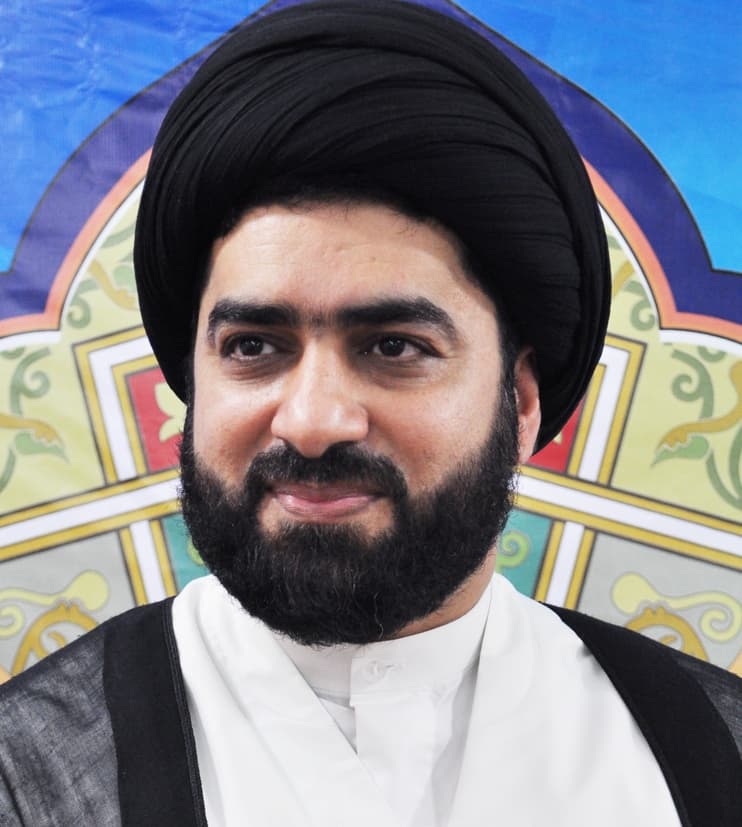
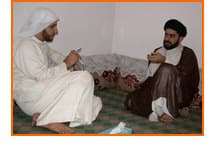
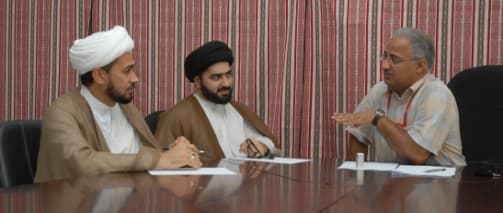
Interviewer: With us in this dialogue is His Eminence Sayed Mahmoud Al-Mosawi, the Islamic researcher. Your Eminence Sayed, to begin with, we welcome you. Peace be upon you, and the mercy of Allah and His blessings.
Sayed Mahmoud Al-Mosawi: And upon you be peace, and the mercy of Allah and His blessings. You are most welcome; may Allah keep you.
Interviewer: Your Eminence Sayed, now, in these atmospheres, the atmospheres of the Hajj season, every year hundreds of thousands of Muslims set out to perform the Hajj to the Sacred House of Allah and to carry out its devotional rites. But this act of worship is not like other acts of worship; it is well known that it is an act of worship that demands strenuous effort from a person. Yet this is not what matters; what matters more is the weighty meanings it carries in many aspects. How can these aspects be recognized and benefited from?
Sayed Mahmoud Al-Mosawi: In the Name of Allah, the All-beneficent, the All-merciful. Regarding the rite of Hajj and the rituals of Hajj, there is no doubt that, as you said, they contain many meanings; that is, these acts and these rituals have conceptual and value-laden content. There are very deep meanings in them, and a person should benefit from these rituals while performing them by learning about the secrets and the wisdom of these rituals. The Ahl al-Bayt (a) have explained to us in their narrations many of these meanings, these ethics and these spiritual proprieties. Acts of worship in Islam are not mere rituals and a formal requirement; rather, they are also an educational factor. That is, if we look at the educational method in Islam, we will place acts of worship as a basic part of the Islamic educational system in general, for these acts of worship contribute to the upbringing of man… to the making of man… to the development of man’s abilities…
Consequently, in order for the pilgrim to know how to benefit from this act of worship in its variety, especially now during Hajj, he must learn about the narrations of the Ahl al-Bayt that speak about these subjects. For example, Imam al-Sadiq (a) speaks of how, when you hasten in the saʿy and in the harwala, a person should think about how to flee from the negative traits he has… from his mistakes… from his sins… as though he were fleeing from them in flight; so he hastens toward acts of obedience and flees from sins and negative traits. Likewise every rite has a meaning; the stoning has a meaning. When the Imam says that when you throw, intend that you are throwing away the negative traits, or throwing away sins or blameworthy acts, as in the Imam’s expression, this means that a person, as it were, throws these acts away, embodying them in reality and throwing them so as to be rid of them. In this way influence can be achieved, that is, by learning about the narrations of the Ahl al-Bayt (a) and becoming acquainted with their educational contents, and not only learning about their jurisprudential rulings. The jurisprudential rulings guarantee you the validity of the act that you perform, but it is the narrations that speak of the meanings, the contents and the spiritual proprieties that have an effect on the educational factor.
Interviewer: Your Eminence Sayed, what is known about Hajj is that it takes place only once each year. A Muslim may be granted the success of performing Hajj once, perhaps many times, and perhaps he may not be granted it. The narrations have mentioned that there is an effect on the pilgrim after he performs this act of worship. The question here is: what makes the Household of Prophethood give Hajj greater attention in their narrations and sayings than other acts of worship? Is this effect that is referred to temporary, or is its effect lasting? And how can we benefit from these effects?
Sayed Mahmoud Al-Mosawi: Well said. Hajj, as we said, is an act of worship for shaping man and man’s personality, but not only on the individual level; rather, on his individual level, on his family level, on his social level and on the level of the Umma—in general, on the civilizational and cultural level of the Umma in its form, or looking at it in general.
First, Hajj is like the other acts of worship, but it differs—where? Its difference is that it has many parts, such that it contains prayer and the effects of prayer, and it even contains charity and the effects of charity too, in these acts which are not found in other places or in other things. There are, for instance, the saʿy and the tawaf… and there is supplication in it—the summit of supplication, as at ʿArafat… there is going out and taking refuge in Allah, Almighty and Majestic, as at al-Mashʿar al-Haram: a person goes out into the open desert in this place, and people gather in this blessed spot in order to call upon Allah, Almighty and Majestic. So there are many things in it that affect the individual as an individual, and there are also contents in it that affect society, given that it is a collective journey and not an individual act of worship; that is, it is not an individual act of worship but a collective act of worship. Therefore, when a person is coming to Hajj, it is better that he perform these rituals within a group, so that he knows how to come together with them, how to exchange views with them, how to convey religion with them, how to keep company, that is, how to practice companionship with them. Consequently, if he applies this soundly, it is reflected afterward on his reality and on his life. We see that the Book of Companionship, which is devoted to the narrations that speak about social relations among people—that is, that friendship is recommended, choosing a friend, cheerfulness, cooperation with the believers, helping and assisting others, covering faults, and the like—all these narrations that came concerning companionship with brethren, which in their reality—if we look at their reality—organize Islamic society, the Islamic reality in its dealings with one another, came at the beginning of the Book of Hajj. The late al-ʿAmili, for example, the author of the book al-Wasaʾil, did not include them in the social books or the like; rather, he included them at the beginning of the Book of Hajj. Why? Because Hajj needs these things fundamentally. It is a collective act of worship too, and it also contributes to shaping the personality of the Umma more generally. How? That is, the pilgrim’s connection with the sacred law; his circumambulation around this House, meaning that he makes Allah, Almighty and Majestic, the axis of his movement and of his life in general; his meeting with the scholars, with the religious authorities. In the past people would perform Hajj with the Hajj of the Imam (a), the Infallible Imam; now, without doubt, the Infallible Imam—the Imam, may our souls be his ransom (aj)—is also present, but here too the deputies, the deputies of Imam al-Hujjah, namely the great marajiʿ of religion, also perform Hajj or come in the form of missions and the like. Scholars of various kinds are also present at Hajj. Consequently, a person should connect with the sources of knowledge, with the deputies of Imam al-Hujjah (aj). Here they take provisions, take knowledge, take this spiritual energy from Hajj and also the scholarly energy from the scholars, so that it is then reflected on their reality in life. Thus the law of Hajj also contributes in this way to building the entity of the Islamic Umma, and not only the individual: the individual, the society and the Umma more generally.

Interviewer: There are many negative views and mistaken ideas that have been directed at us as Muslims, and all of this is due to media influence and immoral cultures of a non-Islamic character, which are called globalization, and which have left negative effects in some Islamic societies, among their young men and young women. So how can one escape from this globalization, its effects and its negative atmospheres, through Hajj?
Sayed Mahmoud Al-Mosawi: Islam has set for us several stations from which we should take provisions: the daily prayers; Hajj as an annual obligation and as annual rituals; fasting as an annual act of worship that comes upon a person every year. These stations are stations of purification, if the expression is correct, not only of building; they build, but they also purify. Perhaps there exists the sincere believing person who practices his worship in the most perfect way and whose dealing with people is in the best way, dealing with them with noble character, good companionship and the like.
But life, as you mentioned, does not leave a person alone. There are plans, global plans; that is, the West works so that any culture different from its own must be confused, must be influenced by its own culture. It propagates its culture and so influences, for example, the youth… their tastes… their cultures… their behavior… Consequently, we in our Islamic countries face strong, fierce and planned attacks for which very huge budgets are allocated. If we take note, most statistics say that the West, and specifically America—the budget earmarked for cultural proselytizing under the heading of cultural goods, meaning the production of films, the production of cultural dolls, posters, CDs and the like, the programs that influence the youth and the behavior of the youth, these things—allocates the greatest share of the money it allocates to these matters, in order to influence Islamic and also non-Islamic societies. But in our conversation we are speaking about the Islamic reality. Yes, we do not see the change—yes, there is change and alteration in the tastes of the youth, in the behavior of the youth—but where do they go? Even the believing person, when he finds these manifestations, when he goes to the market, when he is exposed to a situation here and there and is exposed to challenges even inside his home through satellite channels, the Internet or the like, certainly needs spiritual stations where he can stop and purify this psyche. As in the expression of the narrations, Hajj is an eraser. How an eraser? That is, it erases sins, even the minor ones, which are the “lapses” (lamam) according to the Qurʾanic expression—these small sins that befall a person sometimes even without his will, or which are, as sometimes happens, the temptations of the self or the like. So Hajj is an eraser.
There is a story among the stories: a group of people came to the Messenger (s) and said to him: O Messenger of Allah, when we are with you we are in a spiritual state and close to Allah, Almighty and Majestic, and to religion; but when we go to our spouses and go to our work, carry on with our lives and move away, we forget—that is, we move away from the spiritual state, from Allah, Almighty and Majestic, and are drawn to this world. The Messenger (s) said to them: Then visit frequently. Because they said: when we come to you, O Messenger of Allah, we live this state—then do it frequently, that is, frequently visit the Messenger of Allah, these places that remind you of Allah, Almighty and Majestic, and that give you purifications of the spirit and of the mind too. So if Hajj is practiced—that is, it can stand in the face of the current of globalization and of any other of the plans that befall the Muslims—through persisting in it year after year. It is obligatory once in a lifetime: it is made incumbent on a person to perform Hajj once in his lifetime if he is able; but there are incentives for a person to perform Hajj constantly. Imam al-Sadiq (a): Whoever desires the good of this world and the Hereafter, let him head for this House; or: Keep to the Hajj of this House and be constant in it, for in it is the good of this world and the Hereafter.
There are many narrations that mention the word idman; idman in the sense that one persists in this thing to the point of addiction, that is, you cannot detach yourself or cut yourself off from the Sacred House of Allah. Why? Because of the connection it holds with the source of divine mercy. That is, any person who wants to grow strong must go to the source of strength; if, for example, he wants a weapon, he must go to the source of the weapon, search for where this weapon is made, and take this weapon. Consequently, likewise, if a person wants tranquility, purity of soul and also sound awareness, he must connect with its source, which is Allah, Almighty and Majestic, in His Sacred House, through the Hajj of the Sacred House of Allah.
Interviewer: In one of Your Eminence’s published articles, entitled “Hajj and Self-Development”, you mentioned that the divine legislations in Hajj all flow into developing the self, changing it and raising it to the degrees of perfection. So what are these legislations to which attention must be paid in the few days of Hajj?
Sayed Mahmoud Al-Mosawi: Well said. Indeed, acts of worship in Islam are an educational program; they are an educational method for man if he knows the spiritual proprieties and the contents that he should take into his reckoning and his thinking. Drawing on the narrations of the Ahl al-Bayt (a), we say that Hajj has meanings… every one of the acts of Hajj has a meaning, from its beginning to its end. You asked which acts we can benefit from; we say all the acts. Every act in Hajj has a meaning, from the beginning, when a person enters the miqat: when he takes off his ihram, he must sense and bear in mind and in his thinking that he is taking off the garments of this world. This sewn clothing that he wears habitually in his life, he must take off, and he puts on, as the jurisprudential ruling is, the izar and the miʾzar, which is the unsewn ihram. When he puts on this ihram, he must think that he is putting on the garment of obedience. That is, where is the secret? The secret is that a person must think about the meaning, raise his mind and conceive of these tangible things he has; conceive of them as spiritual things that have spiritual shadows. This sewn clothing—when I think that it is the clothing of this world and take it off, it is as though I have taken off the negatives of this world, the consequences of this world and the desires of this world; and I put on the garment of obedience, the garment of nearness, the garment of commitment and the garment of taking refuge in Allah, Almighty and Majestic. This is the way of thinking so that Hajj becomes a building of the self and a development of the self: every act of the acts of Hajj gives me an additional trait, and also gives me a positive quality, and also rids me of a negative quality. If a person proceeds along this course, conceives of all his acts, and concentrates the conception—concentrates on this conception—then without doubt he will, in the end, obtain the good of Hajj in this world before the Hereafter, because the Ahl al-Bayt (a) always say that in Hajj there is the good of this world and the Hereafter—not only the Hereafter; rather, it also has an effect in this world, and what we have mentioned are among the instances of the worldly effect. Of course there are very many effects, but our subject now is building the self. So among the worldly effects, and which also have no reflection, is building the self through conception and through knowing the contents of these acts of worship and these rituals in general.
Interviewer: We thank you, Your Eminence Sayed, for your time, which you have made fruitful with this information by answering these questions. We ask Allah to accept our Hajj and your Hajj, Allah willing, and to make us return to the Hajj of His Sacred House every year.
Sayed Mahmoud Al-Mosawi: You are most welcome; may Allah reward you with good. I ask Allah for acceptance for us and for you, Allah willing.