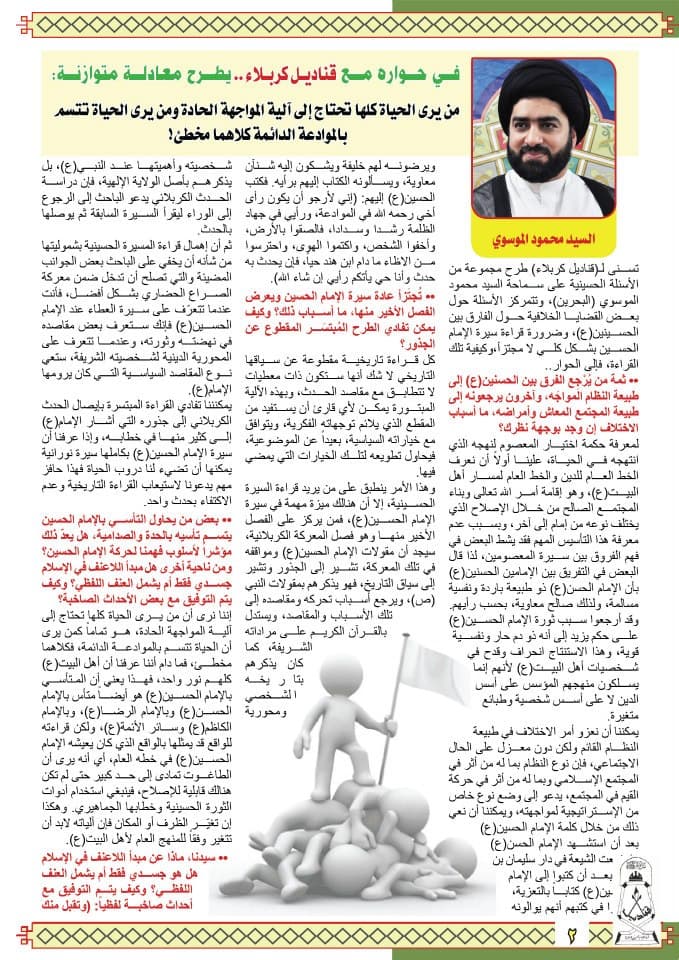
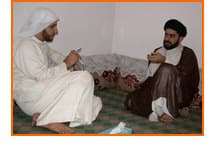
Interview conducted by: Ahlam ʿAbd al-Rahim: Tarout*
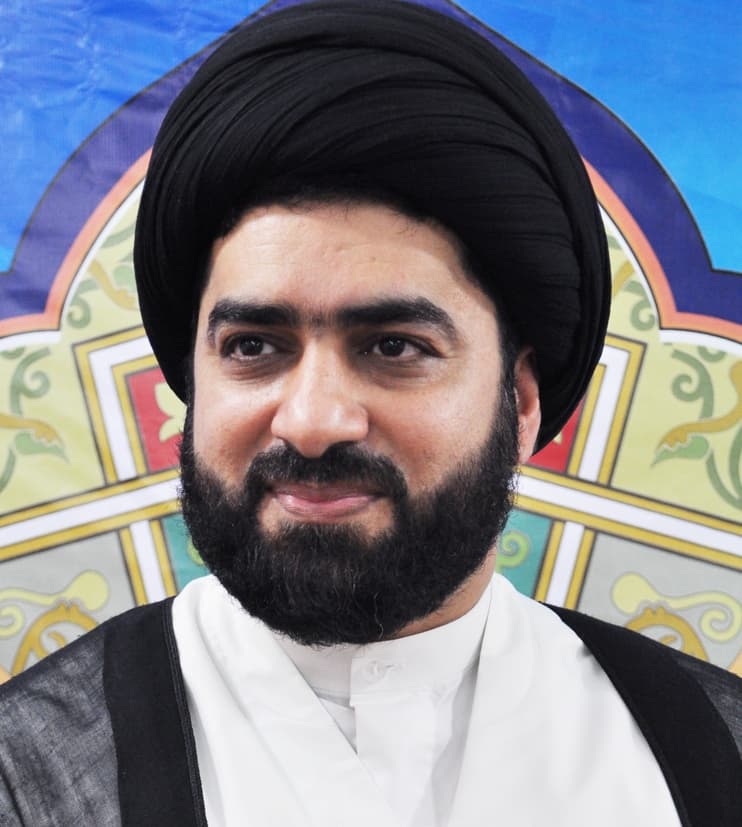
Sayed Mahmoud Al-Mosawi, the Islamic writer and researcher, member of the editorial board of the quarterly journal al-Basaʾir, published by the Hawza of Imam al-Qaʾim (aj) in Damascus, and a dialogue on the method of the thematic exegesis of the Holy Qurʾan
.
in which he addressed its most important topics, its truths and its foundations
Your Eminence Sayed, what is meant by the thematic exegesis of the Holy Qurʾan, and when did it arise as a science? Are there any conditions for someone who wants to probe this method? Or are the general conditions for the exegete sufficient?
In the Name of Allah, the All-beneficent, the All-merciful
And blessings and peace be upon the noblest of Allah’s creation, the Prophet Muhammad, and his good and pure progeny.
At the outset, I thank you for your efforts, and I ask Allah to grant you success and right guidance.
When the expression “the thematic exegesis of the Holy Qurʾan” is used, we stand before two meanings that come close to each other in some features and part ways in others:

The first meaning: it is the exegesis that examines the theme of a complete surah or the theme of a group of consecutive verses, on the basis that the Qurʾanic surahs each have a single thematic unity; even if they branch out in their treatment of various subsidiary topics, in the end they treat a specific theme. Some have called this thematic unity of the surah the (general framework) of the surah, as it is in Tafsir Min Huda al-Qurʾan by Sayed Muhammad Taqi al-Modarresi, and it has also been called (the personality of the surah), as in the exegesis (Nahwa Tafsir Mawduʿi li-Suwar al-Qurʾan) by al-Ghazali.
This meaning of thematic exegesis looks at the theme only as the axis of a single surah or of a group of verses, and it may be called comprehensive exegesis, or explanatory exegesis.
The second meaning: it is the exegesis that searches for a single, specific theme across all the verses of the Holy Qurʾan, and so derives the Qurʾan’s integrated view of that theme from all its aspects. For example, it takes up the theme of (balance) and the Qurʾan’s method in that, and draws on verses such as “and We grew in it every kind of balanced thing” (Qurʾan 15:19) as an indication of the balance in what the earth gives and in the measure of man’s need of it; therefore Allah commands people to “Maintain the weights with justice, and do not shorten the balance!” (Qurʾan 55:9) in their commercial dealings, as an application of balance; and as in the words of the Exalted: “Those who are neither wasteful nor tightfisted when spending, but balanced between these [two extremes]” (Qurʾan 25:67), and similar verses that point to the method of balance and its dimensions in the Holy Qurʾan.
This second meaning is what usually comes to mind when the name “the thematic exegesis of the Holy Qurʾan” is used.
As for the origin of thematic exegesis, it developed in the twentieth century CE, when scholars saw that there was a pressing need for this type of exegesis. However, they do not claim to have invented it on their own; rather, they trace it back to the Ahl al-Bayt (a), by observing how the Ahl al-Bayt (a) used to bring together verses from different surahs on a single theme or on one that complements it. But it developed and became a method. Therefore, the conditions that should be met by the exegete who practices this method are his knowledge of the principles of sound exegesis on the one hand, and his belief in the usefulness of this methodology on the other.
What is the relationship between thematic exegesis and the exegesis of the Qurʾan by the Qurʾan?
We can say that thematic exegesis is not at variance with the exegesis of the Qurʾan by the Qurʾan; rather, the relationship between them can be described as the relationship of the part to the whole. Thematic exegesis needs several tools for understanding the Qurʾanic text, and among these tools is to understand Qurʾanic verses through other Qurʾanic verses; that is, the exegesis of the Qurʾan by the Qurʾan is a mechanism for understanding the Qurʾanic text which lays the foundation for drawing on the verses according to their context or according to their theme, as is the case in thematic exegesis.
For when I gather many verses on a single theme, the exegesis of each of those verses separately should be clear to me; so I need the language and the narrations issued from the Ahl al-Bayt (a), and I need the other verses that clarify the meaning or confirm it, in the expression of the Ahl al-Bayt. From this angle, the exegesis of the Qurʾan by the Qurʾan becomes a part of the method of thematic exegesis.
But if we look at them in terms of purpose, the purpose of the exegesis of the Qurʾan by the Qurʾan will be vertical, that is, it establishes the meaning and brings out its horizon and its depth, whereas the purpose of the thematic method is horizontal, that is, it treats a wide area and looks at the comprehensive, integrative horizon of the theme.
Is the Qurʾan interpreted by the knowledge of the subjects being raised, or are the subjects interpreted by the knowledge of the Qurʾan?
If what is meant by the knowledge of the subjects is those sciences that man has achieved, discovered or crystallized in their modern form, whether concerning nature, other sciences, or the social sciences such as politics, sociology and economics, then here we should stress an important and pivotal truth for understanding the position of the Holy Qurʾan with respect to all of that.
This truth is that the Holy Qurʾan is the balance and the criterion between truth and falsehood, between truthfulness and lying, between reality and illusion, because the Holy Qurʾan is insights and guidance, as the Exalted said: “The month of Ramadan is one in which the Quran was sent down as guidance to mankind, with manifest proofs of guidance and the Criterion” (Qurʾan 2:185). On the basis of this truth, we realize that it is the Qurʾan that acquaints us with the essence of the subjects, by defining their aims, their outcomes and their results.
So we cannot interpret the verses of the Holy Qurʾan through modern discoveries, for example, most of which arise from experimental sciences that may undergo change and alteration after a while. Yes, we may benefit from established cosmic facts or from some modern discoveries in bringing the meaning closer or in understanding a new meaning, without these discoveries being what interprets it; rather, they are what prompts the understanding, through following the sound methods of understanding the Qurʾanic text such that no part of it contradicts another.
It is worth pointing out here that there are referrals by the Holy Qurʾan itself to nature, for example, or to reality, so that we may understand some verses and some of the contents of verses. It refers us to the sun and its motion, the motion of the moon, the mountains, some animals and the cycle of rain, or the commonly known emotional reactions that man is subject to, and the like; all of this so that those established facts give us a clear conception of what the Holy Qurʾan intends, as in the words of the Exalted: “Whomever Allah desires to guide, He opens his breast to Islam, and whomever He desires to lead astray, He makes his breast narrow and straitened as if he were climbing to a height. Thus does Allah lay [spiritual] defilement on those who do not have faith” (Qurʾan 6:125). The reference to ascending in the sky makes us grasp the state of narrowness and straitness that afflicts those who are not guided, for in the sky one does not obtain the ability to breathe and cannot control oneself, unlike the one whose breast is opened to Islam.
These referrals are not a matter of interpreting the Qurʾan by external subjects; rather, they are a matter of bringing the meaning closer, and of making the metaphorical in the Qurʾan definite by means of what is definitive in reality; and the referrals are made only to established reality that is agreed upon among all human beings.
We would like to point out here, regarding the Qurʾan and external subjects in thematic exegesis, that the choice of subject in the thematic methodology may be made by choosing it from within the Qurʾanic text, such as examining the subject of (extravagance), (polytheism) or (pairing), and then bringing in the rest of the verses to form a view on it; and sometimes the subject to be examined is chosen from outside the Qurʾanic text, such as choosing the subject of (family breakdown), (the fall of civilizations) or (managing differences), and then turning to the verses connected to this subject from its various aspects in order to come out with a Qurʾanic view on it.
The method of thematic exegesis is distinguished by the fact that it solves many of the problems of the age; I wish you would mention an example of this for us? And have the other exegeses fallen short in this respect?
Every method has its benefits. Indeed, the basic role of thematic exegesis is to give a comprehensive view of a single subject; it is like forming a theory about something. Because the world today has many ramifications that need treatments in its own language in order to reach the other, and because many of those who want to learn about Islamic thought and the Islamic view of the problems of the Umma today are not connected to the Holy Qurʾan as those who believe in it are connected to it—indeed, as those who are committed to reading it and consulting it constantly are—this is a real benefit that enables the other to learn about the comprehensive view of a given issue.
For example, if we asked how the Holy Qurʾan treats the problem of turmoil and the loss of security, we find that there are numerous verses that speak of security in its different types and its many levels: there is psychological security, social security, political security and economic security, and we find each of those aspects in a verse in a different surah; and then there are some general laws that govern the course of security. Another example of contemporary subjects is the Qurʾan’s view of just rule: the qualities of the just ruler and of just rule can be brought out, and its tools, its fields of application and the like can be made clear.
But at the same time we do not deny the effect of the other exegetical methods in providing solutions to the problems of the age; each plays a role in some way. A person may need to live within the Qurʾanic context in order to sense its contents more, and he may need the narration to reveal to him some doctrinal horizons, or the like. And here I disagree with those who wanted to prove the usefulness of thematic exegesis at the expense of contextual or sequential exegesis, and to impugn the latter’s benefit. The fact remains that the order has its psychological and cognitive effect: the Messenger (s) did not arrange it arbitrarily, nor did he give each surah its personality in vain.
And what is the difference between sequential (atomistic) exegesis and thematic exegesis, Your Eminence Sayed? Is there a degree of difficulty between them, and which of them precedes the other?
Thematic exegesis, as we have mentioned, takes up a single subject by interrogating the sequence of their occurrence in the Holy Qurʾan. all the verses of the Holy Qurʾan connected to that subject; as for sequential or atomistic exegesis, it is the exegesis that interprets the verses according to
There is no doubt that the foundation is for the exegete to obtain the primary meaning that results from the sequential method for the verses, and then to arrange those verses according to the meaning that has emerged for him, in a comprehensive mold whose parts complement one another. That is, when we want to crystallize a comprehensive view of some subject in the Holy Qurʾan, we do not overlook the data of the sequential method, since the verses and their order in the noble Mushaf have their suggestions and their bearing on the meaning.
Therefore this order came about for a wise purpose, for the Greatest Messenger (s) used to instruct the Companions to place the surah that was revealed in a certain position within one of the surahs, until it was completed in this form. We also find that the Qurʾanic surahs have characteristics as single units too: there are short surahs, medium surahs and long surahs, and each surah has its name and its features. So certainly sequential exegesis is indispensable, especially when taking into account the contextual data within which the verses came, whether those data are direct or indirect.
So what comes first is sequential exegesis. As for the difficulties, there is no doubt that every method has its requirements, and since the thematic method is a more advanced stage than the sequential in terms of the benefit drawn, it needs more effort: it needs a process of induction of the verses that speak about the single subject, while taking note of an important matter, namely that the verses and their connection to the subject take two forms:
The first: the direct form, that is, the verses are connected to the subject directly through (the wording) or through (the meaning).
The second: the indirect form, such as the verse being connected to the subject by way of mutual entailment, motives, causes and effects, or otherwise.
Taking this aspect into account, the researcher needs the research mechanisms that enable him to complete his research.
What are the most prominent exegeses that have paid attention to this aspect? Is there a complete exegesis that has adhered to the methodology of thematic exegesis?
Given the nature of thematic exegesis, which examines many subjects across the whole Qurʾan, it is difficult for a comprehensive exegesis of all the Qurʾanic surahs to take shape, since the basis of the methodology is that it is not built on the sequence of the verses as they are in the Holy Qurʾan; rather, its sequence, if it has a sequence, is thematic. Therefore there are many treatises that have adopted the thematic method to give a view on a specific subject, and this is usually published in a book which is usually not called an exegesis, although it bears the characteristics of thematic exegesis, such as finding a book entitled (The Movement of History in the Holy Qurʾan) or (The Law of Pairing in the Holy Qurʾan), or a book examining (The Supplications of the Holy Qurʾan), and similar books.
We also find that some sequential exegeses sometimes resort to pausing at a verse and examining it thematically by bringing in a group of other verses on the same subject, so that the exegete may arrive at the clear meaning; but we find this occurring to varying and small degrees.
The science of thematic exegesis, as “Sayed Al-Mosawi” mentioned, carries out a sequential interrogation of all the verses of the Holy Qurʾan connected to the subjects raised, and gives a comprehensive view for treating the problems of the age; and also, the exegete cannot do without the other dimension in the process of induction, by way of sequential research, and when we want to crystallize a comprehensive view of some subject in the Holy Qurʾan, we do not overlook the data of the sequential method, since the verses and their order in the noble Mushaf have their suggestions and their bearing on the meaning.
——————
* A writer from the Kingdom of Saudi Arabia — Tarout
The interview was published on the al-Tawafuq News Network on the Internet — and in a Qurʾanic bulletin in Saudi Arabia.