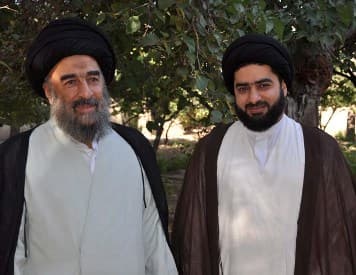
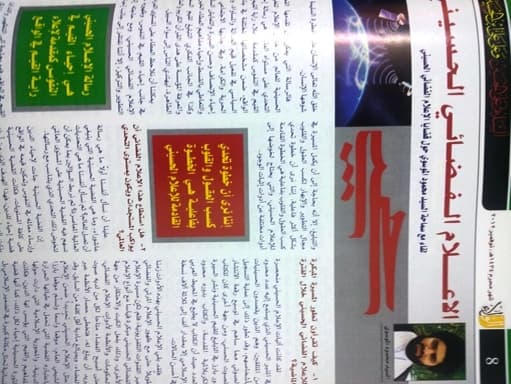
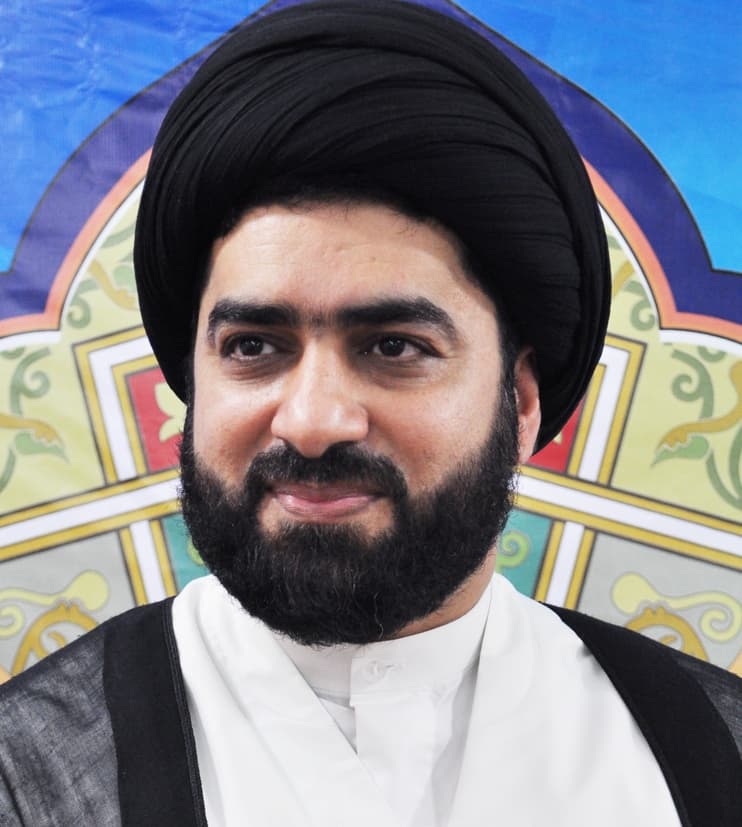
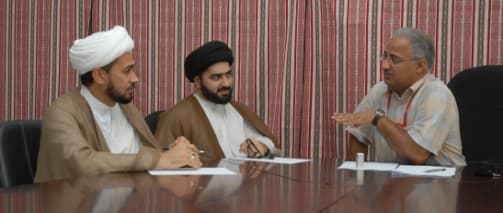
Sayed Mahmoud Al-Mosawi in his dialogue with Qanadil Karbala..
puts forward a balanced equation:
Whoever sees all of life as needing the mechanism of sharp confrontation and whoever sees life as marked by permanent truce are both mistaken:
.
(Qanadil Karbala) 1434 AH had the opportunity to put a set of Husayni questions to His Eminence Sayed Mahmoud Al-Mosawi (Bahrain). The questions center on some contested issues concerning the difference between al-Hasan and al-Husayn (a), the necessity of reading the life of Imam al-Husayn as a whole and not in fragments, and how that reading should be done. Here is the dialogue:
Q/1: There are those who attribute the difference between al-Hasan and al-Husayn (a) to the nature of the regime confronted, and others attribute it to the nature of the society lived in and its ills. What are the reasons for the difference, if there is one, in your view?
To know the wisdom of the Infallible’s choice of the course he adopted in life, we must first know the general line of religion and the general line of the path of the Ahl al-Bayt (a), which is establishing the command of Allah the Exalted and building the righteous society through reform, whose type differs from one Imam to another. Because of not knowing this important foundation, some may go astray in understanding the differences between the lives of the Infallibles. Hence some have said, in distinguishing between the two Imams al-Hasan and al-Husayn (a), that Imam al-Hasan (a) was of a cool nature and a peaceable disposition, and that this is why he made peace with Muʿawiya, according to their view; and they attributed the reason for Imam al-Husayn’s (a) revolution against the rule of Yazid to his being hot-blooded and of a strong disposition. This conclusion is a deviation and a disparagement of the personalities of the Ahl al-Bayt (a), because they follow only their course founded on the foundations of religion, not on personal foundations and changeable temperaments.
We can attribute the matter of the difference to the nature of the existing regime, but not in isolation from the social situation. The type of regime, with the effect it has on Islamic society and the effect it has on the movement of values in society, calls for devising a special type of strategy to confront it. We can grasp this through the words of Imam al-Husayn (a) after Imam al-Hasan (a) was martyred and the Shiʿa gathered in the house of Sulayman ibn Surad, after they had written to Imam al-Husayn (a) a letter of condolence; they mentioned in their letters that they were loyal to him and accepted him as their successor, complained to him of the enmity of Muʿawiya, and asked him to write to them with his opinion. So al-Husayn (a) wrote to them: “I hope that the view of my brother (rh) regarding the truce, and my view regarding jihad against the oppressors, are right guidance and sound judgment. So cleave to the ground, conceal your persons, keep your inclination hidden, and be on your guard against the suspect as long as the son of Hind is alive; and if something befalls him while I am alive, my opinion will come to you, Allah willing.”
Q/2: The life of Imam al-Husayn is usually cut into fragments and its final chapter is presented. What are the reasons for this? And how can the truncated presentation that is cut off from the roots be avoided?
Every historical reading cut off from its historical context will undoubtedly yield data that do not correspond to the purposes of the event. With this truncated mechanism any reader can make use of the segment that suits his intellectual orientations and accords with his political choices, far from objectivity, and so try to bend it to those choices that he is pursuing.
This applies to whoever wants to read the Husayni life. However, there is an important distinguishing feature in the life of Imam al-Husayn (a): whoever focuses on its final chapter, the chapter of the battle of Karbala, will find that Imam al-Husayn’s (a) statements and positions in that battle point to the roots and point to the context of history. He reminds them of the sayings of the Prophet (s), traces the reasons for his movement and his purposes back to those reasons and purposes, and cites the Holy Qurʾan as proof of his noble intentions; he also used to remind them of his personal history, the centrality of his personality and its importance to the Prophet (s); indeed, he reminds them of the very principle of divine wilāyah. So studying the event of Karbala calls the researcher to go back in order to read the earlier life and then connect it to the event.
Moreover, neglecting to read the Husayni path in its comprehensiveness is liable to hide from the researcher some bright aspects that are better suited to enter into the battle of civilizational conflict. When you become acquainted with Imam al-Husayn’s (a) record of giving, you will know some of his purposes in his uprising and his revolution; and when you become acquainted with the religious centrality of his noble personality, you will grasp the kind of political purposes that the Imam (a) was aiming at.
We can avoid the truncated reading by connecting the event of Karbala to its roots, many of which the Imam (a) pointed to in his discourse. If we know that the life of Imam al-Husayn (a) in its entirety is a luminous life that can light up the paths of life for us, then this is an important incentive that calls us to a comprehensive historical reading and not to be content with a single event.
Q/3: Some of those who try to emulate Imam al-Husayn are marked in their emulation by sharpness and confrontationalism. Is this considered an indicator of the way we understand the movement of Imam al-Husayn? On the other hand, is the principle of non-violence in Islam physical only, or does it include verbal violence? And how is it reconciled with some tumultuous events?
We hold that whoever sees all of life as needing the mechanism of sharp confrontation is exactly like whoever sees life as marked by permanent truce: both are mistaken. As long as we know that the Ahl al-Bayt (a) are all one light, this means that the one who emulates Imam al-Husayn (a) is also emulating Imam al-Hasan (a), Imam al-Rida (a), Imam al-Kazim (a) and the rest of the Imams (a). But his reading of reality may liken it to the reality that Imam al-Husayn (a) was living in his general line; that is, he sees that the tyrant has gone so far that there was no longer any capacity for reform, and so the tools of the Husayni revolution and its mass discourse should be used. Likewise, if the circumstance or the place changes, his mechanisms must change in accordance with the general method of the Ahl al-Bayt (a).
Follow-up
“Our master, what about the principle of non-violence in Islam: is it physical only, or does it include verbal violence? And how is it reconciled with verbally tumultuous events: (And accepted from you, O donkey; O son of the goat-herdess, ..)?”
The principle of non-violence is fundamental in dealing with the other, because Islam calls for dialogue in the best manner, as in the words of Allah the Exalted: “Invite to the way of your Lord with wisdom and good advice and dispute with them in a manner that is best. Indeed your Lord knows best those who stray from His way, and He knows best those who are guided.” (Qurʾan 16:125). However, when the conflict with the oppressors and aggressors intensifies, that reality must be dealt with by its own particular and lawful tools. Discussion of the duality of violence and non-violence in Islam needs treatment from many angles, so that one is not content with the bare statement, because every occurrence has its own discourse and every reality its own position. But if we want to speak of the violence rejected by religion, it is everything that realizes the notion of compulsion, for the Holy Qurʾan established the rule “There is no compulsion in religion” (Qurʾan 2:256), whether what leads to compulsion is the act of physically forcing someone to do something, or that in which a person is forced because of the atmosphere in which he has been placed, which is called atmospheric compulsion. This type of violence, if it leads to forcing a person into a position or an act without any choice on his part, falls within rejected violence.
However, the statements mentioned, such as (O son of the goat-herdess) and others, are not discussed within the context of violence or its absence; rather, they are discussed within the descriptions that the other party deserves or does not deserve, because their aim and purpose is not to force anyone into anything; rather, they are a description intended either as a general identification, or as an identification for the sake of reminding the other party of himself, or as an identification that diminishes the other’s standing, or one that raises his standing, or otherwise. To know whether these descriptions are deserved, their objective circumstance must be studied in order to know their purpose.
If we examine closely Imam al-Husayn’s (a) statement about Shimr ibn Dhi al-Jawshan, (It is as if I see the son of the goat-herdess), he is reminding of his foul origin, in fulfillment of the saying of the Greatest Messenger (s): None hates you, O ʿAli, except one whose origin is foul. Whoever would venture upon a deed like the deed of Shimr, may Allah curse him, who cut off the head of the Imam (a), is undoubtedly not a normal human being. The Imam reminds of this fact by alluding to the incident that befell his mother with the goatherd. This is not a reproach for an occupation, as some may understand it; rather, it is a reminder of that incident in order to establish an important fact, namely the foulness of origin. The author of Mustadrak al-Wasaʾil has related the incident, saying: (The wife of al-Jawshan went out from Jabbanat al-Sabiʿ to Jabbanat Kinda; she became thirsty on the way and met a shepherd tending sheep. She asked him for water, but he refused to give it to her except by lying with her; so she gave herself to him, the shepherd had intercourse with her, and she conceived Shimr (may Allah curse him).
Q/4: Does Karbala today need to be read anew? Why? And how?.
We can say that Karbala needs an objective reading, free from the dictates of reality and away from the captivity of the surrounding psychological atmospheres. The problem into which the researcher falls in his reading of the event of Karbala is the surrounding atmospheric influences, which represent the state of deviance that influences the researcher. The deviance and deviation may stem from himself, like one who seeks favor with a ruler, or wants to distance himself from responsibility, or wants to reinforce the position he has chosen for material motives; and the deviance and deviation may stem from the surrounding atmospheres, so that the researcher is influenced by the negative environment, like one who feels defeatism or feels weakness, or one who had been bearing certain responsibilities and then was overcome by fatigue, so that frustrating psychological atmospheres formed within him. Through this we see selectivity on his part in reading the event of Karbala, or he pursues what is metaphorical, as Allah the Exalted said about the verses of the Holy Qurʾan: “It is He who has sent down to you the Book. Parts of it are definitive verses, which are the mother of the Book, while others are metaphorical. As for those in whose hearts is deviance, they pursue what is metaphorical in it, courting temptation, and seeking its interpretation. But no one knows its interpretation except Allah and those firmly grounded in knowledge; they say, ‘We believe in it; all of it is from our Lord.’ And none takes admonition except those who possess intellect.” (Qurʾan 3:7)
We need an objective reading of the event of Karbala even if the researcher comes out with results different from the state he is in, or results that are beyond his capacity, or results that are not an option for his objective circumstances but may be suited to circumstances in another place or time. For the great problem is that the researcher carries out a reading influenced by atmospheres and so diverts history from its course.