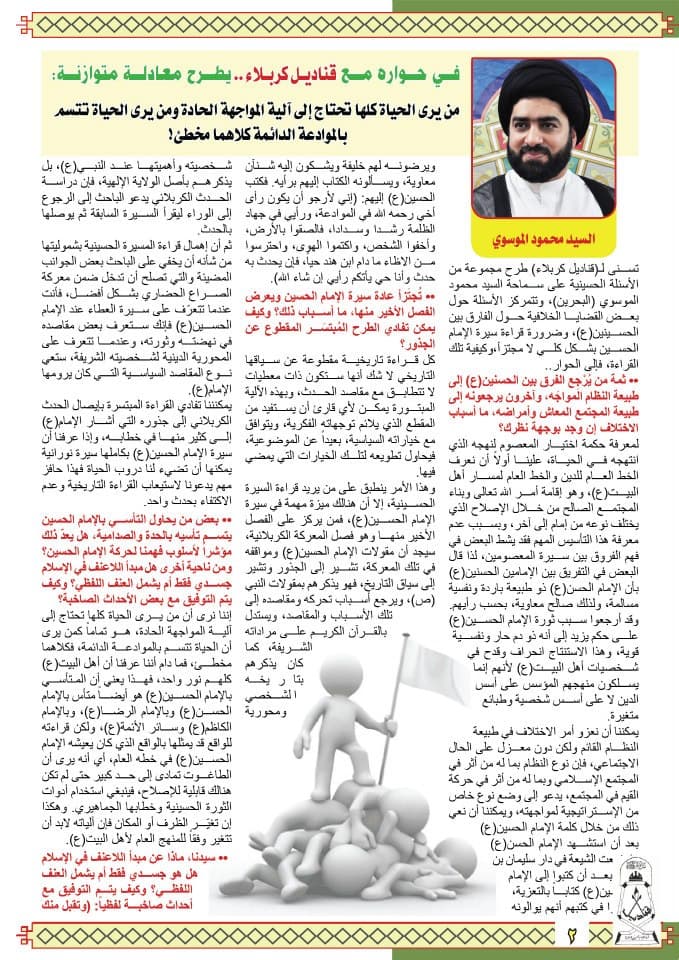
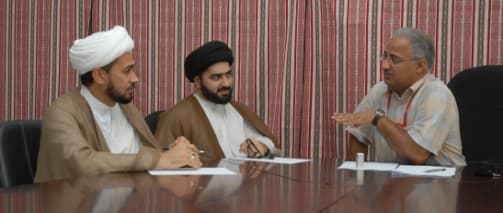
Al-Basaʾir Studies Journal conducted a dialogue with Sayed Mahmoud Al-Mosawi, together with a group of scholars and researchers, under the title (The Mass Movement: A Reading of the Future of Reform and Change in the Umma).
.
The Mass Movement
A Reading of the Future of Reform and Change in the Umma
Al-Basaʾir Studies Journal
Issue 49
The Forum’s Statement
The Islamic Umma today is witnessing the blowing of the winds of political and social change and reform, winds whose whirlwind began in (Sidi Bou ʿAziz) in Tunisia, and before long swept through Egypt and reached Libya, Bahrain, Yemen and Jordan. They have borne some of their fruits in places such as Tunisia and Egypt, and are still struggling for success in other places.
The intellectual—religious and non-religious—sees himself, in the face of these changes, before a great responsibility that demands of him speaking out, not silence; action, not stillness; taking a stand, not spectating; and that he enrich this march with his thought: through reading, drawing inspiration, guidance and active, dynamic participation. He sees himself before an important historical moment and a pioneering, fateful event, which the Umma has perhaps not witnessed for centuries in its political and social life or in its political community. He is witnessing the rise of a popular movement for change that has awakened to topple many of the thrones that were described as (firmly rooted) and (stable), and that seeks to draw a new map in values, thought and action together, and to contribute to the process of theorizing and application alike, in a scene that tells of its weariness of those cold constitutions that condemned the Umma to stillness, numbness and backwardness, and tells of its weariness of those dictatorial practices that muzzled freedom of thought, freedom of expression and freedom of action.
Thus there awoke in the Umma a movement of reform and change which analysts unanimously agree was distinguished by features, among them:
- Popular mass mobilization instead of elitist and factional mobilization.
- The predominance of a youthful character, and the possession of the qualities of successful change: beginning with insistence on reaching the goal, passing through having vision, wisdom, courage and peacefulness, and ending with participation in forming the value and knowledge system of the new constitution, and actual contribution to steering the helm of politics and government.
Hence we at al-Basaʾir journal, as we live through these great, pivotal events that the Umma is passing through, have chosen not to let these events pass without undertaking a conscious, focused reading of them, one that seeks to discern the sources of strength and to know the areas of weakness, in order to entrench the former in the body of the Umma and to remedy the latter.
In order to arrive at this in-depth reading of reality and to look ahead to the future, we sought to put a set of questions to a select group of eminent and well-informed figures, so that they might contribute to the process of intellectual giving and practical guidance for this unique and promising awakening; perhaps Allah will delight the eye of our Umma with the sight of its ripe fruits.
Participants:
His Eminence Shaykh Ibrahim al-Milad:
A religious scholar, a researcher in Islamic affairs, a teacher of advanced studies at the Hawza, from eastern Saudi Arabia. He has published many intellectual research papers and studies in the two journals al-Basaʾir and al-Qurʾan Nur. Among his works in manuscript: Nahnu wa-l-Gharb: Ruʾa wa-Mawaqif.
- His Eminence Sayed Hasan al-Nimr:
A religious scholar, a researcher in Islamic affairs, active at the cultural and social level in eastern Saudi Arabia. Many research papers and studies of his have been published in several local and foreign journals. Among his published works: an Arabic translation from Persian of the book al-Taʿlim wa-l-Tarbiya fi Nahj al-Balagha.
- His Eminence Shaykh Husayn al-Mustafa:
A religious scholar, a researcher in Islamic affairs, a teacher of advanced studies at the Hawza. He contributed to founding a number of social and cultural activities in eastern Saudi Arabia, and also took part in founding the Computerized Islamic Encyclopedia in the holy city of Qom. Among his published works: Adabiyyat al-Taʿayush bayna al-Madhahib.
- Dr. Khadija al-Mahmid:
A researcher in Islamic thought and a political activist for family and women’s rights, head of the Committee for Equity for the Kuwaiti Woman Citizen, and writer of a weekly article in the Kuwaiti newspaper al-Anbaʾ. Among her published works: Mawqiʿ al-Marʾa fi al-Nizam al-Siyasi al-Islami (a doctoral dissertation).
- His Eminence Shaykh Zakariyya Dawud:
A religious scholar, a researcher in Islamic affairs, a member of the advisory board of al-Basaʾir journal and a former editor-in-chief. Many intellectual research papers and studies of his have been published in several journals and newspapers
The questions put to His Eminence Sayed Mahmoud Al-Mosawi (Bahrain).
-His Eminence Sayed Mahmoud Al-Mosawi:
A religious scholar, a researcher in Islamic affairs, director of the representative office of the Marjaʿ al-Modarresi in Bahrain. A member of the editorial board of al-Basaʾir journal; many intellectual research papers and studies of his have been published. Among his published works: Globalization and Society.. New Challenges and the Program of Tasks.
Themes:
A Reading of the Reality of the Umma
Al-Basaʾir Forum: To begin with.. the Arab and Islamic arena is witnessing a mass movement demanding change at the political level, and this movement may perhaps be expressed as internal pent-up tension. The results this movement has achieved are the toppling of the two regimes—of Tunisia and Egypt—which weighed upon the chest of the Umma for decades, during which the Arab and Islamic arena witnessed nothing but oppression, despotism and regression. The question is: how do you read this movement demanding change in terms of the significance of its spreading across the Arab and Islamic world, and in terms of the influence of the international factor, and what are its future results?
Sayed Al-Mosawi:
After the Arab world passed through an era of deep slumber in which the genuine political movement leading to change and development in regimes, faces and policies was paralyzed, it awoke to a radiant morning that kindled in it a new spirit, which has driven the creation of a new awareness that establishes a reality superior to the reality of slumber, retreat and regression. In this important historical moment, Arab societies discovered that within them is enfolded the greater world, capable of bringing about a qualitative change in its life, its concerns and its political reality.
Just as experiences of failure and defeat affect peoples negatively, the effect of successes and victories will generate a positive feeling that inspires hope. That positive leap which has occurred cannot be attributed to the other, represented by the West, for this would be to undervalue the abilities of man inasmuch as he is a human being whom Allah the Exalted created with equal abilities. Among the most important indications that this leap is to a large extent an internal leap is that the revolutions, movements and demands passed from one country to another with a speed such that the West could not manage them all at once; indeed, we find that the movements have spread to regions where the West does not wish a radical change to occur, which causes its weakness in those allied regions, whether it is the very principle of change that is not in its interest, or the breadth of the change, its kind and its range.
But we cannot ignore the benefit drawn from the international situation in encouraging progress and achieving gains in the interest of peoples, given that Western experiences are considerably and noticeably more advanced than the authoritarian Arab experiences; and likewise the benefit drawn from laws and human rights organizations to exert pressure on the dictatorships that try to hide their crimes from the international community.
Without the slightest doubt, the Western powers try to interfere in Arab affairs in times of ease, and in times of hardship and at moments of possible transformation they are more concerned to influence the courses of efforts so that they are in their interest. But not everything the West wishes for does it attain; hence we find confusion in positions, and how the peoples forced the international powers to go along with the will of the Umma in its demands when the Umma is strong and clearly steadfast in its demands.
As for the future impact and the results that Arab society may obtain because of these revolutions, without the slightest doubt they will contribute to the maturing of the experience of governance, so that it develops into an experience in the interest of man and in support of genuine development that is outside the circle of dependency and reliance on the other. Then we can rejoice at the prospect of a future in which the sons of the homeland contribute to building their identity and their independence, which qualify them to enter the arena of the mutual attraction, competition and complementarity of civilizations.
On the other hand, the present, which expresses the spirit of dignity and defiance and the challenging of the policies of oppression and tyranny, will be the history from which man draws resolve in the future, as a positive experience even if not all its ambitions and hopes are realized.
From the Atmosphere of the Movement
Al-Basaʾir Forum: Reaching the goal is not achieved without means that lead to it, and a heated debate is currently under way about the methods of action for change in the Islamic arena. There are those who put forward the confrontational method (the Libyan model), and there are those who adopt peaceful methods founded on demonstrations, which may rise to civil disobedience (the Tunisian and Egyptian model). On the other hand, we find that the political scene reveals the presence of the international factor in the movement of societies. So what are the appropriate means for reform in the Umma?
Sayed Al-Mosawi:
The discussion of the instrumental options in political action can be viewed from two angles:
The first angle: legitimacy. This angle will give precedence to peaceful and civil action over military and confrontational action, because military action has its additional conditions and its various hazards, whereas the scope of the permissibility and preferability of peaceful action is wider. It is not our concern to enter into the jurisprudential and legal debate, because it will be tied to objective circumstances that change from one place to another.
The second angle—and it is the angle on which light should be shed—is the angle of impact, its breadth and its comprehensiveness. From this angle we see that the option of confrontation and militarization will not be open to everyone to participate in the process of change; rather, it is confined to a particular group, the one that possesses the capabilities. On the other hand, the military option cannot continue unless it has a party that supplies it with equipment, or unless it itself possesses enormous resources, and this is what Arab societies lack, because the crisis-ridden political situation has produced the problem of poverty and low living standards in those societies in general.
As for peaceful action with its various tools, among them civil disobedience, strikes, protest marches and long-term sit-ins, all members of the people, of all age groups, can contribute to it and make an effort in it. However, the peaceful method of reform and change needs an important factor that accompanies it, namely the media factor, for the media machine is the real and important nourisher of peaceful action, and without it no serious benefit can be hoped for. We have witnessed the use of targeted media that reach the relevant parties, so that those parties become a factor of pressure and an influential factor in the process of change. From here the vision becomes clear regarding the international factor that has a positive influence on the political movement: as long as the movement is peaceful, it can express whatever it wishes and make any demand, and at the same time it will obtain a wide measure of sympathy and support from international organizations for the preservation of its internationally recognized rights, which are flagrantly violated in the Arab milieu.
Al-Basaʾir Forum:
Among the things that obstruct reform and entrench the slumber of the Umma is the issue of obedience to the ruler. Apparently it is founded on the verse “O you who have faith! Obey Allah and obey the Apostle and those vested with authority among you” (Qurʾan 4:59). When we take note that religion is founded on the philosophy of truth and on the duality of belief in the truth and disbelief in falsehood.. a number of questions arise: Who is the one vested with authority (wali al-amr)? From where does the basis of the right of obedience to the one vested with authority spring? Where does the rite of enjoining what is right and forbidding what is wrong stand? And is the ruler considered the symbol of the state and the Umma, so that rising against him is rising against the Umma and the homeland?
Sayed Al-Mosawi:
The despotic Arab regimes nourish the state of intellectual distortion that is in their interest. From the reality of the Umma today we can understand how the historical process of distortion took place in earlier ages, such as the age of the Umayyads and the ʿAbbasids. The idea of obedience to the ruler goes back fundamentally to an intellectual deviation, through the processes of distortion to which the Umma was subjected in how it reads its texts and its constitutions.
The partial and truncated understanding of the texts of the Holy Qurʾan, and the distancing from the method of the Ahl al-Bayt (a) in understanding religion and in understanding the Book of Allah the Exalted, resulted in the distortion of the term “those vested with authority” (uli al-amr): from the wali who derives his legitimacy from Allah the Exalted and from the Messenger (s), and who represents a genuine extension of the Message, one that conforms to it, it is distorted into the meaning of the ruler sitting on the throne, wherever he may be and whoever he may be.
This distortion is intended to keep the rule of the unjust and despotic ruler on his throne without his being exposed to accountability from anyone, and without anyone having the right to demand his replacement, or to demand something better.
We find that the verse that treats this problem and removes the confusion, if there is any confusion, is verse number 44 of Surat al-Maʾida, in which Allah the Exalted says: “We sent down the Torah containing guidance and light. The prophets, who had submitted, judged by it for the Jews, and so did the rabbis and the scribes, as they were charged to preserve the Book of Allah and were witnesses to it. So do not fear the people, but fear Me, and do not sell My signs for a paltry gain. Those who do not judge by what Allah has sent down—it is they who are the faithless.” (Qurʾan 5:44).
The phrase “as they were charged to preserve the Book of Allah and were witnesses to it” (Qurʾan 5:44) is the basic reference in knowing the wali and in vouching for him. The ruler must be aware and knowledgeable of the contents of the Book and of the values that the Book of Allah brought: adherence to the truth, the realization of justice and equality, upholding equity, spreading security and peace, and other values of governance. The second quality is that he practices and applies those values on the ground; otherwise he is outside the circle of the just ruler, and consequently the discussion must be about the necessity of changing him, not about whether rising against him is permissible or not permissible.
When distortion reaches this extent, everything is summed up in the ruler: love of the homeland and love of the citizen all come down to the degree of submission to this ruler. But when the mind is freed and adheres to the comprehensive and all-encompassing reading of the Mighty Book of Allah, concepts become sound in it, and it is freed from servitude to the ruler to servitude to Allah the Exalted. For this reason Imam al-Husayn (a) called out to the people in Karbala with the call of liberation from servitude to man, when he said to them: “Woe to you, O partisans of the family of Abu Sufyan! If you have no religion and do not fear the Return, then be free men in your worldly life..”
Al-Basaʾir Forum:
The success of the model of political reform in one country.. encourages its repetition in another country; this is what we witnessed in the spread of the reform movement from Tunisia to Egypt, and from them to Bahrain, Yemen and Libya. So what encourages the spread? What are the factors of its success? And does the traditional pretext—the existence of social (particularities) that distinguish one society from another—constitute actual barriers?
Sayed Al-Mosawi:
The model has a great role in man’s movement and effectiveness. For this reason we find that the Holy Qurʾan presents us with historical models in the form of experiences that clarify for us man’s potentials, his abilities and his latent energies that are capable of change and of achieving actual successes, as has come in the Holy Qurʾan: “There is certainly a good exemplar for you in Abraham and those who were with him, when they said to their own people, ‘Indeed we repudiate you and whatever you worship besides Allah. We disown you, and enmity and hate have appeared between you and us for ever, unless you come to have faith in Allah alone,’ apart from Abraham’s saying to his father, ‘I will surely plead forgiveness for you, though I cannot avail you anything against Allah.’ ‘Our Lord! In You do we put our trust, and to You do we turn penitently, and toward You is the destination.” (Qurʾan 60:4).
The Qurʾanic model is not limited to the movement of the prophets only; rather, it includes those who followed the prophets from among those who are not infallible, so that man may find that he is qualified to play a pioneering and great role in his life, and that he is capable of change if he follows the conditions and knows the extent of his energies.
Experiences are influential in several respects, all of which the Holy Qurʾan has mentioned and drawn attention to, among them:
1- The experiences of the prophets and messengers, through following their example, emulating them and trying to draw near to the sacred ideal, along the lines of: “And you are not able to do that, but help me with piety, striving, chastity and right conduct,” as Imam ʿAli (a) said.
2- The experiences of the sincere followers; here the example is closer, as it shows the possibility of change on the part of one who is not infallible.
3- Historical and contemporary experiences, through observing them and benefiting from them, as the Holy Qurʾan referred to the war of the Romans and the Persians in Surat al-Rum, and as reference was made to the defeat of the army of Abraha the Abyssinian in Surat al-Fil, and other such things that bring man closer to the near experience, to reading it and to benefiting positively from it.
Human experiences do not stop, for the Lord of mankind rotates the days among mankind; and whenever man reads an experience with the reading of one who takes heed, he discovers in it that spirit which nourishes him and motivates him to emulate.
What has been said—that Arab experiences cannot be repeated, or that they are not fit to be repeated in another country, on the pretext of the particularity of each Arab country as distinct from the other—is a superficial statement that looks at the varied customs of peoples as though they were deep-rooted culture. While affirming that diversity among peoples in behaviors and customs is a reality, it is not an obstacle to benefiting and to the transfer of experience from one Arab country to another, because what is transferred is the spirit of values—the values of change and the values of capability—those values that reshape concepts anew so that they are translated into behavior and practical reality. Whoever is aware of the values and shapes his concepts on their basis is the wise one who applies his concepts in a way that suits his reality, and so does not copy the experience in every detail. For this reason it has come in the narrations from the Ahl al-Bayt (a) that wisdom is to put a thing in its proper place; and therefore the counsels came from them (a): Take wisdom even from the mouth of an unbeliever, and take wisdom even from the mouth of a hypocrite. So, away from superficial particularities, whoever finds wisdom can draw inspiration from it to benefit from it in his reality. The Exalted has said: “He grants wisdom to whomever He wishes, and he, who is given wisdom, is certainly given an abundant good, and none takes admonition except those who possess intellect.” (Qurʾan 2:269)
The epistemological problem into which Arab intellectuals fell is that they were steered toward mistaken concepts, among them: that (culture) is those customs and behaviors to which society adheres, among which are those superficial particularities that mirror the existing reality, with which peoples have become imbued and on which they have grown up, and among which is the manner of dealing with and viewing the ruler as though he were a lord to be worshipped. For this reason we find some of those affiliated with thought, who claim enlightenment and liberation, bowing their heads and hymning the praises of the tyrants, contradicting all the values they call for—all of this in the name of culture. This distortion can lead to the claim: the particularities of societies prevent the transfer of reform experiences.
The Media, the New Power
Al-Basaʾir Forum:
Means of communication (such as the Internet and social networking sites) are among the most prominent effects of globalization, and they had a great role in the revolution of Egypt, to the extent that this led some to call the revolution (the electronic revolution) and to call its youth (the generation of electronic warfare), as opposed to an old generation with no experience of means of communication, which practiced (traditional warfare) and came to be termed (the generation of traditional warfare). On the other hand, satellite channels had a basic role in creating external sympathy and support and in preventing governments from having a free hand with their peoples and suppressing them. The question is: how do you read the role of communication networks and the media in what the Arab and Islamic world has witnessed and is witnessing?
Sayed Al-Mosawi:
Among the greatest challenges facing movements of reform and change is their ability to convey their voice to the largest possible segment. Therefore we find that the speed of influence on the recipient, in addition to the strength of the idea, lies in its mass presence and the manner of its presence. Development in conveying the idea, and its speed, has had a prominent role in influence, starting from transmitting the idea through loudspeakers, radio and cassettes, to the appearance of television and then the computer, up to the Internet networks, which brought about a broad qualitative leap. What has added to the speed of influence on the Internet networks is the social networking sites, which have added an important dimension to the means of influence, namely the interactive dimension, in which a person can interact with the idea and mobilize for it by the simplest methods and without the need for meeting halls.
We find that some thinkers have played down the importance of communication networks and social networking sites in the Arab revolutions, as against those who went to excess in giving them the first and sole role. However, we find that their great role cannot be overlooked, as they were one of the most prominent factors in the success of the mobilization, because they added important factors to making the movement for change succeed, among them (speed) of influence and of conveying the idea and the information, (breadth of influence) on different and distant segments, (motivation), and (credibility) through conveying events as they really are. All those factors are among the most important things that the movement for change needs in order to achieve its aims. However, without doubt they will be of no benefit unless that is connected to a real and genuine movement on the ground.
To read the dialogue in al-Basaʾir Forum with all the participants in the dialogue