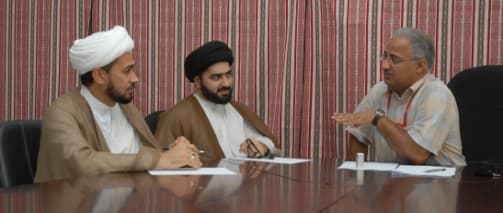
Interview conducted by: His Eminence Shaykh Hasan al-Balushi

Today the world asks—after the peoples, joining hands, have achieved unparalleled efforts in communicating among themselves, until they have come to share concerns and destiny—it asks about the possibility, and indeed the validity, of one culture dominating its sister, or one civilization dominating its peers, under any justification and on the basis of any argument, denouncing all acts of merging that dissolve the personality and assimilate the civilizational identity. This, at a time when all the peoples who take pride in having a history and a civilization strive to resist this behavior, challenging all kinds of standardization, while they range between the capable and the incapable. .
This question still occurs to Muslims too, between a majority approaching consensus on the necessity of the challenge, and a minority that sees no way to revival except in assimilating into the other. The first group wagers on the capacity of the divine tools that Allah—Glorified is He—has stored up for His religion so that it may transcend time and place and rise above everything changing and shifting, among which are the rites of Allah—Glorified is He—which shape the believers with a divine coloring, the best of colorings, in harmony with His precedents, which admit no change and no revision.
As for the second group, it is circling in a whirlpool of doubt.
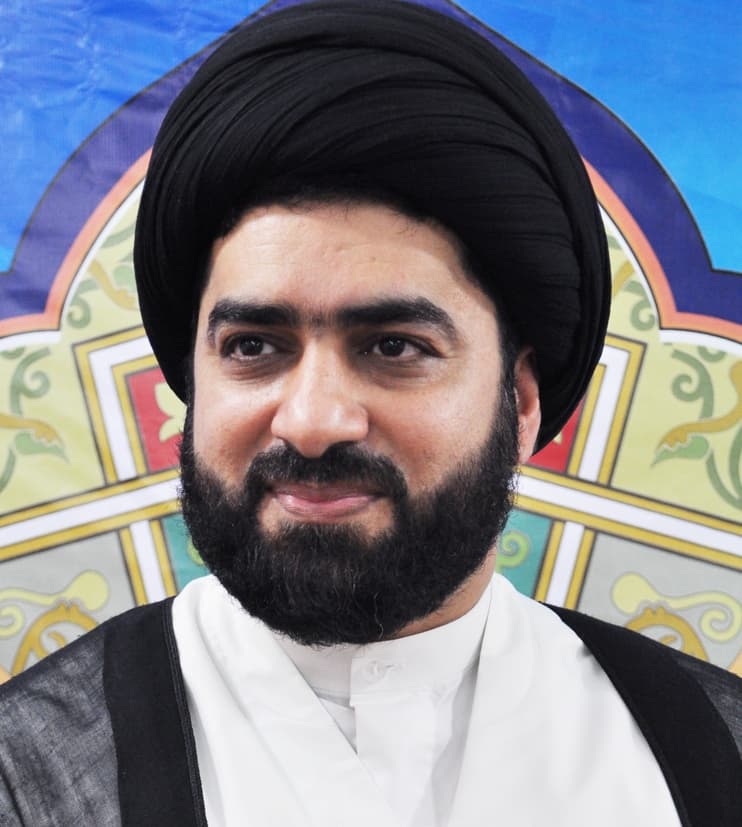
These concerns together are what we try to raise and discuss with His Eminence Sayed Mahmoud Al-Mosawi al-Bahrani, the Islamic writer and researcher and member of the editorial board of the quarterly al-Basaʾir magazine, issued by the Imam al-Qaʾim (aj) Hawza in Damascus, while we are guests of the Master of all creation, the Messenger of Allah, and here before you is the interview..
Al-Marjaʿ wa al-Umma (The Marjaʿ and the Umma): Your Eminence, the contemporary Muslim is pulled in different directions by many cultural and intellectual options and theses, diverse in their schools and in their intellectual, philosophical and doctrinal views. This, at a time when contemporary civilization has managed to strip contemporary man—including the Muslim—of his social and family frameworks, which represent the front lines in facing the challenges of life, which has placed him in the front line facing oceans of cultural waves, which he deals with, dialogues with and wrestles with, on his own. Can Hajj, as a fundamental rite of religion, be a real help to him in this confrontation? And how so?
Sayed Al-Mosawi: Proceeding from the fact that Hajj is one of the greatest of the obligatory duties, if not the greatest of them, and that it includes “benefits” for people in general, without restriction, in all fields of life—proceeding from this fact, there are two aspects here:
The first: the obligatory duty of Hajj is a journey of faith whose field of influence is the spirit; it helps the Muslim face the negatives of society and its impurities. Therefore it is necessary—for the Muslim—to keep coming and going to the Hajj continually, and this is what many texts from the Ahl al-Bayt called for, naming it “constant persistence in Hajj”.
The second: Hajj is a social state of communication, coming from distant places, and it can be used to create a diverse intellectual and cultural exchange on the issues that are matters of contemporary trial for the Islamic Umma, and the field of influence of this state will be: the intellect.
Al-Marjaʿ wa al-Umma: Your Eminence, the calls of al-Khalil more than 4000 years ago from today, when he raised the foundations of the House, were pure monotheism, “Hanifiyya”, in contrast to the other polytheistic cultures that differ from the concept of “Hanifiyya”. What are the horizons of monotheism in the intellectual field, especially when observing the contemporary currents of today?
Sayed Al-Mosawi: There is no doubt that monotheism is the axis of commitment to the rituals, and we cannot separate the devotional, monotheistic state from the other aspects of life, including the intellectual field; indeed it is among the most critical fields, because it lays the foundations of convictions and of methods in whose footsteps people walk.
Monotheism manifests itself in the intellectual aspect in the methodological foundations on which the thinker relies in formulating his visions, so that he is in the line of the Qurʾan and the Ahl al-Bayt, or at the very least does not clash with their contents in the event of the intellect falling short of discovering what is intended in those sources.
Al-Marjaʿ wa al-Umma: Your Eminence, a longing for authenticity and heritage wells up in the visitor of the holy places, and particularly at the city of the Greatest Prophet, especially when he sees the house of the Prophet and his mosque, and the graves of al-Baqiʿ .. and others. At the same time he sees himself living in the age of the information and communications revolution .. and all the embodiments of globalization. How can he reconcile and harmonize the authenticity of the past with the contemporaneity of the present, while preserving his Islamic coloring and his civilizational identity?
Sayed Al-Mosawi: The authenticity of the past is the source of the values that lay the foundation for all civilizational visions in every age, and those visions direct all the productions of the age and regulate their course through the communications and media revolution; and all the more has the responsibility upon the Muslim increased to convey the voice of authenticity to all people in civilized ways, so that people may discover the light of guidance.
_________________
The interview was conducted in Medina al-Munawwara, Hajj 1426 AH, as part of the activities of the mission of the religious marjaʿ, Grand Ayatollah Sayed Muhammad Taqi al-Modarresi.