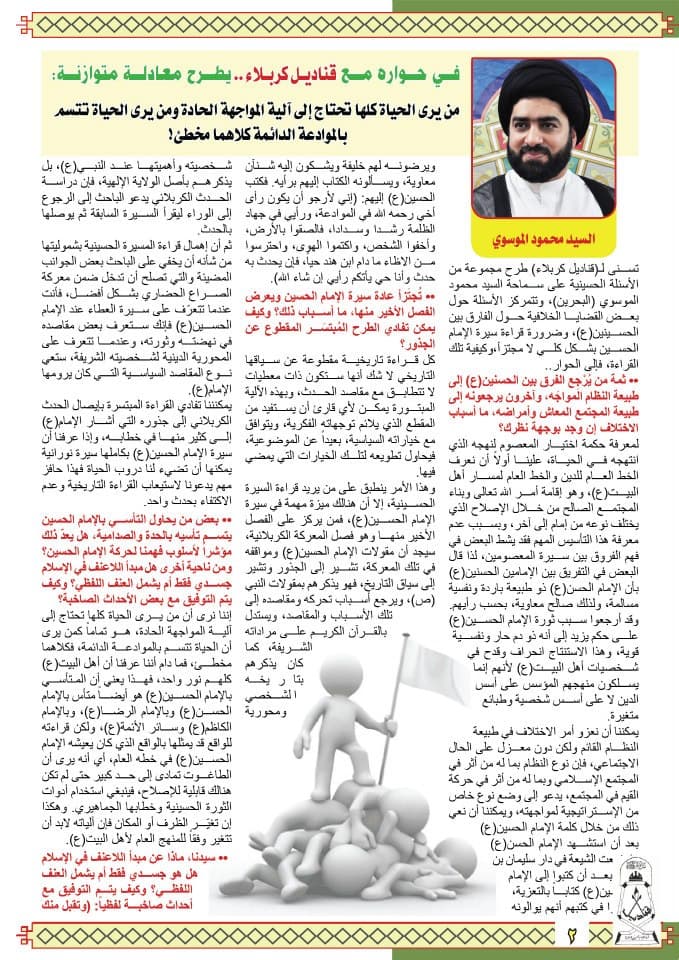
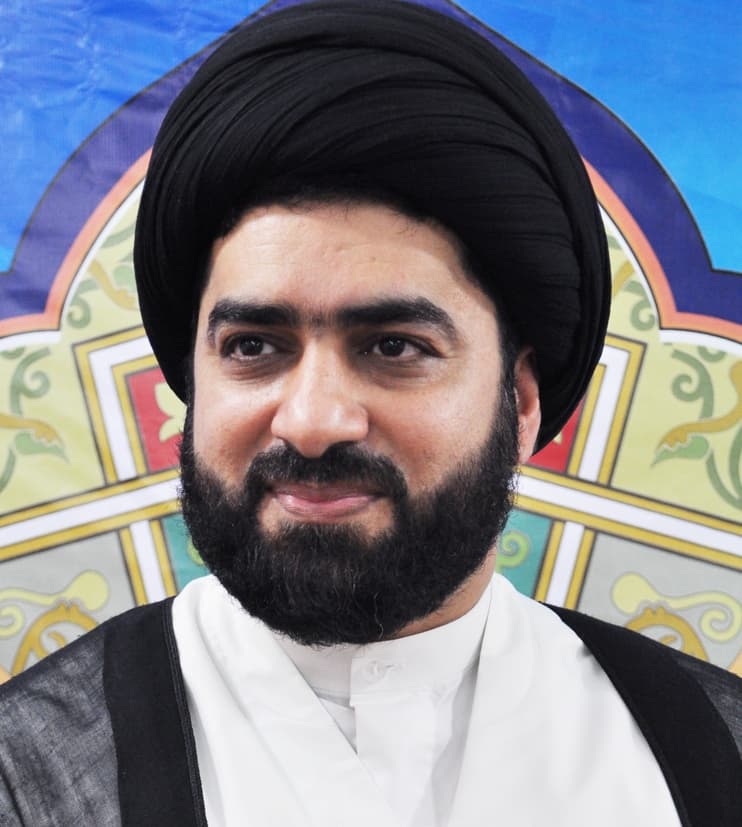
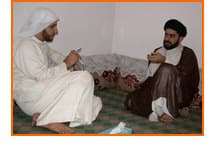
The monthly intellectual magazine al-Nabaʾ conducted an interview with Sayed Mahmoud Al-Mosawi in its issue no. 78, as the magazine devoted this issue to the topic of violence and terrorism. The magazine came out in 319 pages containing various articles and interviews with Arab and Western thinkers and researchers.. Here is the text of the interview with Sayed Mahmoud Al-Mosawi; its introduction ran as follows: The importance of the intellectual stands out in that he traces the paths of knowledge, takes them by the hand toward the shores of safety, and instills in them concepts that contribute to building life in a sound way, by focusing on building a civilized epistemic system that deals with the universals and the details around it in a modern and civilized manner, without violence, exclusion or marginalization.. .
Since the world is witnessing numerous events, perhaps the most prominent of which is this unprecedented wave of violence, it becomes important to learn how intellectuals read this phenomenon and other phenomena...
These days carry with them seeds for founding important new stages of history, through concepts that have emerged onto the scene with problematics seeking a change of the crisis-ridden reality, such as the problematic of reform, the definition of the concept of terrorism, the tottering of worn-out dictatorships, and the masses taking to the streets.
Hence we sought the opinion of His Eminence Sayed Mahmoud Al-Mosawi on these topics, and he answered our questions, for which we thank him.
Q1: In your opinion, what are the causes that drive some Arab and Islamic groups to practice extremism and terrorism? And what are the most important results that extremism and terrorism give rise to?
A: Sometimes the bare phenomenon of violence against the authorities is spoken of as a method that Islamic groups practice to reach their political goals. This type of practice may be justified in the event that the authority uses the same method in quelling people's demands for their rights, and this is established with regard to the Arab regimes that try to preserve their power through repression. However, what is not justified at all is the use of violence in religious practice absolutely, or in political practice by way of initiating it, and this is one of the instances of extremism and terrorism.
The causes of such extremism are the intellectual background that these groups live by and their ways of drawing on religious knowledge, and we can summarize that in two causes:
The first: those groups' view of themselves as an absolute truth that admits no error; consequently others, even if they belong to the religion of Islam, have no right to a differing ijtihād, and if that happens, they are counted among the category of falsehood.
The second: the fragmentary reading of the religious text, cut off from its circumstances, and understanding the Holy Qurʾan without infallible authorities to set thought and conclusions aright. So the verses of jihad are cut off from their contexts, so that fighting overlaps with jihad and becomes a synonymous concept, whereas jihad is a concept more general than fighting. The cause of this goes back to their lack of the authority of which Allah the Exalted said: “But no one knows its interpretation except Allah and those firmly grounded in knowledge” (Qurʾan 3:7). For the Ahl al-Bayt (a), of whom the Messenger said that they do not part from the Qurʾan or from the truth, are the safety valve for any non-infallible understanding of the texts of the Holy Qurʾan, and denying them (a) counts as entering the labyrinths of intellectual deviation that leads to terrorism and extremism, so that it puts on the garb of religion.
This is what we observe in the course of events in the Islamic arena today, and there is no doubt that the effect of that will fall back upon religion itself in the first place, so that people will be repelled from religion, because that is a deviation from the rule that Allah, Almighty, gave to His noble Prophet (s) in His saying, Exalted is He: “It is by Allah’s mercy that you are gentle to them; had you been harsh and hardhearted, they would have surely scattered from around you. So excuse them and plead for forgiveness for them, and consult them in the affairs, and once you are resolved, put your trust in Allah. Indeed Allah loves those who trust in Him.” (Qurʾan 3:159)
Q2: How can we contain cases of extremism and terrorism, or uproot them radically?
When we want a radical uprooting of cases of extremism and terrorism, this means that we ought to head toward the roots in order to treat them. This problem is basically a cultural and intellectual problem, as a person's mind is shaped by a set of mistaken concepts that form for him an ideology for which he will be ready to die. Therefore intellectual treatment is the most important thing in combating terrorism. However, this step cannot be stripped of many reforms that accompany it, namely: allowing intellectual freedom in Islamic countries and permitting plurality to take its full range, establishing forums for dialogue and intellectual exchange, and supporting educational institutions and centers of intellectual research so that they carry out their role competently. For we in the Arab homeland, the last thing we think of is supporting cultural projects in general; the usurping Zionist entity in Palestine, for example, spends on scientific research and education more than the Arab states spend combined, and this is a real tragedy that ought to be paid attention to.
Q3: What is the relationship of the Arab epistemic framework to the spread of extremism and terrorism? Is the epistemic system charged with violence, extremism and hatred of the other? And does the Arab epistemic system constitute an obstacle to development toward reform and democracy?
When we read the Arab epistemic scene, what is drawn before us is a state of separation of the intellectual elite from the epistemic positions adopted by the authority, and both tendencies try to form a vision of life. What can give a justification for cases of terrorism and extremism are the positions adopted by some governments that support certain one-sided projects which claim that they are the absolute truth and that everything other than them is absolute evil.
Many intellectual currents in the Arab and Islamic homeland have ideas and aspirations toward reform and democracy, and these currents as a whole can be viewed as a general epistemic system, by gathering the common spaces between them, the most prominent issue being reform and the release of freedoms. However, these currents themselves are afflicted with the diseases of authority: the necessary freedoms do not exist within them, and they are sick with diseases such as fanaticism and the cancellation of the other. So it is not possible for these efforts to reach an acceptable aim while they are afflicted with the same malady, for one who lacks a thing cannot give it. And the existence of literature in harmony with reform and democracy means nothing if it is devoid of any outward manifestation in action and performance.
Q4: There is a strong reform movement that the world is passing through, especially the Arab and Islamic worlds, represented by peoples surging into the streets to carry out comprehensive civil disobedience aimed at toppling governments and bringing about change. In your opinion, what is the reason for this movement at this stage?.
A: The hopes that aspire to change and reform exist in the minds of Arab and Islamic society, but they are suppressed. The factor of suppression is either the doing of the authorities themselves and their ways of managing and dealing with any opinion contrary to their policy, or the type of justificatory culture that inhabits people's minds, which does not contribute to creating a coalitional and cooperative atmosphere for demanding rights. This problem requires people to discover competent leaderships who sincerely take up the causes of the Umma, so that they may undertake real work in the field.
As for the reason behind the rising pace of demands and demand-driven marches, it is the obtaining of some openings by virtue of the general global pressure on dictatorial practices in states, and taking them as guarantees; indeed some took them as a wager, and this is a grave mistake. A person can benefit from the spaces available, whatever their cause, but that does not call him to adopt them to the point of wagering on them. This is the difference between the two tendencies.
Q5: Does civil disobedience represent a new civilized method that is an alternative to violence, and in your opinion will it achieve the goals of change?
A: Civil disobedience is one of the components of non-violent political action. With the continuation of this effort, its good organization and its effective management, together with persisting in and preserving civilized conduct stemming from religious values, which command non-aggression and gentleness on the one hand, and command steadfastness and patience upon the truth, even if the night journey be long, on the other hand—there is no doubt that, with all of that observed, it will lead to positive results, especially if it is accompanied by serious dialogue from both sides and the adoption of a clear agenda in working toward change and reform.
Q6: We notice that the Arab and Islamic world does not accept the process of reform except in the presence of strong external pressures; what is the reason for that? And is it possible for the Arab Islamic peoples to undertake a reform movement without foreign intervention?
A: There is no doubt that the process of reform is possible from within, but its conditions are difficult. The reform movements have taken this difficulty as an impossibility and dealt with it on that basis, and hence began the reliance on external pressures. The origin of the difficulty is the practices of the dictatorial authorities and their ways of confronting any will for change within. But Allah the Exalted does not leave His servants for long without opening up fields for movement, even if by setting another dictator from outside over the dictator within, as is the case in Iraq, where change took place directly; and this situation now prevails in more than one country, albeit in other forms.
Arab and Islamic governments ought to realize that if change takes place from within, this is better for them and more empowering, whereas if change comes from outside, it is humiliation and disgrace, as Imam ʿAli (a) says: (Never were a people raided in the heart of their home but they were humiliated).
Q7: Why are cases of despotism, dictatorship and absolute centralization concentrated in the Arab and Islamic world? And why has it lagged so far behind in practicing democracy?
A: Cases of despotism and dictatorship are not confined to Arab and Islamic regimes alone; rather they extend even to some Western regimes. However, the difference between them is that the despotism of the Arab regimes is directed inward, that is, at the citizens, while the despotism of the West is directed outward, that is, toward other regimes and other societies, whether it is political, economic or even cultural despotism, in any form of despotism..
Both despotisms work to form a mentality hostile to the West within the Arab countries, because the despotism of the Arab governments is directed at the Arab and Muslim citizen, and Western despotism is likewise directed at the Arab citizen, who is its first victim. The will to export democracy on the part of the West, as they claim, cannot be genuine, because for many long years they remained the friend and ally of all the dictatorial regimes in the world on the basis of interest, not principle. As for the delay of reform in the Arab and Islamic homeland, it is because it does not serve the interests of the ruler and the ruler's ally.
Q8: What are the elements and conditions for the success of practicing democracy in the Arab and Islamic worlds?
A: It is noticeable that governments often claim that they are carrying out reform and that they are ready to open the doors of freedom in the direction of the democratic process, but they quickly retreat from their claims when the matter reaches practical, applied reality. Therefore three directions can have a role in the success of that practice and in preserving it, and this is not by way of limitation:
The first direction: insisting on enshrining in law everything that would contribute to preserving freedoms, and not being content with verbal promises.
The second direction: creating a state of communication between the reform movement within and the relevant international organizations and institutions, so that they may support and monitor the democratic process.
The third direction: working on educating society about the reform movement, the democratic process, and the freedoms and responsibilities entrusted to society, so that a general awareness is created that insists on its demands and preserves them, and renews its demand for them if the authorities turn back on their heels.
Q9: Would you prefer reform to be from within or from outside? And what if we are unable to achieve reform from within because of the brutality and repression that the despotic regimes practice?. In your opinion, what are the consequences of reform from outside?
A: There is no doubt that reform coming from outside, especially if that outside is represented by the Western system, will not be pure good, because of the sovereign, economic and cultural ambitions over the world that those states adopt. Therefore it is difficult for that to be an option expressing a will for change toward reform.
However, as we mentioned, that may come about without the will of the peoples, but rather as a result of a clash of heads and interests, as happened in Iraq for example. The position of the Islamic movements, and of the religious marjaʿiyya in particular, was wise: they did not adopt external change and did not wager on it, despite their very great suffering under the defunct regime, yet at the same time they prepared themselves to benefit from the changes that would occur, and indeed contributed to guiding them aright and to pressing toward achieving justice, even if partially.
As for some Islamic and Arab countries, the matter does not reach that degree of injustice that Saddam practiced. Some openings have occurred as entitlements of the peoples in some of them, such as Bahrain for example, and some openings have occurred in other states because of sensing the storm of change from outside, such as the Kingdom of Saudi Arabia and others.. This calls us to adopt the option of political and rights-based action from within, while cooperating with the relevant international institutions, and not with states that have ulterior motives and covetous designs.