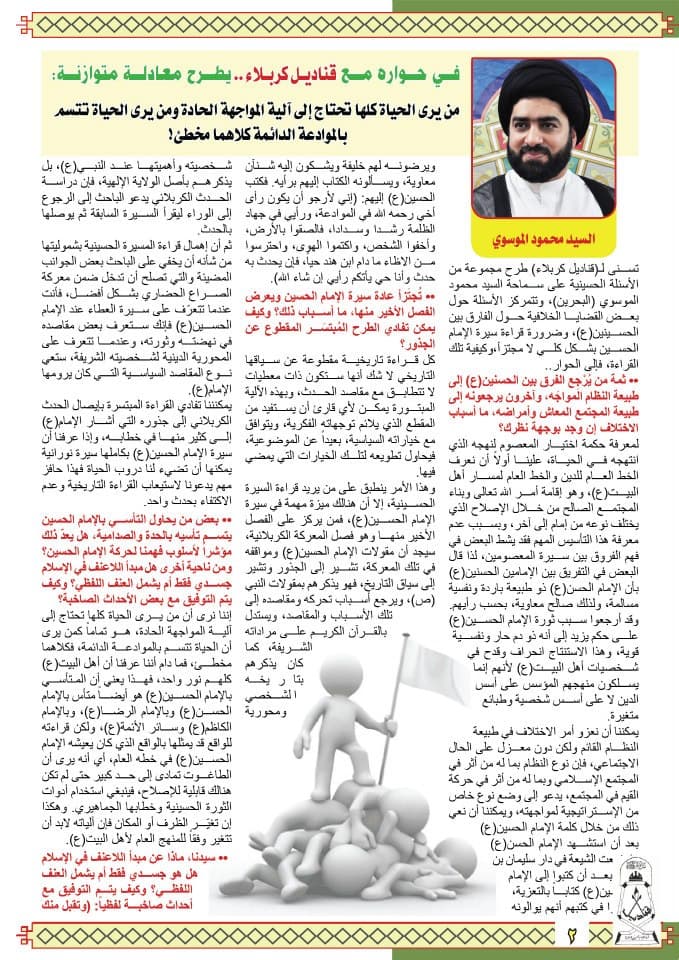
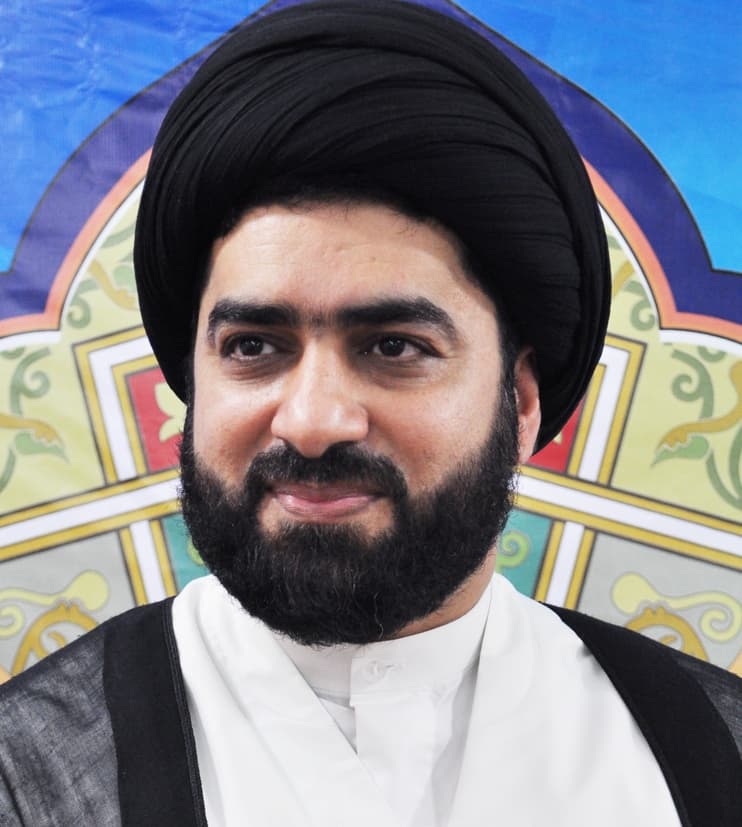
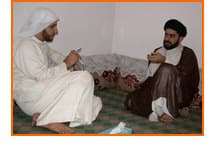
An interview conducted by al-Walaʾ magazine, issued by the Islamic Risala Society, on the occasion of Sacred Muharram 1430 AH .
Issue 22
1/ Do the husayniyyas perform their proper role and fulfill their required purpose?
In order to answer this question precisely, we need to determine the most important roles that the husayniyyas ought to perform in reality, and on the basis of that determination we can measure whether or not they have performed their desired role.

Since the husayniyya is the place designated for reviving the cause of the Ahl al-Bayt (a), we ought to monitor its performance from this angle, and what measure of revival is required. Revival is as Imam al-Sadiq (a) defined it: in answer to a questioner who asked him about the nature of reviving the cause of the Ahl al-Bayt, he said: (That you teach people the beauties of our speech), that is, spreading the knowledge of the Ahl al-Bayt (a), their guidance and their message to humanity, and how they view the world and the contemporary and present problems in society. For if people come to know that speech, they will follow them, and whoever follows them will embody their speech in the reality of his life.
Building on the foregoing, we see that we need more awareness of the reality of the mission of the husayniyyas, knowledge of the nature of the revival that the Ahl al-Bayt (a) defined, and not neglecting the aspect of emulation. After that, the husayniyyas can offer a better message to society and move on to a better performance than they have now.
Yes, they achieve benefits for society, but the required role is far more ambitious than the reality.
2/ How can the vast crowds in Muharram be made use of in raising up the husayniyyas?
Raising up the husayniyyas requires that the administration be aware of the mission of the husayniyyas and of what they ought to perform for society. People are actually attached to the husayniyyas, and it is a doctrinal attachment that is hard to shake. So the best way to raise up the husayniyyas is for the resolve of the administrations to rise and for them to possess an awareness of the Mission, so that they embody that in reality: the preacher is chosen on this basis, and work is done on this basis..
The people are saying to the administrations: We are here. So the question remains: what are you going to do?
3/ What is the educational and media role of the husayniyyas in society?
Many parties that do not belong to Shiʿism, of their various orientations, view the husayniyyas as among the most important Shiʿi gains in the field of influence in society, and they envy us this great blessing, each expressing this feeling in his own way. What concerns us is that we possess great media pulpits, and they are influential because of people's doctrinal attachment to them; they have the most prominent role in shaping the human personality and in religious guidance, and in conveying the religious idea to society.
4/ What is the role of the husayniyyas in building and graduating active cadres?
When we speak of an active cadre in the Umma, we mean by it the person in whom administrative capability, good conduct and taking charge of affairs are formed, all of that stemming from a sense of responsibility. So if the husayniyyas, through the Husayni pulpit, instill the spirit of responsibility in the Umma, the husayniyyas can graduate active energies and cadres for the sake of religion and the Umma.
5/ What is the role of the husayniyyas in unifying the Umma?
Al-Zahraʾ (a) said it: (Obedience to us as an order for the community, and our Imamate as a safeguard against division). Since the husayniyyas are what revive the cause of the Ahl al-Bayt (a), they embody their values and their guidance; and when we are among those who belong to the Imamate, the husayniyyas are the place of our conduct and the arena of our activity. The hearts that believe in the Ahl al-Bayt revolve around them and are united in obedience to them, for love of the Ahl al-Bayt (a) gathers hearts together. This is an important message that ought to be present before us in the husayniyyas and outside the husayniyyas: there ought to be no dispute, infighting or tension; each works according to what he believes in, and all excuse all, respect all, and wish success for all.
Unity within the framework of wilāyah is a beginning for openness and unity on the issues shared with others.
6/ The role of the husayniyyas in the face of the challenges “globalization – satellite channels – moral corruption – sectarian strife?
The husayniyyas are among the most important pulpits that can stand in the line of confrontation against corruption, the media and all social and intellectual problems, especially with the existence of satellite channels, as the influence of the husayniyya will move from its narrow social bounds to a wide influence on millions of viewers.
7/ How can the husayniyyas be developed, energized and activated for the future?
We can make the husayniyyas among the wagers of the future in guidance, building personality and confronting deviations. This is done if we view the husayniyyas as institutions; an institution can grow and keep pace with various challenges. And because reality is advancing toward building strong civil, religious and cultural institutions, so that they may preserve their existence and perform a more effective role while maintaining continuity, our view ought to be in harmony with this orientation. This is among the instances of “Cooperate in piety and Godwariness” (Qurʾan 5:2), among the instances of (The hand of Allah is with the community), and among the instances of (Allah, Allah, regarding the order of your affairs).
8/ Do you have suggestions for developing the role of the husayniyya in society?
Development can be achieved through several axes, which are as follows:
A– The administrative axis, which ought to follow the method of accountability according to the achievements that each administration realizes, so that this becomes an incentive for offering services and performing a proficient role in administrative affairs. In other words, moving from the role of taking on administration to administrative development.
B – The thematic axis, which concerns the scholarly and cultural material presented to the audience; attending to it in cooperation with the preacher can contribute to giving society what it lacks and what it needs.
C – The behavioral axis, which concerns the behavior of the audience in performing the rites and in attending the husayniyyas, such as observing the etiquette of the place and its sanctity, observing good companionship with people, and orderliness in all actions, so that the atmosphere gives a good impression of Husayni upbringing before all people.