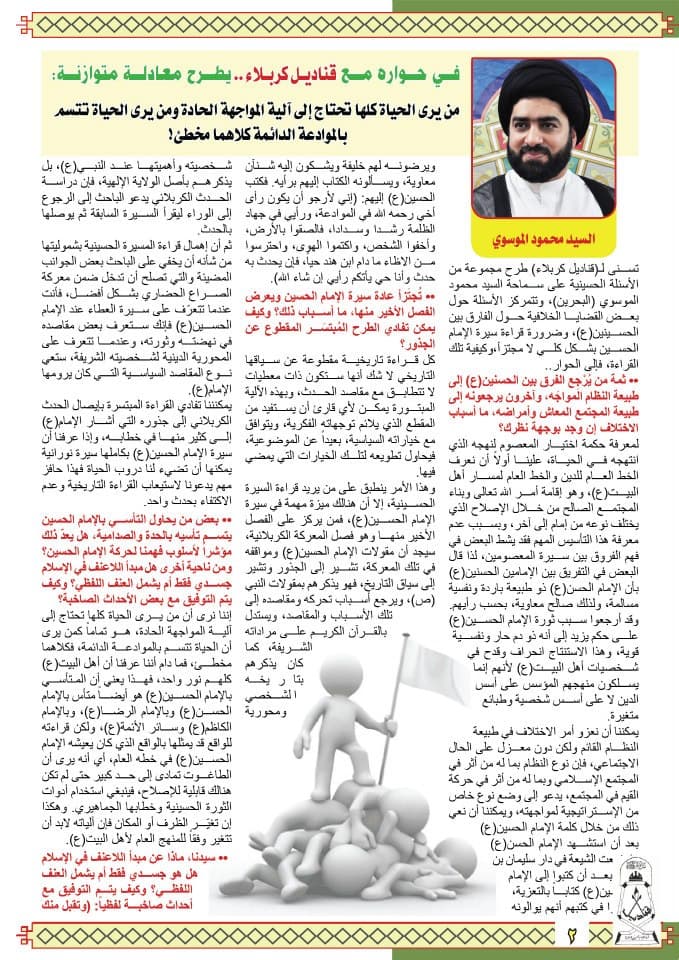
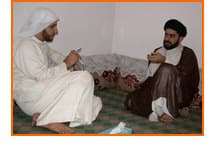
The studies magazine al-Basaʾir, in its issue no. 43, conducted an interview with Sayed Mahmoud Al-Mosawi under the title (Understanding the Text.. Between the Present and the Dominance of Heritage). A group of scholars took part in the interview: Shaykh Zakariyya al-Dawud from Saudi Arabia, Shaykh ʿAbd al-Ghani ʿAbbas from Saudi Arabia, and Shaykh Malik Wahbi from Lebanon, in addition to Sayed Mahmoud Al-Mosawi from Bahrain. .
Al-Basaʾir Forum
Understanding the Text .. Between the Present and the Dominance of Heritage

The first question: Your Eminence Sayed/ :, at every social-civilizational transformation in our Islamic reality, the talk returns to the subject of understanding heritage—religious heritage specifically, and the religious text more particularly—as the most important constituent of Islamic civilization. After the fall of the Ottoman caliphate in the twenties of the last century, scholars and thinkers discussed the issue of religious renewal; and with the declaration of the State of Israel, the beginning of the confrontation with the Zionist project, and the series of Arab and Islamic revolutions, the talk about the same issue was likewise repeated once again. These days, after the fall of the regime in Iraq and the emergence of various currents on the scene, the talk about the same issue is repeated today once again, and urgently. It is noticeable that at each of those stations the talk about religious renewal inclines toward a reading closer to the strongest current on the scene: from the inclination toward Marxism, passing through nationalism, and arriving today at liberalism.
The question: Is this phenomenon considered a natural matter, or is it a defect in the intellectual-civilizational reality of Muslims? How can the waves of these multiple readings of the religious text be controlled? And is it possible to combine firm control over the reading of the religious text with intellectual and cultural creativity?
A: Sayed Mahmoud Al-Mosawi:
The aware Umma is one that is bound to its values with a bond of trust; it sees salvation in its religion, on condition that it is followed and turned into active values and governing principles at the various political, social and economic levels. As for the prevailing condition of the Umma, whether several centuries ago, through the civilizational transformations that have swept over the Umma, and up to now, it is on the whole far from carrying the concern of religion at its theoretical and applied levels. Regardless of the causes, most of which go back to the despotic political condition that has seized the positions of decision, the questions that arise from this crisis-ridden situation, in a situation in which the Umma is far from the values of its religion, are in reality a quest for salvation from the prevailing situation, and a search for a glimmer of hope in what they believe of a religion whose first principles minds have agreed upon.
So it is natural that demands for religious renewal should arise in a situation of such a bleak picture. This question, if we look at it from this angle, will express a state of searching for the rescuer, provided that this rescuer is from the very core of religion. There is no doubt that what is entrenched in the prevailing mentality, as a result of the multiple defeats, is that the concepts they possess do not bring them to a state of revival, and consequently recourse is made to seeking a new understanding of religion.
However, the real crisis lies in the nature of this new understanding. We have found many readings that claim a connection with religion in response to civilizational needs, but many of them were nothing but an import of concepts and values that have nothing to do with religion. Therefore controlling the process of the new understanding of religion is an important matter—indeed, of the utmost importance.
The new understanding is in reality nothing but the extraction of religion's visions from its constants to the variables of time and place. From here we discover the first condition for controlling the process of reading religion and understanding it with a new understanding, which is that the reading rely on the constants of religion and express its spirit and its aims. For attributing something to religion means that religion is its source and its spring; otherwise we are wary of naming any ijtihad that does not express the spirit of religion and does not proceed from its constants.
We can define the kind of guarantees that control any new reading in two basic kinds:
The first: the doctrinal guarantee: this is the one that relies on the agreed-upon foundations in Islamic doctrine, such as faith in Allah, in His Messenger and in the Imams, and faith in the Holy Qurʾan and the Pure Progeny as sources. Observing this faith and taking it into consideration is the cornerstone that cannot be abandoned; otherwise any foundation will be on a collapsing bank, which collapses with its owner and diverts him from the right direction.
The second: the purposive guarantee: for religion came with general and fundamental aims, toward whose achievement and the support of whose civilizational presence all legislation is directed. Any attempt to understand religion ought not to come in response to the will of societies, or to the desires resulting from civilizational transformations as an expression of pressures from the dominant powers; rather, it comes in response to the challenges that society lives, in order to rescue it from its deteriorating reality, so that it reaches the goals and aims that religion heralds, such as peace, security, justice and freedom, as religion wants them, not as human beings want them.
Through these two controls creativity can soar and human scholarly capacity can mature. For true creativity is connected with the extent of a person's ability to transform ideas into mechanisms and rules that can be applied in the external world. The fields of creativity are many, with an understanding of the guarantees: creativity may consist in the ability to find the balances connected with establishing values within thorny laws, or it may be in determining priorities, or in clarifying the ruling of successive variables in time and place.
The second question: Your Eminence Sayed/: In contrast to what can be described as the anxiety and turmoil found among some tendencies in their reading of the religious text, those who have faith in the contemporary religious institution expect it to contribute to crystallizing new visions and mechanisms in reading the religious text, which preserve authenticity in it and, on the other hand, contribute to the process of contemporary development.
The question: What contribution have the scholars and thinkers of the scholarly religious institutions made at the level of visions and mechanisms in reading the religious text?.
A: Sayed Mahmoud Al-Mosawi:
Since Sayed al-Murtada, at the end of the fourth and the beginning of the fifth century AH, who compiled his book on the science of uṣūl, and after him Shaykh al-Tusi, down to Ibn Idris al-Hilli, al-ʿAllama al-Hilli and his son Fakhr al-Muhaqqiqin, the two Martyrs, the First and the Second, and others, down to our present time, the focus of the basis of scholarly research in the field of reading the religious text has been confined to limited topics and a fixed mold, even though some of those topics are of importance, and they are practical mechanisms for understanding the text, as a set of rules that contributed to understanding the text has formed through the development of the science of uṣūl. However, they remain imprisoned in the form that the ancients drew for this science, so research is repeated on the same axes and the same rules, in rejection and acceptance, broadening and narrowing..
The search for mechanisms for understanding religion still needs development, and this development ought to stem from a vision that surpasses the limitedness of the traditional uṣūlī topics, and not be content with circulating them in rejection and acceptance..
Perhaps among the most important developments that have come in the field of developing the study of reading the religious text is Qurʾanic research, which had been absent for a long period of time, as attention was directed toward narration in the first stage of the era of the Occultation, and then it moved to attention to rational and uṣūlī study. Even though the Qurʾan was present in general in the topics of uṣūl as a text, so that the topics of verbal expressions and others fall within its concern, the specificity of the Holy Qurʾan needs intensive research that takes into account the specificity of the Qurʾanic discourse and its fundamental status as a source in the process of legislation.
The pioneering experience begun by Mirza Mahdi al-Isfahani (1303- 1365) was characterized by being a state of development outside the circle of uṣūlī topics, as he directed criticism at many of the topics and worked to establish a concept of the intellect consistent with the Holy Qurʾan's descriptions of it and the Ahl al-Bayt's description of the intellect. Thereby a knot was untied that had arisen between the Akhbari tendency, which rejected the intellect in legislation, and the Usuli tendency, which gave it attributes at variance with its role in understanding the text and apprehending knowledge and the variables of life. Also, his division of reports and narrations into narrations of fatwa and narrations of principles gave the aspect of legislation vitality and a wider dimension.
As a development of al-Isfahani's school came the experience of the contemporary religious marjaʿ Sayed Muhammad Taqi al-Modarresi, in accord with that school and working on development and addition, especially in Qurʾanic research, which had been absent. He intensified this research in the Encyclopedia of Islamic Legislation, consisting of ten volumes, where he worked to establish the system of values that forms the fundamental visions of religion, and to discover the wisdom behind the legislation of rulings, from which he proceeds to know the primary rulings of religion. This means that the large quantity of secondary rulings that have filled the science of fiqh begins to fade away. But this experience still needs to be discovered and crystallized in the form of rules and mechanisms so as to contribute practically to the process of understanding the religious text.
The third question: Your Eminence Sayed/: The thesis of separating religion from religious knowledge, whose presence intensifies through the proliferation of the mechanisms of modernist readings and through the existing disagreement among the jurists and among the schools, raises several questions: some relate to defining religion itself, and some relate to the binding force or legitimacy of religious knowledge.
The question: Is it possible to overcome the problematic of separation in order to know religion in a realistic way, and how can difference and legitimacy, and difference and binding character, be reconciled?.
A: Sayed Mahmoud Al-Mosawi:
The objection raised against the proponents of modernist readings, on the pretext of distinguishing between religion as an essence and the understanding of religion and the human being's relative knowledge, is that they did not rely on arguments and proofs stemming from religion in forming a vision to resolve this problematic; rather they resorted to copying the Western mechanisms produced by debates and deliberations in the West. Some inclined to adopting hermeneutics, or understanding on the basis of personal experience, so that each person has his own Islam; this is the vision built on the legitimacy of the multiplicity of readings, however they may happen to be.
Here we can acknowledge this problematic in principle, that is, in terms of its existence and its need for solutions that address it. However, any solution that may come must be within the controls we mentioned, which are those connected with the doctrinal control and the purposive control.
By relying on the sharʿī controls that religion itself has set—not those that human beings set of their own accord, or that are imported from the West—there then comes sharʿī excusability for the differences that may occur as a result of ijtihad in knowing the religious text, because the excusable deviation or error will not be a deviation from doctrine, nor from the aims of religion and its great ends. For the multiplicity of readings in accordance with the intentions of modernity is a multiplicity in understanding even at the radical level, and here contradiction occurs, the binding character is negated, and the process of legislation and codification at the social level fades away, which in turn demolishes the social and political governing authority of the values of religion; and this step serves the aims of removing religion from the arena of society.
The fourth question: Your Eminence Sayed/: Every nation and civilization has features different from the other, but we can perceive a common denominator among all civilizations, which is reliance on the founding text in the stages of civilizational transition and in the stages of crisis and of the entanglement of the Umma's historical awareness with the contemporary. But the nation most affected by the text and most attentive to it is our Islamic Umma, since the text imposes complete dominance over all the joints of our existence. In your opinion, what are the features of the correct method through which we can make the religious text contribute effectively to directing the course of the Umma so that it keeps pace with the civilized nations—indeed, so that it becomes the pioneer of civilization in our contemporary world, in which the nations await from us a real contribution that will bring them out of their multiplying crises?.
A: Sayed Mahmoud Al-Mosawi:
The talk about the effect of the text on the reality of contemporary life, in order to achieve progress and contribute to the process of the Umma's civilizational development, needs two basic dimensions which must enter into the circle of scholarly work and societal concern, namely:
The first aspect: concern for activating values in the arena of life with all its ramifications. Activation means that values, concepts and rulings in their legal dimensions be present in the societal arena and enter the domain of application. Perhaps this aspect is considered remote from the work of the sciences of reading the religious text, but it is a work that ought to take on importance to the extent of the importance of understanding the text; for values, so long as they are not applied, remain imprisoned in theorizing, and what is required of the text is that it take its effect in life, and the effect does not form except through experimentation, activation and a genuine will to apply.
This path faces various difficulties, the most prominent of which are the absence of confidence in religion's leadership of life, and the fear of falling into previous historical experiences that exploited religion and employed values in the interests of rulers. Also, the product of those rulers, or of colonialism, has made the religious experience, in its vital legal and social dimension, remote from the arena of life.
The second aspect: it is connected with scholarly research, and it is the transition from conceptual research to research into mechanisms and rules in understanding the religious text, so that research takes its course toward formulating many sciences into rules.. For uṣūlī research, despite some observations on its topics, has in several respects taken the direction of formulating rules, and likewise the science of fiqh with regard to the jurisprudential maxims. The transformation of theories into practical, applicable rules makes them materials productive of religious knowledge.. For example, in the field of the sciences of the Holy Qurʾan, we are still at the beginning of the road: there is a great difference between what is intended for the sciences of the Qurʾan in the view of the Ahl al-Bayt (a), which is the production of knowledge and the understanding of the text, and the current manner of treatment. At a time when we see the Ahl al-Bayt (a) presenting the sciences of the Qurʾan as materials that produce and generate Qurʾanic knowledge, we do not find in Qurʾanic research those topics serving that aspiration, as the sciences of the Qurʾan are studied outside the scope of the sciences specialized in understanding religion and the religious text. This is a gap that needs treatment and attention befitting the station of the Holy Qurʾan and its centrality to the Message.
Then the course of understanding the text can contribute to crystallizing the personality of the Umma more effectively.