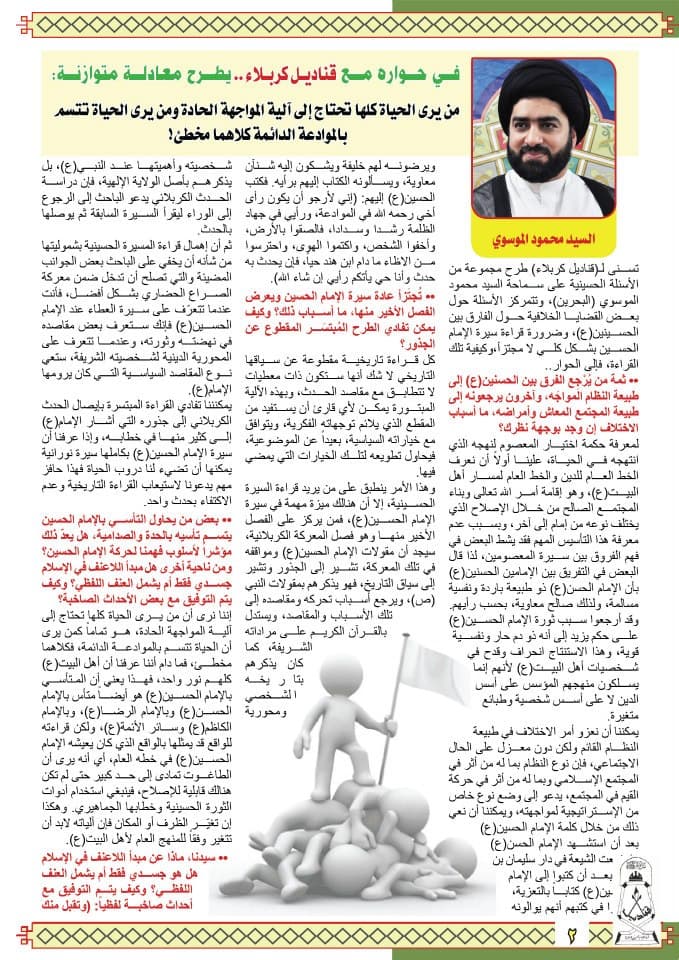
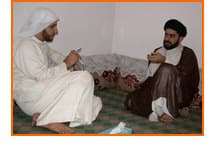
The Iranian Arabic newspaper al-Wifaq conducted an interview with Sayed Mahmoud Al-Mosawi, in its issue 2832 - Wednesday 26 Jumada al-Akhira 1428 - 11/07/2007; the interview was conducted by Dr. ʿImad al-Khazʿali.
The first part of the interview:
.
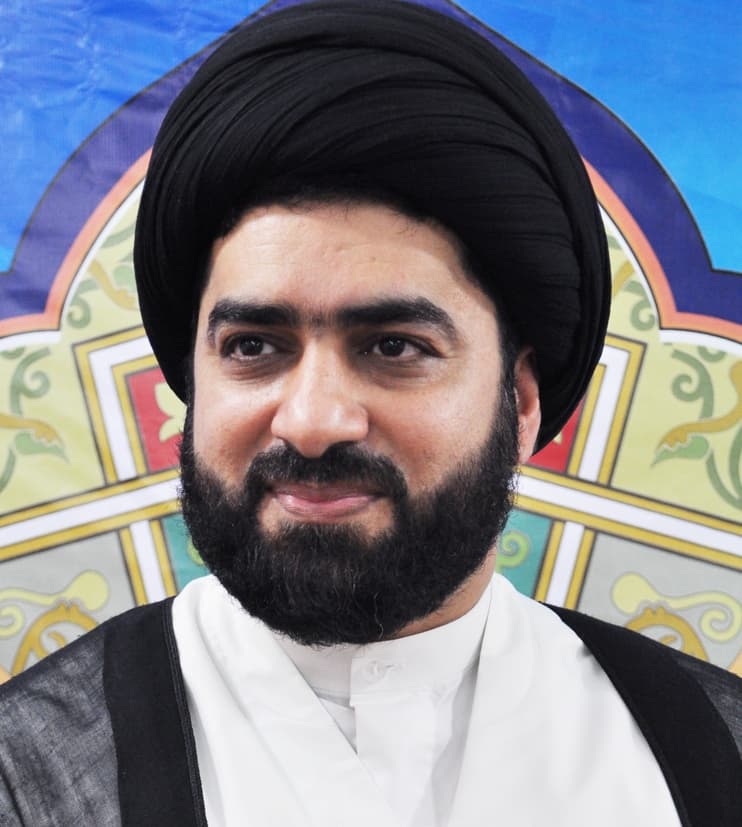
Sayed Mahmoud Al-Mosawi as the guest of “al-Wifaq”
Interviewed by / ʿImad al-Khazʿali *
How did the idea of holding the Holy Qurʾan Conference emerge..

- The basic idea, or the basic goal, in founding the Holy Qurʾan Conference is to spread Qurʾanic culture and Qurʾanic conduct and to make them part of the general currency of society.. And since the Holy Qurʾan is the starting point and the beginning of the civilizational foundations that form the features of the advanced Islamic society, because of what characterizes the Holy Qurʾan of constancy in the principles of the system of values, of completeness in the branches of legal legislation, and of accommodating all the paths that support the progress of humanity in forming its good civilizational life—as Allah, Glorified and Exalted is He, said: “The day We raise in every nation a witness against them from among themselves, We shall bring you as a witness against these. We have sent down the Book to you as a clarification of all things and as guidance, mercy and good news for the Muslims” (Qurʾan 16:89)—for this reason it was obligatory that Qurʾanic concepts be present in people's lives in all aspects.. And at the direction of His Eminence Sayed Muhammad Taqi al-Modarresi, as a general idea, came the idea of the Holy Qurʾan Conference, although the idea of founding the Holy Qurʾan Conference began in Syria “22” years ago; then two years after that it was held in the State of Kuwait and continued for “10” years; after that the Kingdom of Saudi Arabia hosted the conference and it continued for “4” years.. And last but not least, it was held in the State of Bahrain, for two consecutive sessions.
* What is the general goal of holding this conference?
- The general goal of holding the Holy Qurʾan Conference is to spread Qurʾanic culture, the Qurʾanic form and Qurʾanic manifestations in Islamic society.. considering that the Holy Qurʾan is the first guide.. and all spectrums and creeds come together in it.. for everyone unites at the table of the Holy Qurʾan.. for the sake of the meeting of the people of thought and sound opinion, and for the sake of participating in crystallizing new contributions with a divine light shared among them. We hope that the conference will be the first fruit of work in this direction, to be reinforced by successive conferences.. As for the practical recommendations of the conference, in this session no practical committee was formed to take upon itself the activation of the items and proposals that emerge from it; rather, the alternative to this committee was the practical workshops, through which communication takes place between the formations and groupings of Qurʾanic work and its active personalities, to exchange experiences and discuss ways of development in Qurʾanic work, in accordance with the new requirements and challenges.. These workshops are made up of the Qurʾanic institutions working in society and the relevant bodies, societies and personalities..
* There are some Qurʾanic verses that bear more than one exegesis and interpretation, and through these verses the terrorists and takfiris slip in to carry out their satanic acts under the cover of Islam.. What, in your view, are the practical solutions for confronting such bloody acts, which Islam rejects categorically?
- In my conception, in order to prevent any party from exploiting this situation to carry out its own purposes or destructive purposes, and so that the Qurʾan is not understood according to a person's whims, two points are necessary.. The first point is understanding the Qurʾan comprehensively, and that it be connected and sequential according to the historical context and the environment in which the noble verse was revealed, not that it be understood partially or in a manner severed from its general contexts and its historical contexts.. and interpreted according to a person's whims, so that the results are the killing of the inviolable soul.. bearing in mind that the Qurʾan, part of it confirms.. another part. As for the second point, there must be a safeguard in understanding the Holy Qurʾan.. because some verses have no safeguard to safeguard them except those whom Allah, Glorified and Exalted is He, has chosen, and these are like the safety valve for understanding the Holy Qurʾan. But there are groups that do not have such a safeguard, or the infallible one from whom Allah has repelled impurity and whom He has purified with a thorough purification, according to the verse.. therefore they fall into this problem.
* Is there real benefit in the dialogue of civilizations or the dialogue of religions.. and more precisely, do these dialogues have the real prerequisites for their success?
- The wise people of the world and the globe have agreed unanimously that dialogue is better than clash.. because it “that is, dialogue” is a means of bringing human beings closer together and contributes to their awareness and education.. because human beings are from a single soul, but they are diverse in inclinations and human makeup; that is, the origin of creation is one: what exists in me exists in the rest of human beings, but the problem lies in the human soul's tendency toward control, possession and domination.. Therefore dialogue between civilizations is very possible if the required conditions are met in it, and perhaps the most important of these conditions is sincerity of intention.. Dialogues can be divided into “political, intellectual, cultural”, because politics sometimes encroaches on the other aspects, and here there is disagreement and sometimes boycott. Dialogues also depend on the kind of topics chosen.. for example, the view of the sanctity of certain values.. We may differ in this view, but we sometimes agree in another view and on other values. And I believe there are Qurʾanic verses that indicate the possibility of establishing a relationship with the unbelievers, except in the case of engaging in a dialogue in which there is associating partners with Allah, for that calls for leaving the dialogue or departing from the session and the place.
* Some Arab states have today come to fear Iran while they feel safe with Israel.. the first enemy of Islam! What is your comment on that?
- The truth is that there are two main reasons: the first is political interests, according to the principle “the weaker follows the stronger”; and the second reason is the powerful media of the West and of the West's allies, this media that has thrown the scales out of balance because it falsifies the facts and consequently makes Israel a proponent of peace and makes Iran a proponent of terrorism! But I believe that the Arab people are well aware of this game, and such fabricated scenarios do not deceive them.. Nevertheless, we need a great media leap and influential channels that speak in the tongue of the West, because they do not read or hear except through their own language.
* There are numerous narrations emphasizing that rising up and launching revolutions and uprisings in the time of the Occultation are forbidden, and the prohibition referred to is in the time of the Occultation?
...How do you read these narrations at a time when Islam is exposed to organized attacks by the enemies of Islam and the enemies of humanity? - The narrations that you kindly mentioned, which have come from the Household of Infallibility and Purity, do not contradict the verses of the Qurʾan, nor do they contradict the other narrations that have likewise issued from the Ahl al-Bayt (a). For the Qurʾan calls in many of its verses to enjoining what is right and forbidding what is wrong, and calls to jihad in the way of Allah by the various legitimate means established in the sacred Law.. Likewise many narrations command the Muslim to be a helper to the oppressed and an adversary to the oppressor, to wage jihad in the way of Allah, and to enjoin what is right and forbid what is wrong, because of the negative consequences for human life that follow upon that. Therefore contradiction cannot occur between the narrations of the Ahl al-Bayt (a); and what is meant by the banners in the prohibiting narrations is the banners that claim the Imamate and march in the name of the Imam, so a person must not stir in this direction; and what is meant by jihad there is raiding, or offensive jihad, which requires the permission of the Imam. As for the other kinds of jihad, such as defending the oppressed, dissociating from the oppressors and not helping them, and trying to change the corrupt reality into a sound reality that empowers the religious values that Allah has willed, that is among the self-evident truths of religion and among its foundations that bequeath honor, as in the hadith “Wage jihad, and you will bequeath honor to their sons”.. Whoever interprets those narrations as calling for inaction does so either out of confusion and not reading the religious texts with a comprehensive and objective reading that looks at all the narrations, rather than confining oneself to some narrations to the exclusion of others.. or because of defeatism, despair of Allah's mercy, surrender to the corrupt reality and justification of inaction.. Hence I put forward one narration—and the narrations are many—which is narrated from al-Sadiq (a) in al-Kafi and which clarifies these confused matters; it is long and needs reflection.. for in it are clear proofs and crushing replies to everyone who claims that the door of jihad is locked..
* So we will meet again in the second part of the dialogue of civilizations from the cultural platform of al-Wifaq... I hope that will be soon - Allah willing... We will meet the readers of al-Wifaq newspaper very soon, and the second part of the dialogue of civilizations... And to al-Wifaq a thousand greetings from me.