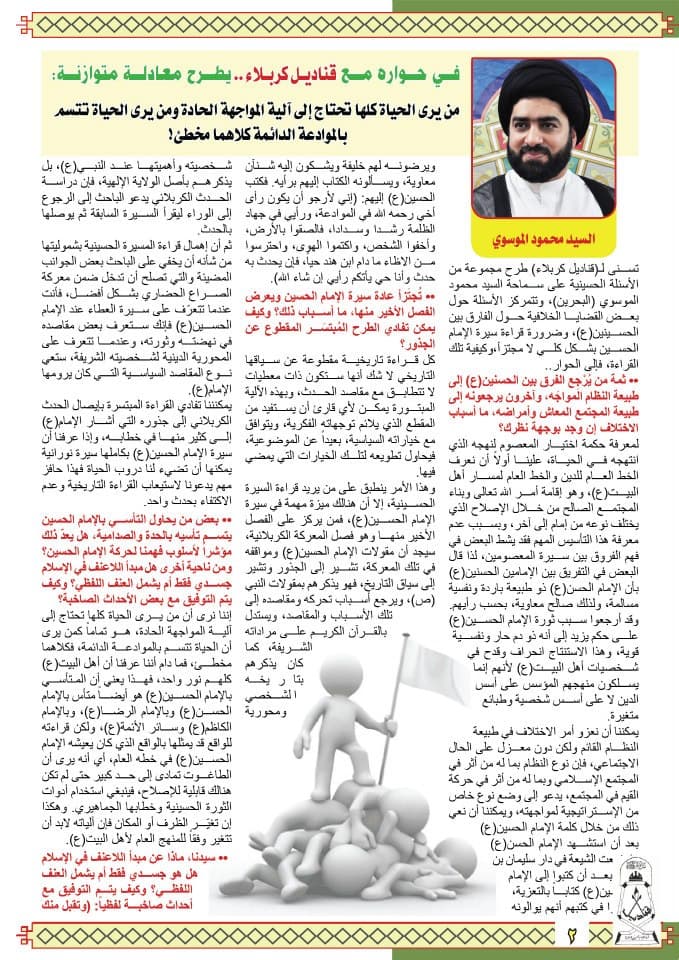
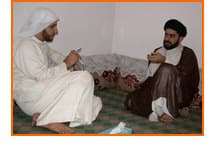
As part of the activities of the Hajj mission affiliated with the religious marjaʿ, His Eminence Grand Ayatollah Sayed Muhammad Taqi al-Modarresi (may his shadow endure), a cultural bulletin is issued by the mission's media committee. The bulletin conducted a meeting with Sayed Mahmoud Al-Mosawi about the Qurʾanic project and contemporary challenges, in his capacity as the general coordinator of the Holy Qurʾan Conference in Bahrain. In an interview with the general coordinator of the Holy Qurʾan Conference
.
The Qurʾanic Project .. and the Challenges of Contemporary Reality
Islamic work in contemporary reality today is surrounded by numerous challenges that confront it in creating a genuine Islamic presence that enjoys authenticity and is in harmony with changing circumstances. The density of the challenges increases if the starting point of the Islamic project is a Qurʾanic institution that tries to proceed from Qurʾanic visions and insights in order to program them within social – media – cultural channels, because of the decline of Qurʾanic concern among many pioneers of Islamic work to begin with, let alone others.
In this atmosphere, we encounter in the Gulf reality a number of Qurʾanic conferences that try to take the Qurʾan as an authority and a method, and thereby try to create a civilizational Qurʾanic awareness that takes the Umma by the hand forward.
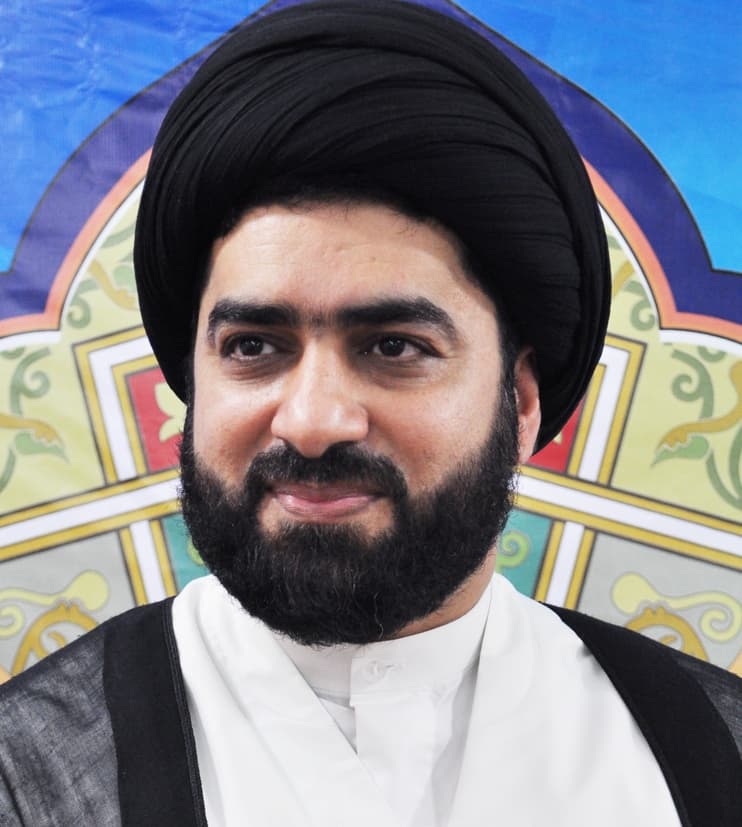
In this interview, the bulletin “al-Marjaʿ wa al-Umma” (The Marjaʿ and the Umma) meets the general coordinator of the Holy Qurʾan Conference, which is held by the representative office of the religious marjaʿ Grand Ayatollah Sayed Muhammad Taqi al-Modarresi in Bahrain, namely His Eminence Sayed Mahmoud Al-Mosawi.
What was the atmosphere in which the idea of holding your first Qurʾanic conference was created?
The idea of the annual Holy Qurʾan Conference in Bahrain took shape out of an atmosphere of awareness entrenched among a group of scholars and students of the religious sciences. This awareness is the result of the tributaries on which this group relies at the scholarly level, the most important and fundamental of which is the tributary of the marjaʿiyya, represented in the directives and concerns of His Eminence the religious marjaʿ Grand Ayatollah Sayed Muhammad Taqi al-Modarresi (may Allah preserve him).
For he has been distinguished by his concern for the Holy Qurʾan as an axis in the process of action, and an axis in the process of thinking at all its levels and varieties, proceeding from the guidance of the Ahl al-Bayt (a) and the insights of the Holy Qurʾan, which affirm that any progress, and any formulation of an idea, in which the Holy Qurʾan is not a fundamental tributary will not be genuine. Therefore the representative office of the Marjaʿ al-Modarresi in Bahrain adopted this project.
What are the goals that you hope for from holding this conference?
Through this Qurʾanic conference we intended that the Qurʾan be present in the awareness of the Umma, and present with society in its receptiveness to those theses, and that we truly be among those who are guided by the light of the Holy Qurʾan, which came as a cure for every malady. Through the conference's engagement with vital topics, it will become clear to people to what extent the Holy Qurʾan is intertwined with and concerned with the affairs of the Umma at all its levels.
Were there difficulties that you faced?
There is no doubt that any project will meet ordinary difficulties in its administrative dimension, but the resolve and insistence of those in charge of it eased all those difficulties and overcame them, praise be to Allah. We can record the most important procedural difficulty that faced the holding of the conference, which is that this project is taking place in a state that has its own circumstances, considerations and fluctuations. It had been planned to hold the conference about five months before it was actually held, and it was delayed because of those fluctuations on the part of the state's executive bodies, as its holding was obstructed at the venue where it had been agreed that it would take place, namely (Bayt al-Qurʾan) in Bahrain; we were surprised by the cancellation of the timing and its replacement with another event. Also, one of the key participating figures was prevented from entering the country through the airport.
We were also asked for an official license and similar complications. But although this incident delayed the conference by five months, those in charge of it insisted on holding it in its non-governmental form and as it was meant to proceed, and Allah the Exalted granted success in that.
Have you put in place a mechanism to follow up the work of implementing the conference's recommendations?
Since the beginning of the conference's founding, our concern has been to contribute to creating deliberative atmospheres centered on the Holy Qurʾan, so that a state of awareness of and concern for the Qurʾan forms in society, as being Allah's firm rope and the light that was sent down upon our master Muhammad (s). Perhaps we will go further than this goal in the coming conferences, since conferences and intellectual activities in general can be divided into two categories. The first: activities of a deliberative character, which in turn accumulate knowledge in society and thereby spread certain intellectual and cultural atmospheres so that society lives this coloring, and this in turn leads to general benefits through the atmosphere, and to specific benefits for those who follow them. As for the second category: these are activities of a practical character, that is, they have extensions and avenues along which the intellectual works proceed as recommendations or resolutions.
In this conference we are of the first category, and there is no doubt that this category can turn into the second in a process of developing its goals. So far we are at the beginnings of the experience, and we hope that it will proceed in a process of completion.
In the first session you raised the topic of reform and change; what is your conception of the nature of the topics planned to be adopted in the coming sessions?
The horizon on which the advisory committee that determines the conference's topics relies is the need that society has at its present time, and working to fill the deficiency in the existing areas of void. Since the void is wide, the committee works to determine the priorities that the country itself is living. This is what will be adopted in the second conference, Allah the Exalted willing.
We have two aspects in the conference: the aspect of Qurʾanic research, which the conference addresses through studies drawn from the Holy Qurʾan to treat the needs of reality; and another aspect, which is the aspect of discussing the Qurʾanic situation and reality and the ways of contributing to its development. This aspect is undertaken by the workshop, which in the first conference was devoted to discussing the Qurʾanic discourse directed at children by the societies and centers, and a number of them participated in it with an engagement that calls for developing and continuing it.
As one of those undertaking this Qurʾanic activity, what is your assessment of the level of engagement with the Holy Qurʾan?
In general, the engagement with Qurʾanic events is good, but this engagement is so far an engagement with the Qurʾan as form, as script and as outward appearances; it has not risen to genuine engagement with the serious Qurʾanic contents that treat the concerns of reality, and the idea of the conferences is a step in this direction.
What are the echoes that you have observed after your conference was held in its first edition?
Praise be to Allah, the echoes from the people and from the Qurʾanic centers and societies are very good, and they expressed this feeling to us. Also, the press covered it with news reports, and some of it with criticism, and this is in itself attention that we welcome for the sake of the completion of the experience.