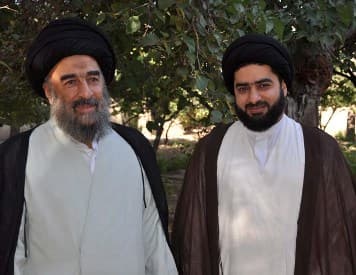
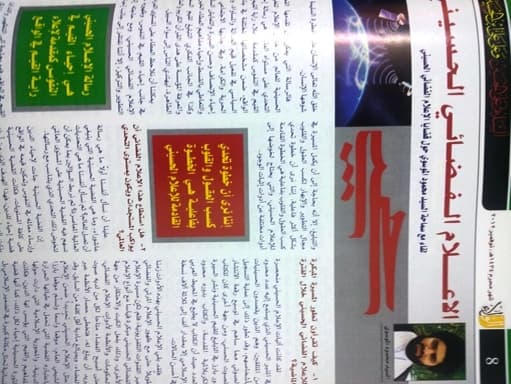
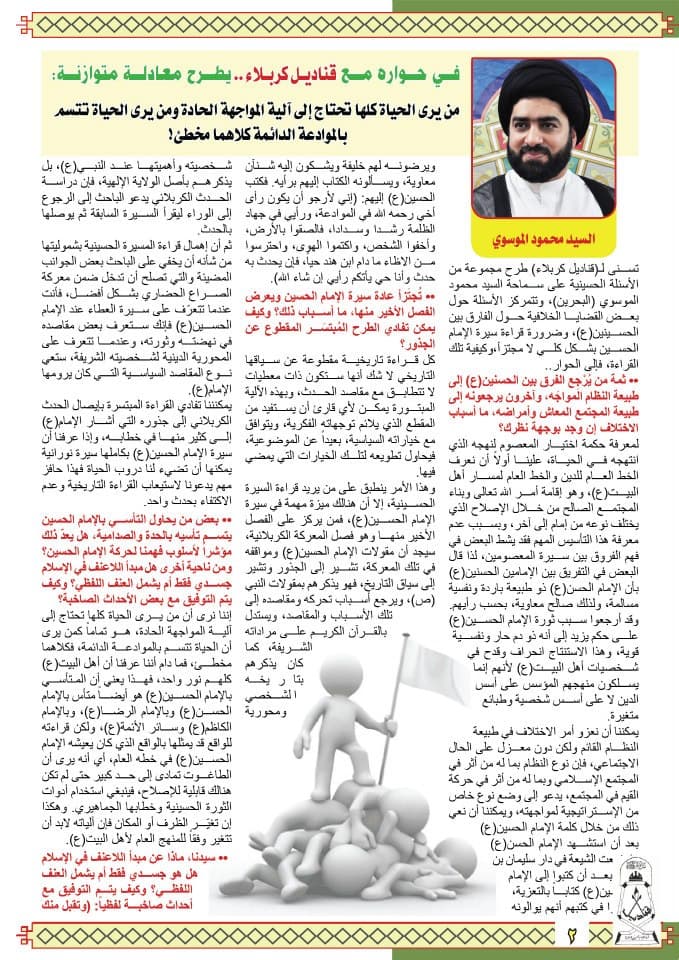
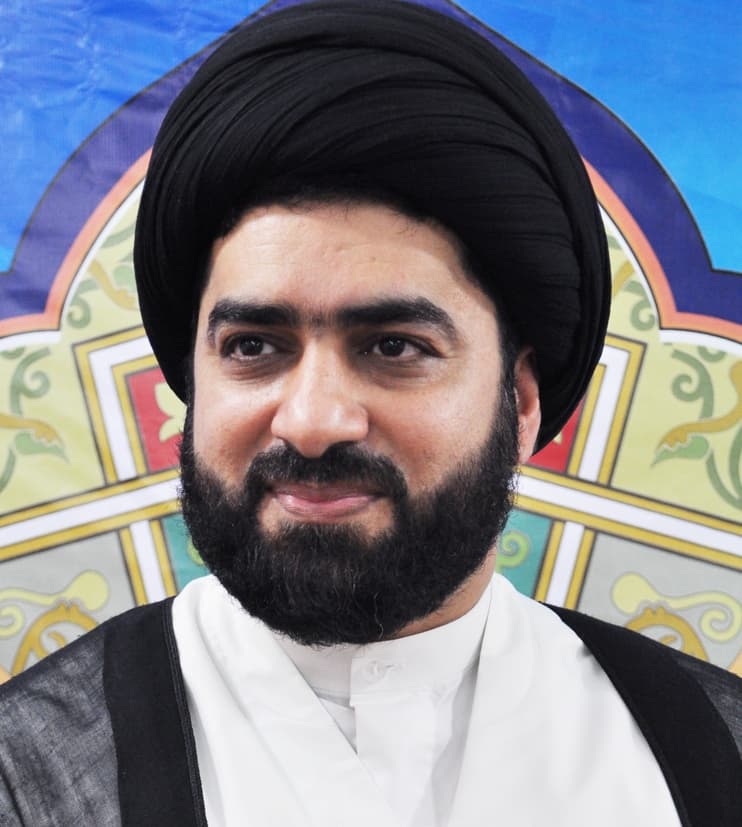
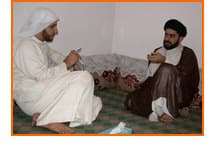
Al-Waqt newspaper, in its issue published on Thursday 7/6/2007 CE, published within the Profile feature a lengthy interview with Sayed Mahmoud Al-Mosawi and His Eminence Shaykh Habib al-Jamri about religious scholars and the Internet, and their personal experience in that; the interview was conducted by Husayn al-Mahrus. A Profile Interview..
From the “Cassette” Revolution to True Information
.
Al-Waqt - Husayn al-Mahrus:
The media available to the opponents of the Iranian Shah's regime were not many: cassette tapes, and badly printed leaflets which were read nonetheless. In 1978 the “cassette revolution” began, which Imam Khomeini led and broadcast from France into Iran.

At that time Iran was a hell boiling with currents whose revolution and boiling had no limit. The young men of what was then known as “the Islamic Front for the Liberation of Bahrain” had an extraordinary role in smuggling cassettes of Imam Khomeini's speeches into Iran. They were ideal for that because of the ease of their entry and the leniency in searching them. The Shah fell in 1979, and the revolution was named the “cassette revolution”. Revolutions exploited technology, and exploited different nationalities too. If a new revolution were to arise somewhere in the world today, it would not do without electronic blogs, “the bloggers”. Tapes of religious-political lectures spread in Bahrain: Hadi al-Modarresi, Muhammad Taqi al-Modarresi, Hasan al-Shirazi, ʿAbd al-Hamid al-Muhajir, Hasan al-Saffar, ʿAbd al-Hamid Kishk; anthems produced by the Islamic Front for the Liberation of Bahrain, an extension of “the Daʿwa Party”. Leaflets. Opposition cartoons.
Now.. after more than 25 [years] have passed since those means and technologies, and after the group has undergone transformations and divisions, and those who follow Sayed al-Shirazi in taqlīd have come to call themselves “the Risaliyyun current”, while the others will become “the—Allah willing—Risaliyyun current”, how has their course with technology turned out? Especially the computer and its accessories? Is it true that it is the current that uses this technology the most? To what does that go back, if the matter is true? Has it opened them up to the world? Have they opened themselves up to it? Have computers become their majlises? The questioner used to come to the shaykh in his majlis and put questions to him, and he would answer him. Of course, I do not forget the late Shaykh Sulayman al-Madani and his story with technology, with the Internet and with the computer.
Profile met Sayed Mahmoud Sayed ʿAdnan Al-Mosawi and Shaykh Habib Abu Hamza on this topic:

* Profile: Sayed Al-Mosawi, your relationship with this technology is not recent, and your website is one that you manage and whose information you update yourself. Shaykh Abu Hamza, it seems to me that you have a story with the flash memory, and that when you moved from an ordinary phone to a very advanced one, a problem happened to you.
Al-Mosawi.. when did you buy the flash memory?
- Al-Mosawi: About a year ago; of course it is not the only one, for I have ruined more than one
* Profile: How many do you have?
- The Sayed: Two, in addition to the one I carry..this one.
* Profile: Are you the one who buys them?
- The Sayed: Certainly
* Profile: Shaykh Habib Abu Hamza, do you have a memory flash?
- Shaykh Abu Hamza: Yes.. my wife bought it recently; she beat me to buying the memory flash, so she is the one who brought me into the whole world of the memory flash.
* Profile: You let women bring you into the world of technology..
- Abu Hamza: That is a good thing (he laughs)
* Profile: Does that not detract from being a shaykh, or from manhood?
- Abu Hamza: In our relationship with women, we often lead them properly, but we leave them room to lead us. I preceded her into the world of the computer and the Internet, for she was illiterate in that field, but I used to tell her that if she reached this world I would lose the device, and indeed that happened.
* Profile: How did you lose the device?

- Abu Hamza: I lost the time available to me for using the device, and I taught my daughters on it too. Suddenly I discovered that I had 3 women in the house (my two daughters and my wife) racing toward technology, and they excelled at the same time as they deprived me of it (deprived me of the device), and as you know my time is limited. Now we have two devices at home and one Internet line.
? Profile: I want to raise the point of the relationship of religious scholars, the relationship of the Islamic movement in Bahrain with the Islamic revolution in Iran. The cassette and the leaflets were two means of spreading the revolution, and there was no third technology; nevertheless they were used very intensively, especially the leaflets, which played a much greater role than the cassette.
- Al-Mosawi: The use of the fax too..
* Profile: Yes, the use of the fax was greater in the period of the nineties. That group has had a relationship with technology for a long time: now, is the Risaliyyun current really the greatest user of this technology now?
- Al-Mosawi: The beginning of the Risaliyyun line's entry into technology stems from the basis of its view of mechanisms (all mechanisms), meaning that religion is a religion of aims and ends, not of means and formalities. There are goals, there are ends, which are what is sacred; consequently, anything that leads to this, as long as it is within a sound framework, it is natural that they embrace it. So the device that speeds up information, the device that transmits information—we will have the result that we transmit information of the Mission, information that we consider true, to other domains, and so the process will be faster.
I recall a story about His Eminence the Marjaʿ Sayed Muhammad Taqi al-Modarresi, which he told in his own words during Hajj: when they were in Iran in the days of the revolution, the first movement to bring a fax machine was the Risaliyyun movement. His Eminence says: We heard of the fax only in the news; we tried and tried until we brought it, so much so that the religious milieu was astonished (a device that transmits paper from one country to another!!). When the Internet first appeared, too, there was a rapid take-off, from the websites of the marjaʿiyyas to the institutions, for the existing institutions were many, and every institution in any country came to include among its media activities the opening of a website on the Internet, presenting itself as a portal and a window and as a service to others. So the Internet came and broadened the horizons so that the aim, or the sound idea, so to speak, might arrive correctly, and it has spread up to this day. So if the Hawza has entered the technological framework, whether the computer [or] the lessons—for we had two technical rooms in the Hawza in Syria: a room dedicated to lectures and speeches, and a room dedicated to lessons, which began with tapes and ended with the computer, to compact discs, to the Internet—so it is always ahead and quick to use it. Others also used it, and we do not deny that, but I am speaking about this reality. So naturally, the religious scholar who graduates from this Hawza will have lived in that environment (the environment of technology), and he will move to it quickly and easily, become familiar with it, live in it, and also give through it.
* Profile: You spoke of true information; is there information that is “not true”?
- Al-Mosawi: The true idea, or in other words the sound idea: we take the Qurʾanic idea as a genuine and sound idea, and consequently we put it forward to others as a true idea, given that its source is the Holy Qurʾan, or, in turn, the Sunna and the Ahl al-Bayt. This is our expression for the true idea, which we believe to be sound by our disciplined ijtihad within the general constants among Muslims.
* Profile: Does this technology transmit an idea or information?
- Al-Mosawi: It transmits an idea, and information too.
-Abu Hamza: There is true information and false information, if we define the two terms true and false. We live in a world of illusions and lies, and there is no difference between illusions and lies; I may have information that I broadcast while it is nothing but an illusion.
* Profile: So true information is truthful information?
- Abu Hamza: We mean by it correct information, for there is correct information and lying information, and the generality of people are in a sea of lies.
* Profile: What do we do with information that after a while turns into a lie?
- Abu Hamza: We abandon it immediately for the correct information, of course within the limits of cultural matters and not certainties.
* Profile: Do you have an idea, Your Eminence Sayed, of the number of websites of the Risaliyyun current now?
- The Sayed: Difficult.
* Profile: Sayed Mahmoud, do you think the Bahraini hawzas have surpassed other hawzas abroad, such as the hawzas of Najaf and the hawzas of Qom, in technology?
- Al-Mosawi: No.. not at all; they are at the tail end of the caravan. Let us first verify that they have entered that world. The uses we see in the hawzas of Bahrain are uses for administration, tables.. names, a very simple and elementary use. The use of the hawzas abroad is very advanced because it began a long time ago; computer teaching exists in many hawzas, so the student himself learns how to deal with the device. Another thing is the establishment of committees, of scholars and non-scholars, that run websites. For example, if you go to one of the hawzas abroad, you will see 3- 4 rooms (the room of such-and-such network, and the room of such-and-such network.. etc., each of them an independent network unrelated to the others, and the Hawza is the one that sponsors them. But in Bahrain there is no such thing. There are attempts to have websites for the hawzas, but not with the same strength; the existing websites are for the offices of the shaykhs, websites for personalities only, and they are the ones that have succeeded and offered something to people.
- Abu Hamza: The Risaliyyun current: there is a very important idea behind the joining of many young men in their early days—the early days of the Risaliyyun movement—I believe it is the idea of the outstanding man of religion who fills us with liberation, excellence and aspiration, so to speak. Consequently we were drawn to that current, or to this school, because we found in the man of religion, whether al-Shirazi or al-Modarresi, someone who excels in many matters, so that we can identify with him. For example, in Bahrain Sayed Hadi al-Modarresi influenced us, for he was ahead of his generation. I met him two years ago in Syria; I saw him talking about the Dubai technology market and analyzing it, and talking about the latest international innovations that come down into the Dubai market. Then he turned to the difference between Dubai and Bahrain, and how Bahrain was economically superior to Dubai, and how Dubai has now become. .etc. He also had a flash memory, in addition to (MB3), on which he follows Arabic and English lectures. He suggested that I acquire the “Ustadh CD”, as he put it. The mentality we were brought up on is assimilating these mechanisms. The Risaliyyun movement's orientation toward the Internet, toward websites, was pioneering for two reasons: the first is what His Eminence the Sayed kindly mentioned, which is spreading the idea, as they believe it, in record time. And the second is the sense of being wronged, whether real or imagined. Ten years ago someone asked me: Why have you Shirazis invaded the Internet with your websites? I said to him: So that we may demolish the wall of injustice and lies that has been built around us. Also the satellite situation: now the Risaliyyun current has become the gateway that accommodates all the other currents, through it, for broadcasting.
* Profile: Which hawzas have websites?
- Al-Mosawi: In Bahrain there are 10 hawzas, not one of which has a website. There is a possibility that the Khatam al-Anbiyaʾ Hawza of Sayed Shaykh ʿAbd al-ʿAzim al-Bahrani [has one]; do not be surprised if they are, for they are the forerunners.
- Abu Hamza: The Iranians and the Iraqis have excelled in this. And when the state of insecurity in Iraq lifts, the world will be surprised that many people have put themselves in order. The hawzas will become universities and institutes equipped with this technology.
* Profile: What is Al-Mosawi's story with the Internet?
- Al-Mosawi: Before the Internet entered Bahrain, I was personally following the features published in magazines about the Internet. This following acquainted us with the Internet and with the great service it offers in the field of human communication in general, and also in spreading culture, and also in learning and cultural exchange with others. I followed many discussions between foreign companies and Batelco about introducing the Internet. At that time I wrote an article in the London-based al-Majalla magazine, “The Arab Project for the Internet”. What does this article talk about? That the Arab states ought not to delay introducing the Internet service any longer, as there were many apprehensions about the dangers of the Internet, all of them security delusions.
As soon as the service came in, I went with a friend to an Internet café, and it was the first café opened for the Internet, in Salmaniya. We went straight there, and I stood beside the device not knowing what to do, so we asked the Asian man in charge of the shop to guide us. He told us where to write the address, and we indicated that we had no addresses! Then we asked him to open for us the site (Ayna), which is a search engine from before Google.
* Profile: Frankly, our Sayed.. what was the first thing you searched for on the Internet?
- Al-Mosawi: Imam al-Shirazi, because we knew that the marjaʿiyya of al-Shirazi had a website.
* Profile: Strange. Usually, in the first days, those searching the Internet open pornographic sex sites.. ? (By “strange” the journalist meant that young men usually enter these sites).
- Al-Mosawi: May Allah guide them. . The funny thing is that we wrote the word (al-Shirazi) in the search engine and suddenly a set of options appeared to us; the first site that appeared to us was for acquaintance between boys and girls, and worse still, pictures of girls appeared to us, so we said: Is that the beginning?. .Pictures of girls, no less! Because the search gives you more than one result for the search and you have to choose.
* Profile: Who was with you?
- Al-Mosawi: Shaykh Muhammad Hasan, who is one year younger than me. We moved on to another, changing the letters of the word, until we reached what we wanted. The matter developed until the service came into the home by the first method (dial-up), and it was slow. By the way, my email address has not changed since that day, on “Hotmail”. After that came the idea of creating a website, and it was the idea of one of the brothers; he said: You, after all, have writings; why don't you launch a website? I agreed, but on condition that I too learn, and indeed we sat and learned the Hotmail language (through FrontPage) on the old system, and it was something tiring, unlike the situation now, since you had to put in a long, broad “code” with complete precision. We also used to rely on the sites that give free space, and the name of the site, as I recall, was (Cross One). We started, and there were no pictures on the site; I did not even put my own picture on it.
* Profile: Why? A religious issue?
- Al-Mosawi: No.
* Profile: Things are different now, for your pictures are everywhere on your website. What's the story?
- Al-Mosawi: Because rights have come to be usurped: there is a person called Mahmoud Al-Mosawi, so when I write a book it is attributed to the other, and when I write a certain article it is attributed to another person.
* Profile: It is the same with me, for there are five people called: Husayn al-Mahrus.
- Al-Mosawi: I created my website in the mid-nineties. It became a window for us onto society, a very large window. We have a special section on the Bani Jamra network in which we answer inquiries, or we answer questions through the website itself; there are questions we can publish and others we cannot because of their private nature.
* Profile: So the idea has changed and shifted from the scholar whom people visit in his majlis, receiving questions, whereas now it is enough for him to sit at his private desk and receive the questions?
- Al-Mosawi: 5 people visit the scholar in his majlis, while there are 500 people whom shyness prevents from visiting the majlis. Through the website we have been able to resolve many family problems between husband and wife
* Profile: Did anyone help you in managing the website?
- Al-Mosawi: I am the one who manages the website and answers all the issues and inquiries, but in matters of design and technology I received help from some friends. We keep away from technical matters that keep us away from reading and from the basic subject for which we created the website; we did not create the website in order to work on it technically, but rather to offer an idea and help to others.
* Profile: Why don't you answer Shaykh Habib's question, which is: why did you not involve your wife in the website?
- Al-Mosawi: My wife is an indirect logistical supporter. I personally try to keep away from technical issues, so how would I bring in others? The wife, after all, has her tasks in the home.
- Abu Hamza: You mean she might bring you water while you are working at home..!
- Al-Mosawi: Possibly (he laughs). There are stories, which I will not mention, recounted in the Bani Jamra forum about some cases that arrived via the Internet; in particular there is a long and very sensitive story. It is a case of a mistaken divorce, where the woman married while she had not been divorced, and it became a thorny problem. You will see how technology worked in this story, and you will also see my wife's role in this story.
* Profile: How much time does following up the website take you? And do you follow it daily?
- Al-Mosawi: Yes, daily, especially the messages, for my email is always open, especially since I use (Gmail); previously I used (Incredimail), a program similar to the Gmail service
* Profile: Do you have your own device?
- Al-Mosawi: I have a general device and a private device (a laptop)
* Profile: Is the laptop on continuously, or only if you are present?
- Al-Mosawi: Only if I am present
* Profile: Does anyone look at your email?
- Al-Mosawi: The stories—my wife may look at them, unless there are names and private matters, in which case no one looks at them; the cases that reach the website, no one looks at.
* Profile: Do you go on the website at night?
- Al-Mosawi: During holiday periods.
* Profile: Does that time crowd out devotional matters for you: prayer, and so on?
- Al-Mosawi: This time that I give it is the time for reading, research and answers. I write on the device directly without using paper, apart from scraps; I am not sitting for the Internet but for the device
* Profile: If you were sitting and the time of prayer came in, would you break off those things? Or would you do as is narrated of one of the shaykhs who are attached to the computer?
- Al-Mosawi: Let me give you an idea about the intrinsic effects of our conduct. Delaying the prayer has intrinsic effects, even if they are in the Hereafter; if you delay the prayer for the sake of a certain work, blessing is removed from that work.
* Profile: So you break off your thoughts and your writing at the time of prayer?
- Al-Mosawi: Without doubt. The pleasure of writing and all its enjoyment melt away before the performance of obligatory duties in particular; there is no argument about it. Even if someone is with me in a conversation on Messenger, and even if he is a faraway person, I excuse myself from him.
* Profile: What if Sayed Hadi al-Modarresi were with you on Messenger?
- Al-Mosawi: Even if it were him. I would tell him so.
* Profile: Abu Hamza, you told me that your wife and daughters got ahead of you in technology?
- Abu Hamza: Before the home, I want to say that the man of religion has three points in his relationship with electronic technology: media and advertising publication; calling to the idea, institution or personality to which he belongs; and finally addressing people's issues and problems—and Sayed Al-Mosawi has given us a model of that
I want to comment on what the Sayed has related: since I was close to the Sayed and saw how he took up the subject of technology in that way, a feeling of fear came over me; I feared that this side would take me, and I found by experience that cyberspace takes you away from people, and my appetite for people is greater.
* Profile: Can we count the Internet as a majlis?
- Al-Mosawi: It can be a virtual majlis, but the people it contains are real.
- Abu Hamza: At the time when Sayed Mahmoud was in Salmaniya—where the Internet café was—I was in Jaw prison, and so we heard about the Internet while we were in Jaw prison and could not fully grasp it. In fact, the computer rose to prominence from the end of 81-94; many matters we did not live through at their launch. Learning the computer before the Internet was beyond us, because it falls within the practical domain. In prison a memo about the computer reached us, but no one could apply it, so a feeling came over us that we were, in the end, illiterate in the computer, not the Internet. This feeling kept pursuing me when I left prison and worked, so I realized that I had to learn the computer, and indeed that happened.
* Profile: In what year did you get out of prison?
- Abu Hamza: I got out in the year 1994.
* Profile: And where did you see the computer?
- Shaykh Abu Hamza: There is a possibility that I saw it at some friends' places, and I saw it at Al-Mosawi's house, and this made computer illiteracy pursue me in the end, until, while I was working in one of the institutions, I and some friends who were illiterate in the computer decided to learn it. So we went to the al-Muʿallim Institute in the Jidhafs area, in the al-Hashimi Complex, to eradicate our computer illiteracy. The computer imposed itself, but I did not enter into it strongly; I remained on the margin of the subject, partly because I used to convince myself that I did not have the time. For the popular state and the people are the air that the religious scholar breathes and the sea in which he swims. Some religious scholars have been taken by this virtual world, so to speak, and have weakened popularly; but where others have popular roles, that has no effect. There must be a state of balance: at the time when some set out into the virtual world and actually perform a mission in this world, there must be compensation on the other side
* Profile: Let us ask Sayed Mahmoud!
- Al-Mosawi: Direct social work—I mean, it makes no difference whether it is a matter of concern with technology or concern with research. For example, we now have a research task that of course demands time of us, and this is bound to affect any man of religion who has a research task that will take time from him. We have just now finished the Holy Qurʾan Conference at the level of Bahrain and Saudi Arabia, and it was a conference in direct contact with people, so it was naturally affected.
I want to add something, regarding when you asked about its effect on the devotional matter or not: from the beginning of my entry into the field of the Internet and the computer in general, I have always had the idea of self-accounting, especially in this thing. But where is the scale? The scale I set for myself is “the product”: what is the production that you have produced in your contact with this device? If the count of the product is zero—for some people are carried away by time, and you come to ask him what he has produced, and he answers: Knowledge! Fine, knowledge of what? What is the news of the world and the globe? He does not know. What are the new concepts? He does not know. All they know is matters of chatting and other unbeneficial things. Praise be to Allah, we have been able to deal with the press and with printing houses outside Bahrain, and all of it through the Internet.
* Profile: How many people's addresses do you have on Messenger?
- Al-Mosawi: Around ten or fifteen people.
* Profile: So you have no popularity?
- Al-Mosawi: Basically I only open it rarely, for it wastes time in chats and greetings, and I do not want to use it for such things.
- Abu Hamza: I still prefer meeting face to face over electronic acquaintance.
* Profile: Do you have a problem with technology? Do you have some sensitivity toward it? From the beginning you have been putting it aside?
- Abu Hamza: Yes, I have a sensitivity. I assume that the time I spend with people face to face has a much deeper effect.
* Profile: But the number will be limited, and the place confined to the local.
Abu Hamza: Indeed.
__________________________
Links to the Profile feature
http://www.alwaqt.com/art.php?aid=58828
http://www.alwaqt.com/art.php?aid=58827
The photographed pages
http://www.alwaqt.com/pdf-browse-files.php?pid=17883&i=472&f=alwaqt&p=11
http://www.alwaqt.com/pdf-browse-files.php?pid=17880&i=472&f=alwaqt&p=12
http://www.alwaqt.com/pdf-browse-files.php?pid=17881&i=472&f=alwaqt&p=13
http://www.alwaqt.com/pdf-browse-files.php?pid=17882&i=472&f=alwaqt&p=14