Under the title ((The Values of Reform and Change in the Holy Qurʾan)), the project of the (First Holy Qurʾan Conference) was launched with a distinctive presentation and with great support from the marjaʿiyya of Grand Ayatollah Sayed Muhammad Taqi al-Modarresi, may his shadow endure, and under the patronage of His Eminence's representative office in Bahrain. Shahrazad Hall on Budaiya Street witnessed a distinguished attendance from early morning, to which groups of the educated elite and scholars, women and men, came from Bahrain and the Eastern Province, numbering more than 250 persons, among them rights, political and official figures.
.
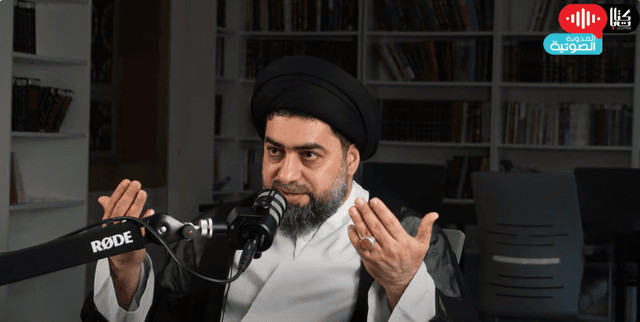
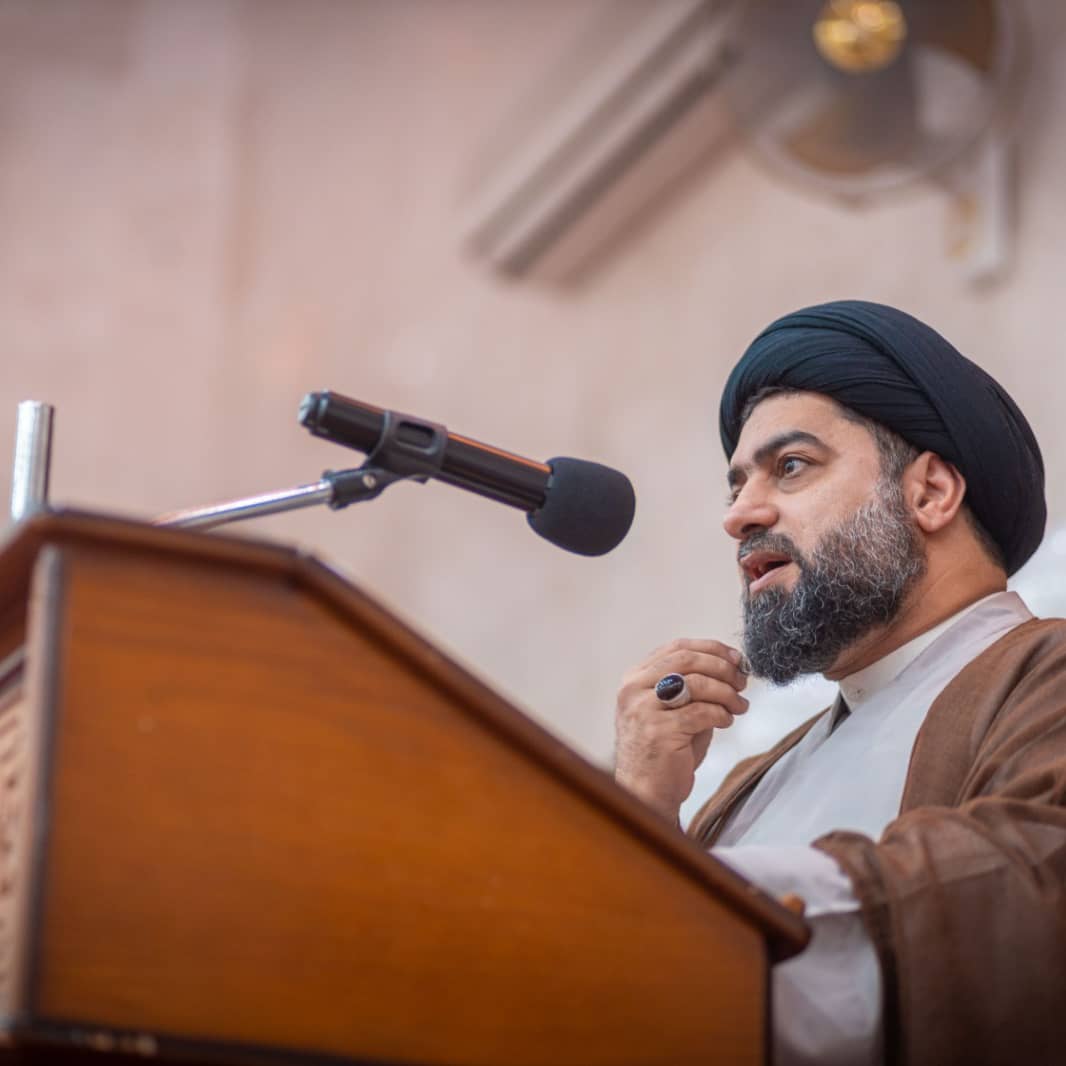
The conference began its first day at 9:30 with blessed verses of the Wise Reminder; then the director of the conference, His Eminence Sayed Mahmoud Al-Mosawi, presented the perspectives of the Holy Qurʾan Conference project, in which it was stated:
The Perspectives of the Conference:
1- The Holy Qurʾan is the starting point and the beginning of the civilizational foundations that form the features of the advanced Islamic society, because of the constancy that characterizes the Holy Qurʾan in the principles of the system of values, its integration in the branches of legal legislation, and its comprehensiveness of all the paths that support the progress of humanity in forming its civilizational life.
2- Qurʾanic research needs further effort, whether on the level of method, the principles of thinking and the ways of deduction, or on the level of deriving the remedy for contemporary problems and the new challenges to Islamic thought.
3- Contributing, through the Qurʾanic method, to solving a set of intellectual, moral and administrative crises.
4- The Holy Qurʾan is the best table around which one can sit, for the meeting of people of thought and reflection in order to participate in crystallizing new contributions of a shared divine light among them.
5- The project of the (Holy Qurʾan Conference) seeks to strengthen Qurʾanic fieldwork in society, and to contribute to its maturing and completeness, in order to spread and generalize Qurʾanic culture in the Islamic society.

The Opening of the Conference:
At 9:55 His Eminence Shaykh Majid al-Majid delivered an opening speech for the conference, in which he welcomed those present. His Eminence explained the marjaʿ al-Modarresi's care for the Qurʾan and for Qurʾanic affairs, and set out in an elegant presentation the methodology of the marjaʿ al-Modarresi, which is based on contemplation of the Holy Qurʾan in order to understand the spirit of the Qurʾan and to contribute to forming the human personality. This call is guaranteed by the Qurʾan, and it is contrary to exegesis by personal opinion, which means inventing a new meaning from the individual's own notions.
His Eminence the marjaʿ al-Modarresi has attended to the Qurʾan since the outset of his life; this is shown by his books, filled with the insights of revelation, and his distinguished exegesis (Min Huda al-Qurʾan).
The First Paper:
Dr. Nasir Hamid al-Mubarak
(The Ethics of Reform and Change).
Under this title Dr. Nasir al-Mubarak treated the concept of reform and change
and he mentioned three levels of change:
1-Changing feelings or an idea.
2-Changing individual behavior.
3-Changing a wilayah or a creed.
Then he took up the ancient experiences of reform and change through the ancient ethical approaches such as Aristotle and Plato, as well as the heavenly messages and the Holy Qurʾan, which came in the Qurʾan in two types:
1-Changing the laws of Allah and moving contrary to the will and volition of Allah, and this is a blameworthy change.
2-Changing the reality that has deviated from the will and volition of Allah, and this is a praiseworthy change.
Then he showed that change is a neutral concept subject to the five legal rulings: obligatory (wājib), forbidden (ḥarām), recommended (mustaḥabb), disliked (makrūh), and permissible.
He took up three main axes in the study:
The First Axis:
The ethics of change: meaning, is the process of change itself consistent with morals? For change presupposes from the outset the error of the reality to be changed and then reformed, and this process of reform and change entails guardianship and wilayah over human beings. No intellectual systems differ about the morality of change and reform, but they differ in its concept.
He mentioned several points:
-Change in the Qurʾan derives its legitimacy from the divine wilayah over human beings.
Thus the right to change and reform is acquired from heaven.
-The Qurʾan issues a call to change and does not change people by force; rather, it is a call to change with wisdom and good advice.
-All the threats in the Qurʾan are directed at those who want to change the righteous reality after reform has been established.
The Second Axis: The ethics of change: that is, the moral goal of change.
The Third Axis: The ethics of change: that is, the moral controls of change, which is the harmony between the goal and the means; for the goal is a claim and the means is evidence of its truthfulness.

The Second Paper:
His Eminence ʿAllama Shaykh Muhammad ʿAli al-Mahfuz
(Priorities on the Path of Reform and Change)
Introduction:
1-Making the Qurʾan the judge is more conducive to change and righteousness.
2-The Qurʾan gave attention to change and reform and regarded it as a responsibility upon the individual and society.
3-The way of life is change, for life is in constant motion with the changing of time, and this is an intuitive truth.
4-Among the most important basic goals of the Qurʾan are the education of the human being and his reform.
Means of Change:
1-The call to respond to Allah and to the Messenger (s), and that is through stirring minds.
2-Focusing on the human being, for he is the one addressed by the discourse of the prophets and messengers.
3-The Holy Qurʾan focuses on changing the human being from within.
4-The struggle against the self, its refinement and its reform, the Holy Qurʾan regards as the most important on the level of reform.
5-Political reform is built on the basis of the truth and of organizing society on this basis.
Interventions:
Sayed Jaʿfar al-ʿAlawi:
-Reform is rational and innate, and likewise its priorities are subject to the rule of the important and the more important.
-Society's deficiencies must be identified by subjecting society to measurement and comparison with the model Islamic society.
Shaykh Salih al-Jamri: (President of al-Nabaʾ al-ʿAzim Society)
Change is not a Qurʾanic term equivalent to reform, for it was used only in negative meanings; therefore it would have been more fitting for the title to be (The Values of Reform and Rectification...).
The Break:
It included performing the noon and afternoon prayers in congregation; then those present had lunch.
At 2:15 the conference resumed with a fragrant recitation of the Holy Qurʾan.

The Third Paper:
His Eminence ʿAllama Shaykh Faysal al-ʿAwami
(Reform and Change between the Insights of Revelation and Human Conceptions)
He presented his thesis under the title (The Spiritual Intellect and the Intelligent Spirit
A Comparison between Two Approaches), that is, the approach of the spirit and the approach of the intellect.
He treated the terms intellect and heart conceptually and established many points and conclusions in this direction through an inductive survey of the verses of the Holy Qurʾan on this same subject, among them:
- Parallel to the human approach that calls for abstract rationality comes the Qurʾanic approach, emphasizing the necessity of pairing intellect and spirit, and in this lie the most prominent points of divergence between the two approaches on the level of reform.
- When we speak of the intellect here, we mean the faculty that performs the task of thinking, making concepts and analyzing meanings, exactly in the form that Imam ʿAli (a) drew in his saying: (The intellect is the root of knowledge and the summoner of understanding).
- As for the spirit, we mean by it the inner conscience of the human being, the place and repository of faith.
- Between the intellect and the spirit there is an intimate, organic and strategic relationship.
Thus the process of rising and reform is based on the approach of the spiritual intellect and the intelligent spirit, and it is the starting point for any successful and complete reform process.
The Fourth Paper:
His Eminence Shaykh Zakariyya al-Dawud
(A Qurʾanic Exemplar in Reform and Change – Prophet Muhammad (s) as an Example)
1-The Holy Qurʾan forms the best of exemplars and presents important historical models.
2- It is very important that we understand the Qurʾanic method through its representatives, who applied it, grasped it and understood its depths, its outward and its inward aspects; and none claims this complete knowledge of the Holy Qurʾan other than the Pure Progeny, on whose authority and from whom Allah and His Messenger commanded taking.
3- The most important thing distinguishing the Qurʾanic outlook of the Ahl al-Bayt (a) is the necessity of making the Qurʾan a way of thinking, civilizational morals and constructive insights.
4- The Holy Qurʾan holds that the matter of society's development, advancement, balance and survival depends on the question of the continuity of the reform process.
The Most Noble Messenger Muhammad (s) represents the most prominent and most perfect example in reform and change, through his possession of all the tools of the process of reform and change and his complete awareness of those Qurʾanic starting points.
The method of reform in the Qurʾanic vision rests on several starting points, which are:
1-Faith in Allah and His messages.
2-Godwariness and fear of Allah.
3-Repentance and turning to Allah.
4-Vicegerency on the earth.
Through these important texts we can know that the most important themes of reform and change for the Messenger of Allah (s) are:
1-Religious change.
2-Social reform.
3-Political reform.
4-Moral and legal reform.
5-Intellectual and cultural change
Religious Change: The Method and the Approaches
We summarize the features of that method in the following points:
1- Using the law of religious adjustment
The most important pillars of the law of adjustment consist of two things, which are:
The first pillar: attraction and drawing in.
The second pillar: repelling and expulsion.
3-Gentleness, peace and peacefulness.
4-Dialogue and the exchange of knowledge.
5-Gradualness in knowledge and in religious duties.
6-Drawing in the youth and the deprived.
(Some of those in attendance)
Interventions:
Sayed Jaʿfar al-ʿAlawi:
A comment on Shaykh al-ʿAwami: reducing the discussion to the two approaches is faulty, since neither camp kept straight on a single method, or they did not come together.
-The intellect is wholly a positive meaning, and what is other than it is not counted as intellect; rather, it is devilry.
Shaykh Salih al-Jamri:
During the process of reform, society must be united, not divided.
And any sound reform project must be encouraged
and a steady methodology followed.
(Some of those in attendance: the civil-society and official figures)
The Second Day
Report on the Workshop Program of the Holy Qurʾan Conference (Bahrain) 1427 AH
On the sidelines of the Holy Qurʾan Conference, which was initiated by the representative office of Grand Ayatollah Sayed Muhammad Taqi al-Modarresi, a workshop was held on the second day of the conference, on the morning of Friday 12/5/2006 CE, in Shahrazad Hall, in which many civil institutions, societies and figures — interested in spreading Qurʾanic culture — from within Bahrain, Saudi Arabia and Kuwait participated. Papers were presented in this workshop by each of:
1-Al-Dhikr al-Hakim Society (Bahrain).
2-Al-Nabaʾ al-ʿAzim Society (Bahrain).
3-Anwar al-Qurʾan Committee (Saudi Arabia).
4-The Holy Qurʾan Forum (Saudi Arabia).
5-Al-Qurʾan Nur Foundation (Saudi Arabia).
6-And figures specialized and interested in the affairs of the Holy Qurʾan.
The workshop bore the title:
((Our Qurʾanic Discourse Directed at Children and the Ways of Developing It))
It included four axes:
1-The structures and characteristics of the directed discourse.
2-The differentiation and complementarity between the method of teaching memorization and the method of teaching comprehension.
3-Ways of developing the conveying of Qurʾanic culture to children (ideas and proposals).
4-Practical experiences in Qurʾanic work directed at children.
The workshop was moderated by Ustadh Radi al-ʿUsayf (Saudi Arabia)
After breakfast, the segment of introductions among the societies and figures began; then, at the start of the workshop, its first activity began with each participating society, center or foundation briefly introducing itself.
Introduction of al-Dhikr al-Hakim Society (Bahrain):
Speaker: Ustadh ʿAbd Allah Mansur.
1-Al-Dhikr al-Hakim Society was founded at the end of 2002 as a society specialized in the Qurʾan, and it was officially registered.
2-The project's beginning was merely teaching the prayer; then it attended to teaching the reading of the Qurʾan under the name (al-Dhikr al-Hakim Committee).
3-The al-Dhikr al-Hakim Competition was launched, which met with wide acceptance from the public, and the committee continued opening teaching circles and various activities and competitions.
4-Al-Dhikr al-Hakim Society looks forward to forming a Qurʾanic league with the active institutions and to being one of the links of communication.
Introduction of al-Nabaʾ al-ʿAzim Society:
Speaker: Shaykh Habib al-Jamri
1-The origin of the founding of al-Nabaʾ al-ʿAzim Society came through the concern of His Eminence Shaykh Salih al-Jamri. The society was something like a committee that developed and became a center for memorizing the Holy Qurʾan; then a formal request was submitted for its registration, and the existence of al-Dhikr al-Hakim Society encouraged that. Despite all the difficulties and obstacles, the society saw the light and was officially registered after strenuous effort.
2-The goals of the society:
-Spreading Qurʾanic culture in society at large.
-Linking the Qurʾan with its legitimate representatives, who are the Ahl al-Bayt (a).
-Graduating generations who read the Qurʾan and memorize it.
3-The society has worked to establish several centers for memorizing the Holy Qurʾan, three of them in the village of Bani Jamra and the village of (al-Qurayya), for boys and girls.
4-The society keeps before its eyes the focus on establishing Qurʾanic media and spreading Qurʾanic culture.
Anwar al-Qurʾan al-Karim Committee:
Speaker: Husayn Munayyan
1-The committee was founded in the year 1421 AH.
2-Its mission is serving the Holy Qurʾan, through graduating a promising Qurʾanic generation.
3-Spreading the culture of the Qurʾan in society, attending to it and encouraging researchers in it.
4-Raising a generation on Qurʾanic culture is among the most important goals of the committee.
5-The committee has participated in many Qurʾanic gatherings, activities and competitions.
6-It has worked in teaching the rules of tajwid and recitation.
7-It has held and participated in many workshops with centers, institutions and figures interested in the Holy Qurʾan.
Introduction: al-Qurʾan Nur Foundation
Speaker: Ustadh Hasan Al Hamadah
1-It was founded in the year 1421 AH.
2-It worked as a subcommittee in some civil institutions.
3-Al-Qurʾan Nur Foundation is now an attempt at complementarity with the other institutions, and it has attended to Qurʾanic intellectual and scholarly production.
4-The foundation focuses on the necessity of spreading Qurʾanic awareness for the individual and society.
5-It is currently seeking to establish a Qurʾanic school project.
6-It has issued many studies and researches.
7-It has issued the al-Qurʾan Nur Book series.
8-It has issued the Qurʾanic Curricula series.
9-It has participated and participates on the Al-Anwar satellite channel through the program (Nur al-Nur).
Introduction of the Holy Qurʾan Forum:
Speaker: ʿAbd al-Jalil al-Rashid
1-The Qurʾan Forum was founded in the year 1424 AH.
2-Among the most important goals of the forum is spreading Qurʾanic culture in society.
3-It launched the Holy Qurʾan Conference project, which produced recommendations and practical ideas, among them:
-Holding Qurʾanic seminars, and three seminars on the Holy Qurʾan have been held.
4- The forum has held three successful conferences.
The introductions were then followed by a small introduction by the moderator of the workshop, in which he focused on the importance of early education for the child in building the child's personality and developing his linguistic, writing, spelling and other skills.
The First Paper: Al-Dhikr al-Hakim Society
Speaker: Ustadh Hashim al-Mosawi
The First Axis: The structures and characteristics of the discourse directed at the child:
1-Clarity and explaining the vocabulary used during the teaching process.
2-Arousing interest and attracting children through new and innovative methods such as stories, drawings and plays.
3-Prompting questions in the child.
4-Blending the process of teaching memorization with exegesis.
5-Knowing what goes on in the child's mind.
6-Explaining the student's place in the events taking place in the Qurʾan and encouraging him to take a stance (the story of Moses and Pharaoh as an example).
The Second Axis: The differentiation and complementarity between the method of teaching memorization and the method of understanding:
1-Attention should be given to teaching memorization and to memorizing, for it is noticeable that memorization is regarded as a marginal matter in some groups.
2-All members of society need memorization, and it is not limited to children only.
3-Among the benefits of memorization is perseverance in reciting the Qurʾan, because memorization needs constant periodic maintenance, regular review and connection with the Qurʾan.
4-The memorizer can worship through the remembrance of Allah and find intimacy in the presence of the verses with him and his calling them to mind.
5-Memorization should not be at the expense of understanding.
6-Not memorizing casts negative shadows on prayer leaders, religious propagators and callers.
The Third Axis: Ways of developing the conveying of Qurʾanic culture to children. (Ideas and proposals)
Among the ways that ensure quality of conveying to the child:
1-The illustrated story.
2-The Qurʾanic play.
3-The Qurʾanic chant.
4-Drawing and coloring.
5-Benefiting from the experiences of others.
The Fourth Axis: Practical experiences in Qurʾanic work directed at children:
Encouragement and arousing the child's enthusiasm through competitions has the most far-reaching effect in drawing the child's interest toward learning and memorizing. We have tried this in several ways, among them:
The al-Furqan Competition, which is a written examination on a page of exegesis distributed to the competing children before the competition, read at home with their guardians; then the competitor is examined on it, and it has met with brilliant success.
The Second Paper: Al-Nabaʾ al-ʿAzim Society
Speaker: His Eminence Shaykh Salih al-Jamri
Shaykh Salih merged all the axes in these points:
1-We must define the age of childhood (the target group). The stage of childhood begins from the first day a person is born until the eleventh year of his age, after which the stage of adolescence begins, and adolescence is the approaching of sexual, mental, physical and psychological maturity.
2-Among the features of modern education is that it is integrated in its attention to the student's physical, psychological, sexual and mental aspects, so that skills may be consolidated in the individual, and this is the distinguishing feature of the Qurʾanic education that is sought.
3-Individual differences among students must be observed according to their aptitudes and capacities, and any burdening of the child beyond his ability will produce a state of frustration in the child and a feeling of incapacity and inability to keep up with his peers.
4-In the process of Qurʾanic teaching we should deal with the textual dimension: memorization, understanding and writing; and the dimension of meaning: implanting the Qurʾan as concepts and meanings that grow with the child and widen as he grows; as for the relational dimension: it looks to impelling children to understand and grasp the place of the Qurʾan and their relationship with it as a fixed reference point for them.
5-The most important elements that should be present in the educational guide are the ability to pair information with the ways of benefiting from it.
6-The awareness of the teacher who undertakes the task of the importance of his role and position, for he is not a tool that delivers mechanically, then finishes and returns to stillness; the educator's role is that of a good exemplar, so there should be creativity and earnest striving for his development and his methodical renewal.
7-How to convey information competently represents a challenge and one of the elements of the educational problem; therefore one should:
-Generalize the Qurʾanic discourse.
-Embody the meanings.
-Adopt modern means.
-Direct the student toward research.
-Adopt competitions as a method of developing the child's abilities.
-Plant the seeds of faith in the child through tapes and other means.
-Put on plays and dramatizations and involve the child in them.
-Be informal with the child and hold dialogue sessions in order to reach his depths and touch his heart.
The Third Paper: Anwar al-Qurʾan Committee
Speaker: Ustadh Mahdi Sulayl
Introduction: The child lives in a world full of excitement, and this creates great competition with what we present, so we must not stray far from understanding the child's needs for excitement and stimulation
The First Axis: The structures and characteristics of the directed discourse.
He put forward several points:
1-The teacher and educator should start from the tangible to arrive at the abstract.
2-And variety in methods within a single lesson; the variety includes the way of participating, the seating arrangement and the elements of motivation.
3-Linking the Qurʾan with our lived life.
4-Imparting intimacy and delighting the student with the information.
The Second Axis: The differentiation and complementarity between the method of teaching memorization and the method of teaching comprehension.
1-Posing questions and prompting them in the child.
2-Knowing the children's ability to memorize and to imagine.
The Third Axis: Ways of developing the conveying of Qurʾanic culture to children (ideas and proposals).
Consulting books of psychology and benefiting from modern means that are beloved to the child
The Fourth Axis: Practical experiences in Qurʾanic work directed at children:
We have set aside a corner for children that includes intelligence games, and it has attracted many children, 250 students.
(Ustadh Fahmi al-Baqlawa, the executive director of the conference, and Sayed Mahmoud Al-Mosawi, the director and general coordinator of the conference)
Interventions:
Sayed ʿAdnan al-Mosawi (al-Nabaʾ al-ʿAzim Society):
-What is meant by (generalizing the Qurʾanic discourse) is that the Qurʾan be present to the child in every place.
-There must be a discourse directed to society as a whole and to the family in particular, to attend to their Qurʾanic culture and that of their children.
Ustadh Basim al-Bahrani: (al-Qurʾan Nur Foundation) and editor-in-chief of the al-Qurʾan Nur website:
The teacher must have complete knowledge of the child's psychological and other characteristics, and therefore he must educate himself through educational courses, conferences and workshops.
Shaykh Habib al-Jamri : (al-Nabaʾ al-ʿAzim Society):
-What is the relationship of civil institutions to the official educational sector?
-And he answered that it is important that there be contact with the school for mutual cooperation.
-Al-Nabaʾ al-ʿAzim Society has a pioneering experience in this field with one of the schools (Budaiya School).
-Then he directed a question to families:
Which is better: attention to the child by the parents, or sending him to civil institutions?.
Zahraʾ Muradi, Islamic activist:
-The workshop was very successful, and its success exceeded yesterday's conference session.
-Attendance was small, and parents and teachers of religious education should have been invited.
-Recently a notable interest has emerged among us in memorizing the Qurʾan and in its tajwid.
Proposal:
Would that a program of iʿtikaf were arranged in the summer vacation, in which the child devotes himself or is given free time to memorize the Holy Qurʾan.
-There are some negatives that we hope will not be repeated, namely not being content with the civil centers and institutions, but rather including the teachers of religious education in schools and institutes (the Jaʿfari Institute).
-I propose that this conference be a starting point for communication among institutions, centers and those interested, through networking on the Internet..
Sayeda Siddiqa al-Mosawi (Umm Duʿaʾ), preacher and Islamic activist:
-I propose sending our children to the Qurʾanic institutions in the Eastern Province, since the institutions we have in Bahrain are weak and do not meet the societal need.
-There are four competencies in academic education that must be observed:
1-Listening.
2-Conversation.
3-Reading.
4-Writing.
-Would that there were a focus on the qualities of the Qurʾan teacher, for he has the basic role in shaping the child.
-Understanding the Qurʾan leads to memorization, whereas memorization does not necessarily lead to understanding the Qurʾan.
Zarina : (a nurse in the children's department):
-Encouraging the child is something desirable and very excellent, but the child who did not obtain high marks should not be deprived, for that generates a bad feeling in him.
Talal ʿAbd al-Hamid (al-Nabaʾ al-ʿAzim Society):
He focused on the necessity of family motivation for children, encouraging them and creating a righteous exemplar for them at home; he also focused on the role and position of the teacher and the necessity of his having high positive qualities.
Ustadh ʿAbd Allah Mansur (al-Dhikr al-Hakim Society):
He proposed an annual Qurʾanic week adopted by all the civil institutions in Bahrain, with the Holy Qurʾan Conference under the patronage of the representative office of the marjaʿ al-Modarresi being part of this week.
In conclusion, the coordinator of the conference, Sayed Mahmoud Al-Mosawi, offered thanks on behalf of the representative office of Grand Ayatollah Sayed Muhammad Taqi al-Modarresi to all who participated in, contributed to and supported the conference project. He affirmed that there was a great response to the conference and the workshop, as shown by the discussions that took place and the many proposals presented, and he also affirmed that all the proposals will be taken into consideration in order to arrive at work more beneficial to Qurʾanic work, for the sake of spreading Qurʾanic culture in society.