Skip to content
Back to the home page
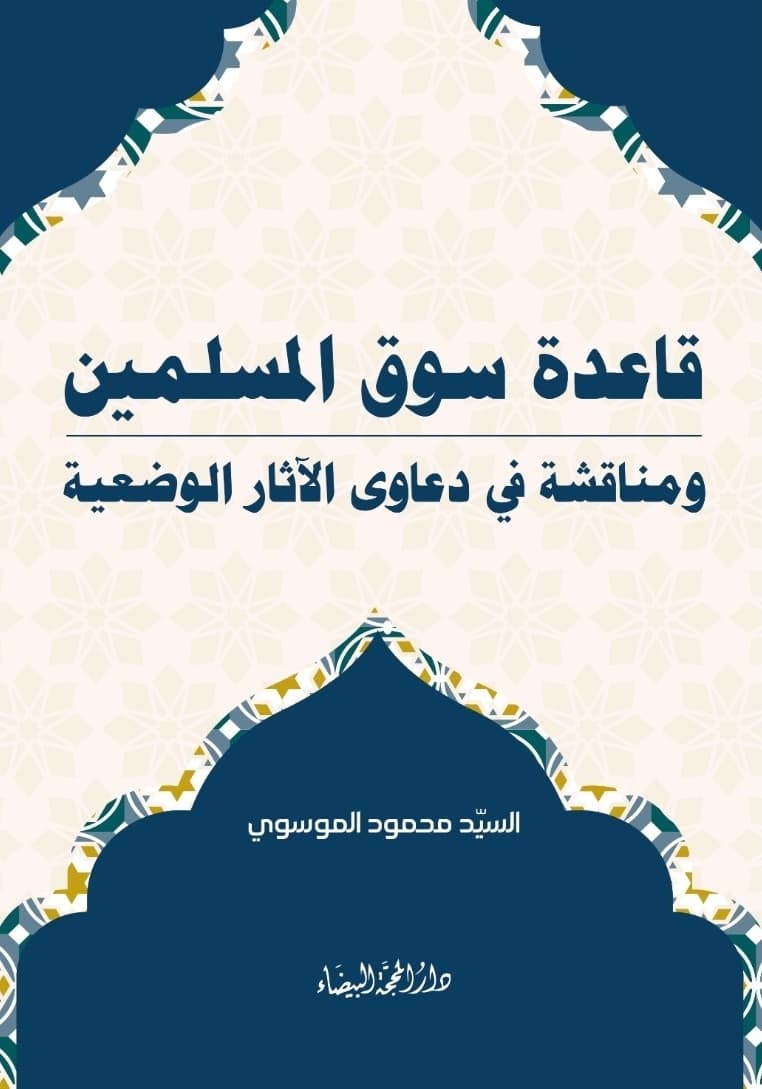
Cover of The Rule of the Muslims' Market

Book

The Rule of the Muslims' Market

And a Discussion of the Claims of Intrinsic Effect

Sayed Mahmoud Al-Mosawi

  • 120 pages
  • Added to the site: 14 May 2024 · 6 Dhu al-Qaʿda 1445 AH
3,510 views126 downloadsFor the press

About the book

Translated from Arabic — the Arabic original is the authoritative text.Read the Arabic original

Title:
The Rule of the Muslims' Market
And a Discussion of the Claims of Intrinsic Effect
Author:
Sayed Mahmoud Al-Mosawi
Size:
Medium, 120 pages
Released:
1444 AH/2023 CE
Publisher:
The author.
Manuscript copy.
Contact the author:
Email: smamood@gmail.com

To download the book in PDF format

The Rule of the Muslims' Market

About the book:

From the introduction..

As it appears, the paradox has manifested itself in the egregious distance of contemporary discourse from the givens of religion. For while religion establishes a general rule so that the markets of the Muslims may be well ordered, their interests set right by it, and their food and clothing made wholesome through its application, we find that, in the discourse of many religious guides, they practice a discourse entirely contrary to those aims: they call on the Muslim to examine closely when buying from the Muslims' market, to scrutinize the identity of the seller, or to pursue the attainment of personal certainty that the meat sold has been ritually slaughtered—with what follows from that in obliging people to ask and to monitor, or to refrain, to shun buying, and not to eat from those markets.

Indeed, they present this guidance as the guidance by which the believer is saved through his precaution for his religion; and, conversely, the believer who buys from the Muslims' market without asking, relying on the legal rule established in fiqh, is presented as lax in his religion, not caring about the foods that enter his stomach.

The arguments put forward in this context—which rejects eating from the Muslims' markets and calls for examination and asking—are many and varied, and we will study and address them in this research. However, the general outcome of the practice to which contemporary discourse calls with regard to examination is contrary to the practice followed by the pure Imams (a), and at variance with the practice of the believers that is connected to the practice of the Infallibles (a); indeed, it contradicts the texts transmitted from the Ahl al-Bayt (a), which are the pivot of legislation and of establishing the practice of communities of faith. Perhaps this flaw and this paradox are among the greatest errors of application into which the discourse of some religious guides has fallen.

Contents of the book

Table of contents

6 chapters · 45 headings
  1. 1Introductionp. 5
  2. Two Remarksp. 10
  3. 2Chapter One: The Jurisprudential Dimensions of the Rule of the Muslims' Marketp. 15
  4. The Purport of the Rulep. 15
  5. The Ruling on Askingp. 24
  6. The Narration “If It Is Guaranteed”p. 28
  7. 3Chapter Two: Discussion of the Claims of Negative Effects of Food from the Muslims' Marketp. 35
  8. The Claim of an Inevitable Ontological Effectp. 38
  9. Discussion of the Claimp. 40
  10. The Claim of a Psychological and Spiritual Effect of Eating Forbidden Foodp. 46
  11. Discussion of the Claimp. 47
  12. First: Reliance on the Data of the Narrations, between Eating Carrion and What Has Not Been Ritually Slaughteredp. 47
  13. Second: The Claim of the Experience of the Awliyaʾ or the Gnostics regarding the Spiritual Effectp. 56
  14. The Claim of Physical Harmp. 65
  15. The Claim of an Effect through the Conflict of Underlying Criteriap. 69
  16. The Claim That the Rule of the Muslims' Market Is a Rule of Facilitationp. 77
  17. The Claim That Our Time Differs from the Time of the Narrationp. 81
  18. The Claim “I Do Not Like Something Whose Source I Do Not Know to Enter My Stomach”p. 86
  19. The Opinions of Some Contemporary Juristsp. 87
  20. 4Chapter Three: A Thematic Treatment of Eating from the Muslims' Marketp. 91
  21. Features of the Religious System regarding Foodp. 93
  22. Attention to Foodp. 95
  23. The Sharia Is the Path of Attentionp. 96
  24. Food Is a Matter of General Welfarep. 99
  25. The People of Moses and Their Testp. 102
  26. The Reasons for the Prohibition of Carrionp. 105
  27. Sustaining the Muslims' Market Is of Great Importancep. 108
  28. Reliance on the Muslims' Marketp. 110
  29. Divine Latitudep. 111
  30. Divine Wilayahp. 114
  31. Wilayah for the Ahl al-Baytp. 115
  32. The Compensatory System Is One of the Manifestations of Facilitationp. 119
  33. The Effect of Intentionp. 122
  34. Washing the Hand before Eatingp. 122
  35. Saying the Name of Allah when Eating Is a Blessingp. 123
  36. Supplicationp. 124
  37. Cookingp. 124
  38. Beginning with Saltp. 124
  39. Compensation by Consuming Something Elsep. 125
  40. Physical Affliction Is Forgivenessp. 125
  41. “And He Excuses Many” of What Is Deliberatep. 126
  42. Choosing the Bestp. 127
  43. Instructing Sellers in Jurisprudencep. 129
  44. 5Conclusionp. 133
  45. 6List of Sourcesp. 135