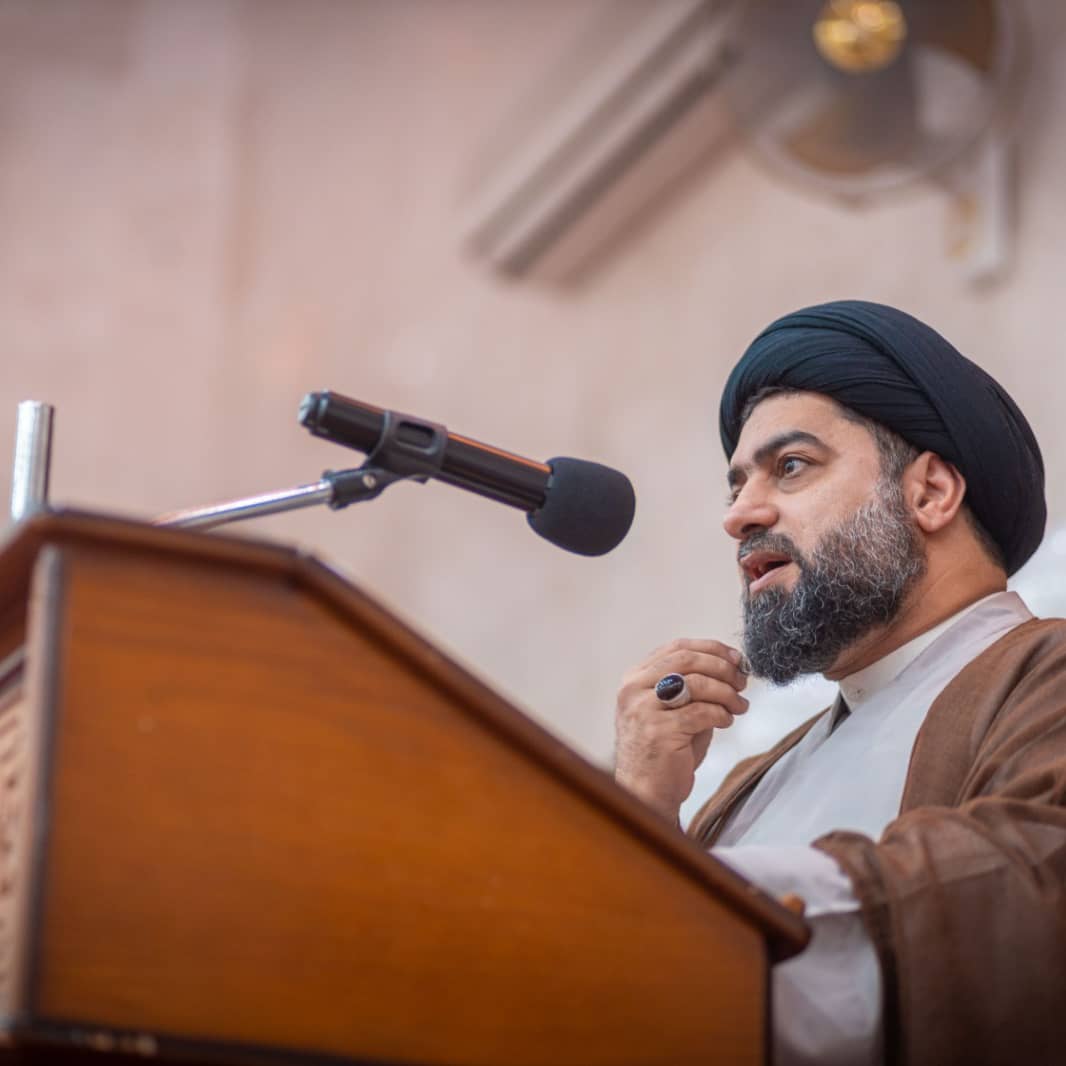
The Bahraini newspaper Al-Wasat, in its issue of Sunday corresponding to 15 November 2015 CE, published an investigative report on the difference in ʿAshura practices, and it conveyed the opinion of His Eminence the ʿAllama Sayed ʿAbd Allah al-Ghurayfi, followed by the opinion of Sayed Mahmoud Al-Mosawi.
.
Among what Sayed Al-Mosawi said was:
On the other side stands Al-Mosawi, defending the right of his group to practice its rites and convictions, and calling for attention to what he called “the three circles” in dealing with this problem.
He said: “The first circle is the juristic circle, and here we must look at the difference as to whether it is juristic, in which case it becomes the occupation of the jurists and marajiʿ, for they are the ones concerned with giving an opinion on this or that practice, as to whether or not it realizes the character of a rite by being practiced,” adding: “It is true that in the juristic circle there is an opinion that holds permissibility, but this opinion sets limits, such as that it not lead to harm or to harming religion,” explaining that there are secondary headings that may prohibit this thing or allow it, and that these controls are mostly personal controls concerning harm or its absence, and therefore the difference will remain.
On the second circle, Al-Mosawi said: “It is the administrative circle. For there are many recommended acts, meaning that one who believes in the recommendation may take an administrative decision not to practice a certain rite for reasons they see fit, connected with the general situation and the effort and capability of this husayniyya, which may believe in this type of practice but does not see that it is able to carry it out. This is an administrative matter on which they agree, and those with the competence and the decision here are the administration of these maʾtams.”
As for the third circle, Al-Mosawi explained it by saying: “It is the circle of general social treatment, and in my view it is the circle that we are concerned with, where some suffer from confusion: you see him striving to treat the matter socially, but he confuses these three circles, so the result is his working to decide for others a decision that belongs to the administrative domain, and sometimes he wants to force others into a juristic opinion, thereby entering into the domain of the first circle, which is particular to the jurists and marajiʿ.”
He added: “This happens, while the social circle requires, for treating it, the partnership of the social parties present in it. This means that the language of discourse must be a social language, instead of using the vocabulary of the lawful and the forbidden, which expresses a very great problem due to the confusion between these circles.”
He continued: “In the case of social treatment, one should look to social considerations in terms of plurality and the diversity of societies. We need to be people of a very broad outlook; I may not believe in one of the rites but others believe in it, which necessitates our need for breadth of chest and of hearts to accommodate these diversities.”
He went on: “We do not live within a single party, but within the plural circle and within a society that is plural even in understandings, temperaments and choices, and even in determining priorities. Consequently we need to think with this elevated mentality that is wide enough for all these differences and diversities, so that we respect the one who sees this as a rite, and in return the opposing position can be set out, in parallel with our fairness to the other.”
Al-Mosawi criticized what he called “the appropriation of fatwas,” and explained: “We have seen that some booklets that appeared tried to cut out the opinions of some jurists from this or that fatwa, only to turn the matter to their own advantage, and this is contrary to professional work and even to religiously lawful work.”
He also said: “In Bahrain, we have seen that some maʾtams sat down and agreed administratively with some parties, and decided either to delay some practice or to cancel it, and that was done amicably,” stressing the need of Bahrainis for a culture of mutual understanding and a culture of dialogues in all their outstanding issues in the country, including the question of the rites, so as to prepare the ground for reaching, even if in the future, a state of mutual understandings.
As to whether he sees that the ʿAshura season needs reform and purification from offensive practices, Al-Mosawi said: “What we see is that the season needs development, and that includes the discourse of values, how we present the thought of Imam al-Husayn and convey it to the world by modern methods, and how the preachers have gone deep into scholarly research and treating the issues and concerns of society. As for the rites, we need a Husayni sensibility that takes the other party into consideration and abandons partisan zealotries, so that each party acts on its own opinion without offending the other parties.”
The Bahraini newspaper Al-Wasat - Issue 4817 - Sunday 15 November 2015 CE corresponding to 02 Safar 1437 AH
To view the full investigative report