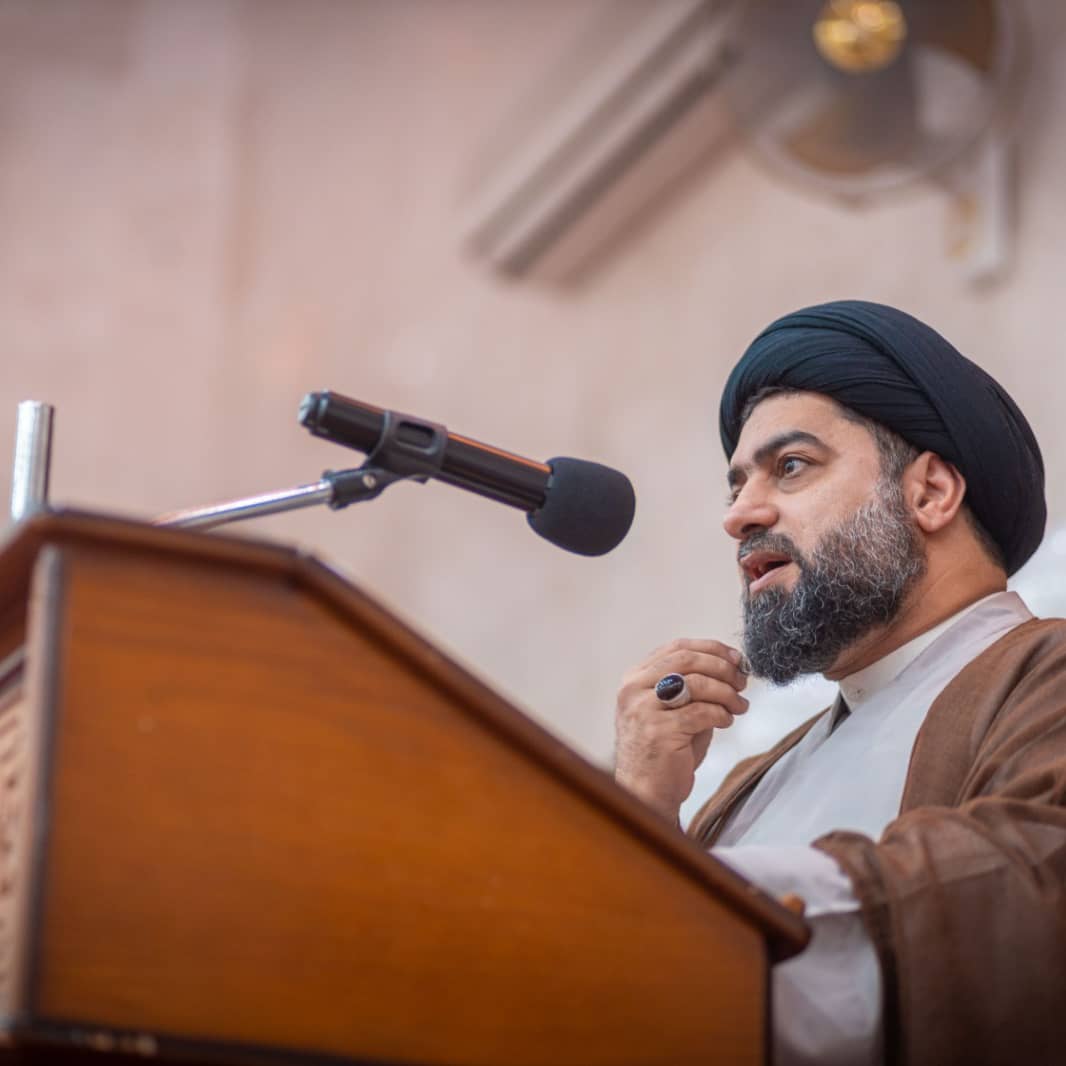
Sayed Mahmoud Al-Mosawi took part in the twelfth session of the Noble Qurʾan Conference, held by the Qurʾan Forum in the city of Saihat in the Eastern Province.
This was in the activities of the second night of the conference, the eve of Wednesday, the eve of the fourteenth of the month of Ramadan 1436 AH.
He took part with a study under the title: The Stories of the Qurʾanic Civilizations.. Features in the Philosophy of History.
.
Report of the Mozn Cultural Network

In its twelfth session and under the title The Qurʾan and the Question of Renaissance, the Noble Qurʾan Conference began its first night on 12 Ramadan. It was held in the Mosque of Imam al-Baqir in Saihat, and during it three research papers were presented by: Shaykh Zakariyya Dawud, Shaykh Muhammad Mahfuz, and Sayed Khidr al-ʿAwami.
- Shaykh Zakariyya Dawud: The Qurʾan and the Question of Renaissance
The conference began with an opening paper by His Eminence Shaykh Zakariyya Dawud, in which he explained that among the most important drivers
of change in societies is the religious driver, as it is a fundamental factor in shaping, reforming and changing societies; this is because of the authority that religion has, immersed in the human innate nature, propelling man toward it. He also pointed out that the Holy Qurʾan has proven its superiority over all other books, because it constitutes a method and a road map for building peaceful and rising societies. His Eminence also drew attention to the fact that speaking of awareness without turning it into action is considered detestable according to the Qurʾanic method, and that speaking of renaissance awareness is necessary for solving many of the problems that the nation is going through, such as the two phenomena of takfir and of infighting among the different segments of the nation; and that the backwardness and the various challenges we live through in our reality are a principal driver for speaking of renaissance and establishing its mechanisms through five tracks, which are: founding contemporary intellectual structures, laying a foundation for the intellect, changing the general reality of the nation, reform in all fields, and development of the nation's reality. He also stressed the centrality of the Qurʾan and its absolute authority for the renaissance, which makes us need to study and analyze reality by means of the Qurʾanic method, which condenses for us the experiences of the rising nations and of those that went against the factors of renaissance. At the end of his research paper he pointed out that civilizational renaissance in the life of the nation and its future is dependent upon deep awareness of both the Holy Qurʾan and the Imami religious text.
- Shaykh Muhammad Mahfuz: Renaissance Concepts in the Verses of the Wise Reminder
His Eminence Shaykh Muhammad Mahfuz began his paper by explaining that the religious idea has accompanied human civilization in
every time and throughout history, that societies were founded and administered through the prophets and the prophetic will, and that man did not know civilization before religion. Stressing the necessity of the question of renaissance for building and establishing civilizations, he pointed out that the distance between reality and ideals and values continues to increase because of many factors, and that renaissance, as a purposeful human will that works to overcome any obstacle, is a way of narrowing the gap between reality and ideals; and that there is no fruit from a renaissance that is hostile to and inconsistent with religion. His Eminence then linked the two concepts of wakefulness and heedlessness to the fate of societies, as the Qurʾanic text works to alert man against heedlessness and toward clinging to the concepts of wakefulness. He then mentioned three obstacles to renaissance in the nation:
The first: the political pattern in the historical Islamic political experience, as it lacks important concepts such as holding the ruler to account and balancing duties and rights.
The second: the burden coming from reality, among its forms being the absence of responsibility and placing it on the shoulders of a particular group in society.
The third: the burden coming from personal choices and misjudgment, as what we suffer from is a result of that.
Finally, he pointed to three Qurʾanic renaissance factors, which are: liberating the Muslim mind from material and moral shackles, cooperating in piety and Godwariness, and stimulating and mobilizing the mind.
- Sayed Khidr al-ʿAwami: The Rise and Fall of Civilizations .. A Qurʾanic Vision
His Eminence the Sayed opened his research paper by pointing out that the Holy Qurʾan has presented to us a sober historical vision by addressing the history of previous nations in many places, and this leads us to answer questions such as the factors of rise and fall and the actors in each of them and their roles. His Eminence the Sayed sees that the importance of the research lies in the study of historical and Qurʾanic models, since historical research is a fundamental factor among the factors of renaissance; and that following the movement of the course of history leads us to several basic points, among them that true renaissance is dependent on connection with Allah the Exalted through the messengers in every nation, and that reform centers on correcting creed, since it is connected with human conduct and thought. He also stressed that the movement of contemporary civilizations is an instance of the historical movement, for the laws that govern its course are fixed and do not change, explaining that the Qurʾan has centrality in explaining the march of humanity and the values important for the ascent of civilizations, and that awareness of the Qurʾanic historical laws is obligatory upon the believers so that they may complete the march of history, as the Qurʾan includes a comprehensive intellectual frame of reference that prevents the fall of nations and civilizations and raises them up.
The second night:
The Noble Qurʾan Conference in Saihat concluded its twelfth session on Tuesday, corresponding to 13 Ramadan. The conference, located at the Mosque of Imam al-Baqir (a), was on the Qurʾan and the question of renaissance, and during it two papers were presented by His Eminence Shaykh Salih al-ʿId and Sayed Mahmoud Al-Mosawi.
Shaykh Salih al-ʿId: The Method of the Holy Qurʾan in Rousing the Intellect
His Eminence the Shaykh began his paper by pointing out the importance of the intellect in Islamic thought, by pointing out that the Holy Qurʾan has attended to the derivatives of the intellect and its functions, such as its authority and the obligation of referring to it for judgment in many places, and hardly any of its suras is free of mention of the intellect
and of rousing it. His Eminence likewise explained aspects of the Qurʾanic method of rousing the intellect, such as reminding of the intellect and the obligation of using it, reminding man that he is rational, censuring whoever does not activate it, and the obligation of preserving the intellect and removing the veils from it, such as love of this world and blind imitation of forefathers, clarifying that imitation in itself is not blameworthy; rather, blind imitation without guidance is what is blameworthy. He also mentioned in the same context that the pressure of the group, or what is called the sense of social conformity, which makes multitude or paucity a measure of truth against falsehood, is a measure that the Holy Qurʾan has abolished, and that acquiring knowledge and using the intellect by means of the will is a path to reasoning. He then explained that the Qurʾanic insights call for reflecting on history and drawing lessons from it, and for reflecting on nature and the sciences as means of moving and mobilizing the intellect to extract knowledge and widen the circle of man's knowledge, which contributes to building rising civilizations.
- Sayed Mahmoud Al-Mosawi: The Stories of Civilizations in the Holy Qurʾan .. Features in the Philosophy of History
Sayed Mahmoud Al-Mosawi opened his research paper with an introduction to the effect that the view of the philosophy of history is an element
necessary for rousing nations and building civilizations, and that non-Muslims were influenced by the method of the Muslims of old in the philosophy of history for building civilizations. He also pointed out the ongoing debate on the theories related to the philosophy of history and their development after the First and Second World Wars, and also the Islamic experiments in attempting to extract the philosophy of history in the Holy Qurʾan. After that he stressed the superiority and prominence of the Qurʾanic text in the study of history by mentioning the conditions of previous nations in the course of admonition and lesson, because they stem from the fact that the Qurʾanic story is a historical unit that investigates the facts and corresponds to them, in addition to its integrity and the certainty of its origin, and its inclusion of historical laws, means of rising and evident lessons. His Eminence then moved on to mention the patterns of historical narration in the Qurʾan, among them individual history (the conditions of men) and the history of civilizations, which is the general conditions of societies. He also attributed the causes of the rise and fall of civilizations to factors mentioned by the Holy Qurʾan, such as collective logic, and he clarified that the logic of nations and the movement of nations are a result of the influence of each of the individual, the group and society.