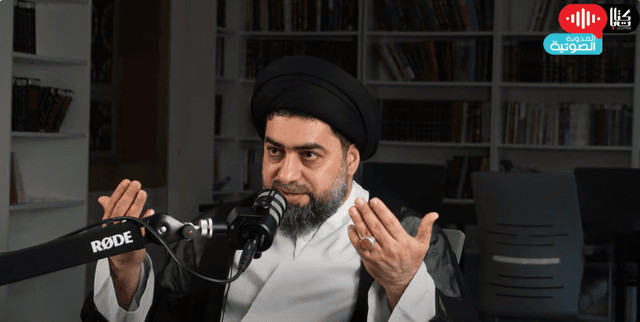
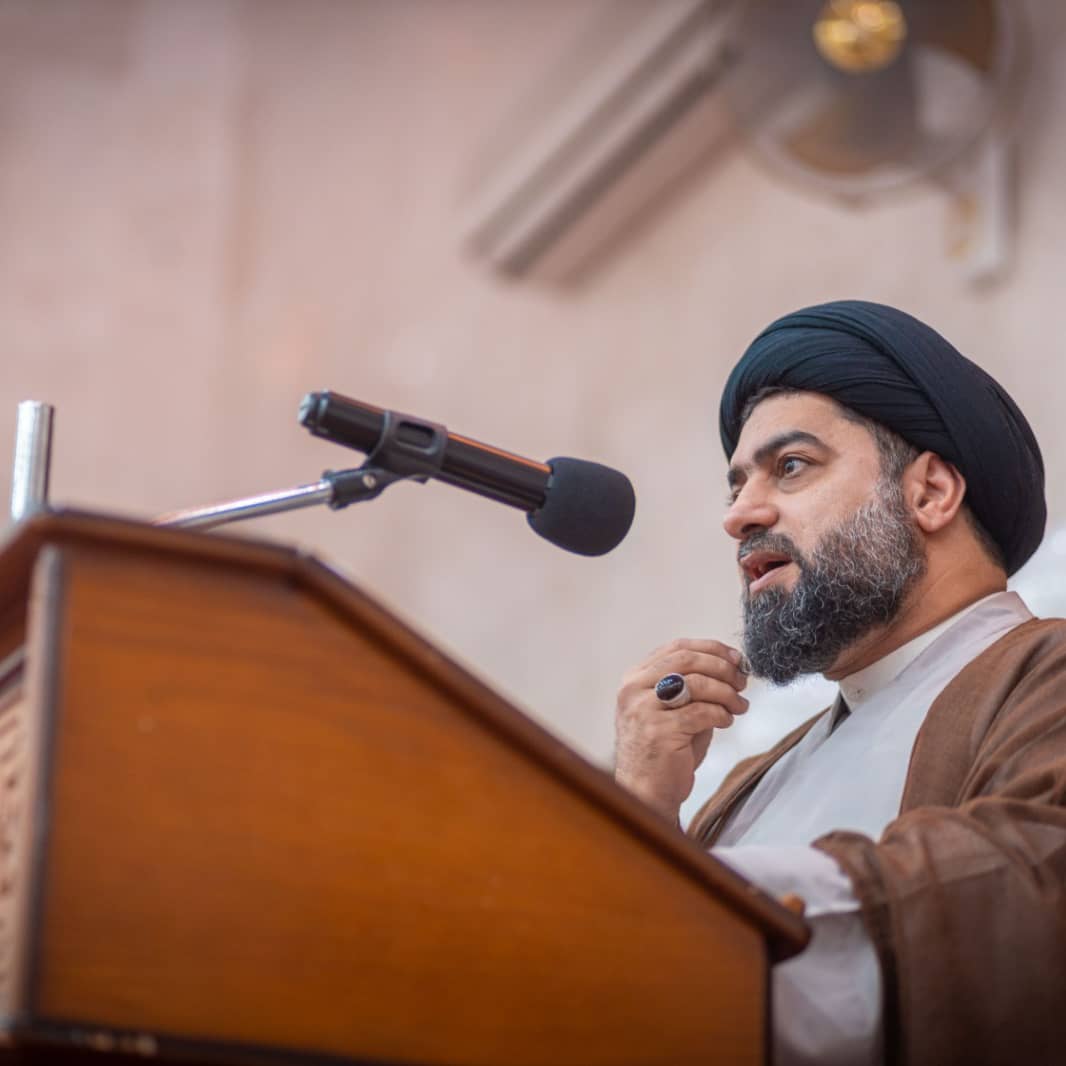
The radio of the Islamic Republic in Iran held an interview with Sayed Mahmoud Al-Mosawi on the occasion of the Arbaʿin anniversary of Imam al-Husayn (a), 1432 AH, within the program The Immortal Days. The interview was about the ziyarah of Imam al-Husayn (a) on the twentieth of Safar and the blessings of the ziyarah on foot.
.
Sayed Al-Mosawi began his talk with the narration from Abu Muhammad al-Hasan al-ʿAskari (a) that he said: “The signs of the believer are five: the prayer of the fifty, the ziyarah of Arbaʿin, wearing the ring on the right hand, placing the forehead in the dust, and saying aloud: In the Name of Allah, the All-beneficent, the All-merciful.”
He explained that the sign is the emblem.. therefore the ziyarah of Arbaʿin has important dimensions and particular characteristics connected with the emblematic and media state, in addition to the general reward that the visitor obtains as a visitor of the Imam, irrespective of the timing, or the state he is in, or intention, or other things..
We can present a number of these important aspects that the ziyarah of Arbaʿin includes:
1/ The general reward that the visitor attains, irrespective of the timing.
That he attains Paradise and enters it forty years before people (It is narrated from Zurara that he said: I heard Abu ʿAbd Allah say: Indeed the visitors of Imam al-Husayn (a) will have on the Day of Resurrection a superiority over people. I said: What is their superiority? He said: They will enter Paradise forty years before people, while the rest of the people are in the reckoning and the standing).
Among them is that they attain the supplication of the Messenger (s), Imam ʿAli (a), al-Zahraʾ (a) and the rest of the Imams (a)..
There is no doubt that whoever attains the supplication of the Prophet (s) and his Ahl al-Bayt (a) will be a place of blessing and will attain blessings in his life before the life of the Hereafter.
Likewise, the visitors attain the supplication of the angels and those appointed over the grave of Imam al-Husayn (a), who are seventy thousand angels.. and the reward of their prayers returns to the visitors..
2/ Also, the visitor to the grave of Imam al-Husayn (a) obtains the reward particular to the state in which he comes.. and walking here is an example.. for those steps are measured, counted and observed by Allah the Exalted; those steps are not like other steps..
Abu ʿAbd Allah (a) al-Sadiq said to al-Husayn ibn Thuwayr: O Husayn, whoever goes out from his home intending to visit the grave of al-Husayn ibn ʿAli (a), if he is on foot, Allah writes for him for every step a good deed and erases from him a bad deed, until when he reaches al-Haʾir Allah writes him among the felicitous and the successful, until when he has completed his rites Allah writes him among the triumphant, until when he wishes to depart an angel comes to him and says: The Messenger of Allah (s) conveys greetings of peace to you and says to you: Begin your deeds anew, for what has passed has been forgiven you).
Indeed there are narrations indicating that Allah writes for the visitor heading for the grave of Imam al-Husayn (a) a Hajj each time he raises a foot, and writes for him an ʿUmra each time he puts that foot down..
These feet that walk toward the grave of the Imam (a), intending to visit him, acknowledging his right, his standing and the rank in which Allah has placed him, have a great importance and are the object of the regard of Allah the Exalted, and their blessings are all-embracing.. For a person in the ordinary state, when he walks in his life toward some place, this walking takes time and diminishes his lifespan; but the time in the ziyarah of Imam al-Husayn (a) is not counted from the appointed terms, rather it is added to the lifespan as blessing and increase.. Indeed, these steps work automatically to erase sins, as if it were a continuous process of accepted seeking of forgiveness, and the visitor's steps also add to his balance a great reward, estimated at the reward of Hajj and ʿUmra for each step. How great those steps are..
We can also depict this walking as a striving of the heart toward wilayah for the friends of Allah the Exalted, who gave their lifeblood for Allah and raised the banner of truth as guiding Imams whom Allah the Exalted appointed to lead His creation, and a striving for disavowal of their enemies, the enemies of religion, and of all the oppressors and tyrants on the face of the earth..
Walking toward the grave of Imam al-Husayn (a) is not a walk toward death and the dead as some imagine; rather, it is a walk toward life. With Imam al-Husayn (a) life begins, for from him (a) all the values of life are taken.
Also, the state of fear and the like have a bearing on the ziyarah of Imam al-Husayn (a) as well..
It is narrated from Zurara that he said: (I said to Abu Jaʿfar (a): What do you say about one who visited your father in a state of fear?
He said: Allah will secure him on the Day of the Great Terror, and the angels will receive him with glad tidings, and it will be said to him: Do not be afraid, nor grieve; this is your day, in which is your triumph)..
3/ We can add an important dimension in the ziyarah of Imam al-Husayn (a) at the Arbaʿin, namely the state of consoling the Ahl al-Bayt in their calamity over Imam al-Husayn (a). In the Arbaʿin there is an important dimension carried out by Jabir ibn ʿAbd Allah al-Ansari, who performed the rites of the ziyarah on that very day,
Therefore we should call to mind all the reward and blessings obtained by the one who consoles the Ahl al-Bayt and weeps over their calamity (a).
As has been narrated from Imam ʿAli ibn al-Husayn (a): (Any believer whose eyes shed a tear for the killing of al-Husayn ibn ʿAli (a), so that it flows down his cheek, Allah will settle him because of it in chambers in Paradise in which he will dwell for ages...).
In conclusion we stress
that the ziyarah of Arbaʿin is an emblem of the believers and a media voice that resounds in the sky of the world, that we are Husaynis, Husaynis in our creed, in our morals, in our refusal of humiliation, in our dignity, in all our values, and upon this course we proceed.