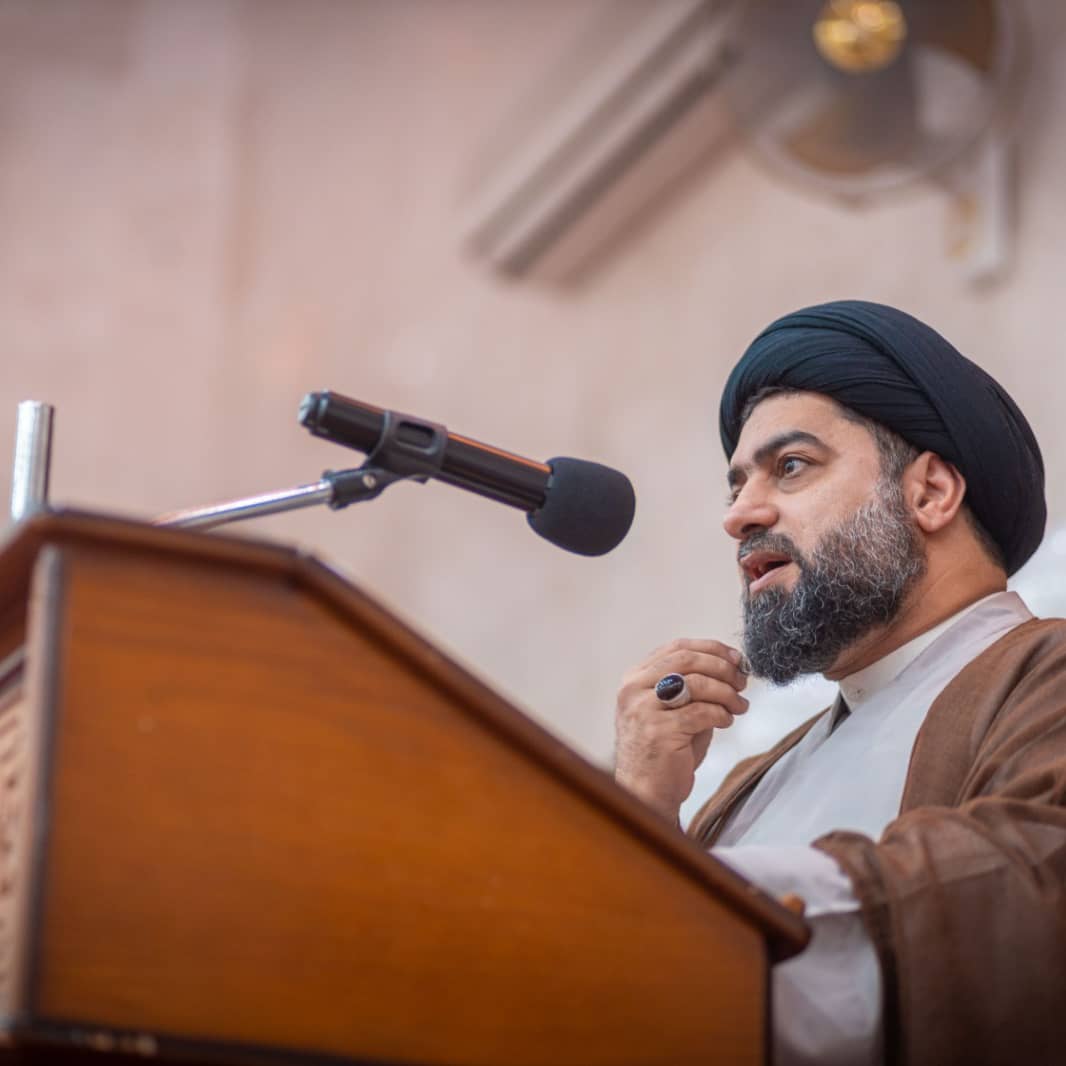
Sayed Mahmoud Al-Mosawi took part with an intervention in the Qurʾanic conference held by the Noble Qurʾan Forum on the evening of Friday 16/9/1431 AH in the city of Saihat in the east of Saudi Arabia, the eighth session of the Noble Qurʾan Conference, under the title (The Value of Dignity..Its Legislative Horizons and Its Human Manifestations) a Qurʾanic vision.
.
After the researchers delivered their papers on the second night of the conference, on Saturday evening, Sayed Mahmoud Al-Mosawi offered an intervention, which consisted of an observation on the topic of the conference, namely the value of dignity.
He offered it by first stating that dignity, as a value, makes the mouths of many thinkers water; thus we find them singing its praises and citing the Holy Qurʾan as proof of its centrality for humanity, with the saying of the Exalted: “Certainly We have honoured the Children of Adam” (Qurʾan 17:70), yet we find the great paradox that these people turn a blind eye to the reasons for the honoring with which Allah has honored human beings, namely religion, the laws of religion and the teachings of religion.
If we were to take the verse in its context, we would find that the Qurʾanic context speaks of faith and the challenges of the Mission, and then mentions “Certainly We have honoured the Children of Adam” (Qurʾan 17:70), thereby giving us considerations worthy of attention, and it is fitting for thinkers not to neglect this aspect, namely that Allah has honored human beings by legislation, the Mission and faith, and has made Islam for them a code [of law] and a path, so that by it they may ascend to stations of dignity.
Therefore, human dignity, which lies at the basis of creation, in that Allah preferred the Children of Adam with a complete preference over many of those He has created, and created him in the best of forms, is dignity at the minimum level; he must then climb the ladder of honoring, as Allah the Exalted says: “Indeed the noblest of you in the sight of Allah is the most Godwary among you” (Qurʾan 49:13), that is, Godwariness contributes to a person's dignity, and all the heavenly legislations have come to honor man.
As for what is observed among some researchers, those who take part of the Book and reject a part, it is that they lay a foundation for the value of dignity and then strike at Islamic legislation in the other aspects; that is, they reject the reason for honoring in its higher ranks, and then you see them equating the believer with the non-believer; that is, they remove the merit of religion, the merit of propagating religion and religious work from the scale of comparative merit, while we see that the context of the verses that spoke of dignity in Surat al-Israʾ has the statement “But whoever has been blind in this [world], will be blind in the Hereafter, and [even] more astray from the [right] way” (Qurʾan 17:72), for the one blind of insight and heart in this world will have an evil end in the Hereafter.
He pointed out that the error is a methodological one that cuts some verses out of their contexts, so that they are torn away from the applications that clearly explain their meaning.
Participating in the conference were Their Eminences:
1/ Shaykh ʿAbd al-Ghani ʿAbbas.
2/ Sayed Hasan al-ʿAbd Allah al-Nimr.
3/ Shaykh Habib al-Khabbaz.
4/ Shaykh Muhammad al-ʿUlaywat.
5/ Shaykh Muhammad Mahfuz.