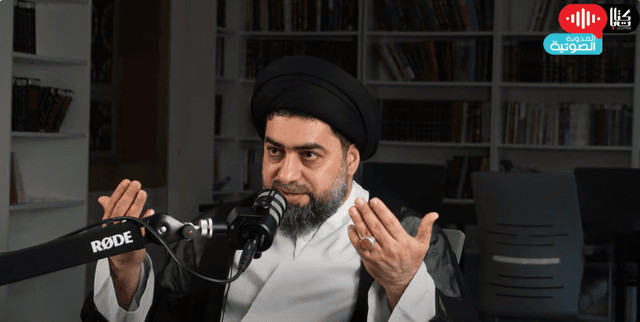
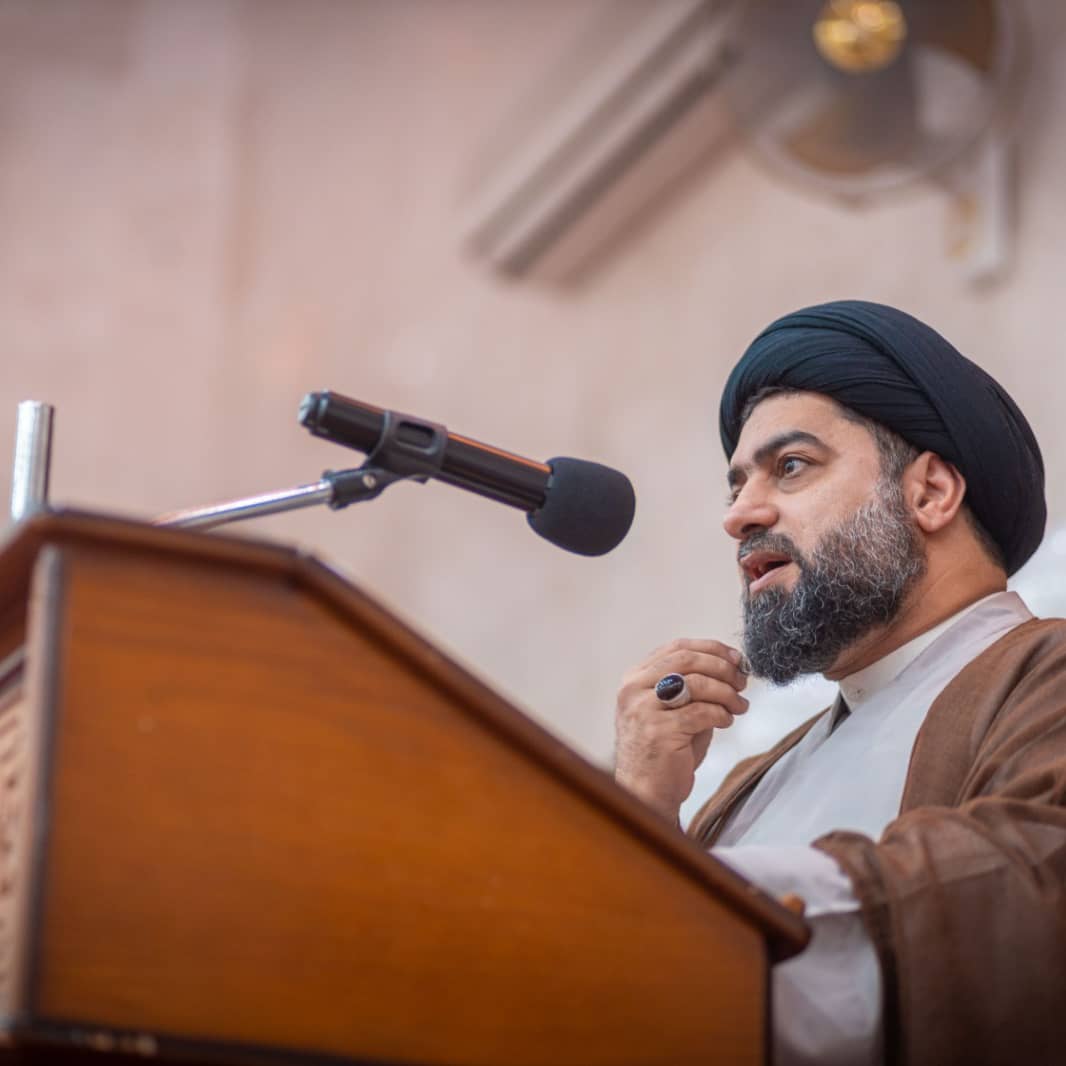
Invoking blessings upon the Prophet Muhammad (s) was the subject of the talk delivered by Sayed Mahmoud Al-Mosawi at the Representative Office of the religious authority (marjaʿ) Grand Ayatollah Sayed Muhammad Taqi al-Modarresi (may his shadow endure) in Bahrain, on the eve of Wednesday, at the weekly majlis held by the Representative Office. .
Summary of the lecture:
In the Name of Allah, the All-beneficent, the All-merciful
“Indeed Allah and His angels bless the Prophet; O you who have faith! Invoke blessings on him and invoke Peace upon him in a worthy manner.” (Qurʾan 33:56)
In the blessed verse there is a command from Allah the Exalted to the believer to invoke blessings upon the Prophet (s), and this command indicates obligation, even if only once in a lifetime, especially given the absence of contextual indicators that would divert the imperative verb from the Master, Almighty, to recommendation. That obligation is fulfilled by mentioning it at least once in a lifetime. After that it is recommended (mustaḥabb), and it has many benefits and bestows great reward on the human being, so much so that it has come in the hadiths that (the best of deeds is invoking blessings upon Muhammad and the family of Muhammad).
When we want to speak about invoking blessings upon the Most Noble Prophet (s), we point to several points:
1. At the outset, invoking blessings upon the Prophet is not complete except by invoking blessings upon the family. The Messenger (s) forbade the curtailed blessing, saying: (Do not invoke upon me the curtailed blessing. They said: And what is the curtailed blessing? He said: You say, O Allah, bless Muhammad, and fall silent; rather, say, O Allah, bless Muhammad and the family of Muhammad.) (Ibn Hajar in al-Sawaʿiq, 146, and al-Bukhari and others among the books of the Ahl al-Sunna wa-l-Jamaʿa.)
Very strange, and something that calls for reflection, is that this manner (that is, adding the family) for the Prophet in invoking blessings upon the Prophet is agreed upon by all Muslims, Sunni and Shiʿi; yet we find many Sunnis bypass it and delete (the family) from it.. Even al-Bukhari in his Sahih mentions these narrations in which the Messenger forbids deleting the family, yet he titles the chapter, saying (On the merit of invoking blessings upon the Prophet (s)), and he himself deletes (the family) from it..
This conjunction of (the Prophet and the Ahl al-Bayt), and the emphasis on it by the Messenger (s), indicates only the unity of light and method.
From this observation alone we can establish the rightful claim of the Ahl al-Bayt after the Prophet (s), whom Allah and His Messenger commanded to be joined with the mention of the Prophet wherever he is mentioned, so much so that al-Shafiʿi said in his well-known poetry:
O Ahl al-Bayt of the Messenger of Allah, love of you
is an obligation from Allah, which He sent down in the Qurʾan.
It is enough for you, of great standing, that
whoever does not invoke blessings upon you, there is no prayer for him.
On the meaning of invoking blessings upon the Prophet and his Ahl al-Bayt:
a/ It represents identity and belonging, because of the saying of Allah, Almighty, commanding the believers to do it: “Indeed Allah and His angels bless the Prophet; O you who have faith! Invoke blessings on him and invoke Peace upon him in a worthy manner.” (Qurʾan 33:56)
So the blessing is from Allah and from the angels, and here there is a command to the believers to invoke blessings upon the Prophet as well.. So it becomes a slogan for them..
b/ The meaning of salat is multiple: it is supplication, seeking forgiveness, mercy and the specific prayer.. But here, Allah blesses the Prophet, the angels bless him, and the believers.. and each has a different meaning according to the one to whom it is ascribed..
So the salat of Allah is: mercy from Him and the raising of the station of the Prophet (s).
And the salat of the angels: their commendation of him..
And the salat of the believers: their supplication for him..
· From Imam al-Kazim (a): (The salat of Allah is mercy from Allah, the salat of the angels is commendation from them for him, and the salat of the believers is supplication from them for him). Tafsir Nur al-Thaqalayn vol. 4, p. 202
· All of that is in the interest of the believers, and returns to him with benefit and great reward, as it is narrated from the Messenger of Allah (s) that he said: (Whoever of my nation invokes blessings upon me once, ten good deeds are written for him and ten evil deeds are erased from him). Thawab al-Aʿmal wa ʿIqabuha p. 45
2. Invoking blessings upon the Prophet is the keys of supplication; so it is recommended that a person mention it at the beginning of every supplication, and indeed at its end as well.. For supplication is accepted because of it.. The Messenger of Allah (s) said: (Every supplication is veiled from Allah until blessings are invoked upon Muhammad and his Ahl al-Bayt). Reported by Sunnis, among them al-Suyuti in al-Jamiʿ al-Saghir 1/656 h. 4266 / and Kanz al-ʿUmmal: 2/78 h. 3215..
As has also come in the narrations, it is recommended that the one supplicating mention invoking blessings upon the Prophet and his Ahl al-Bayt at the beginning of the supplication and at its end, for Allah does not reject the supplication that lies between two answered supplications, and a person's supplication that Allah bless the Prophet and his Ahl al-Bayt is answered, so Allah answers that supplication also..
And the answering occurs, as is known, when there is no obstacle preventing the answering of the supplication or delaying it.
A story:
From Fadala ibn ʿUbayd, who said: While the Messenger of Allah (s) was sitting, a man came in and prayed, and said: O Allah, forgive me and have mercy on me. The Messenger of Allah (s) said: You have been hasty, O one who prays; when you have prayed and sat, praise Allah as He deserves, and invoke blessings upon me, then supplicate Him. He said: Then another man prayed after that, and he praised Allah and invoked blessings upon the Prophet (s), and the Prophet (s) said to him: O one who prays, supplicate and you will be answered.
(Sunan al-Tirmidhi 5/179/3544, Kanz al-ʿUmmal 2/129/3461)
3. Among the indications that we draw from mentioning invoking blessings upon the Prophet and his Ahl al-Bayt at the beginning of the supplication, as is the custom of the supplications of the Ahl al-Bayt (a), is that what the supplication contains is knowledge drawn from the method of the Prophet and his Ahl al-Bayt, sciences from which benefit can be drawn in all aspects of our lives. Likewise, a supplication composed by a person, that is, not a supplication transmitted from the Ahl al-Bayt, ought to be composed by the person from the guidance of the Prophet and his Ahl al-Bayt, in the manner of etiquette in addressing the Lord of the worlds, in requesting lawful things, and the like..