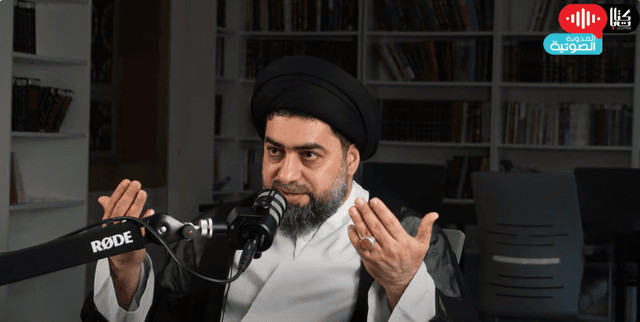
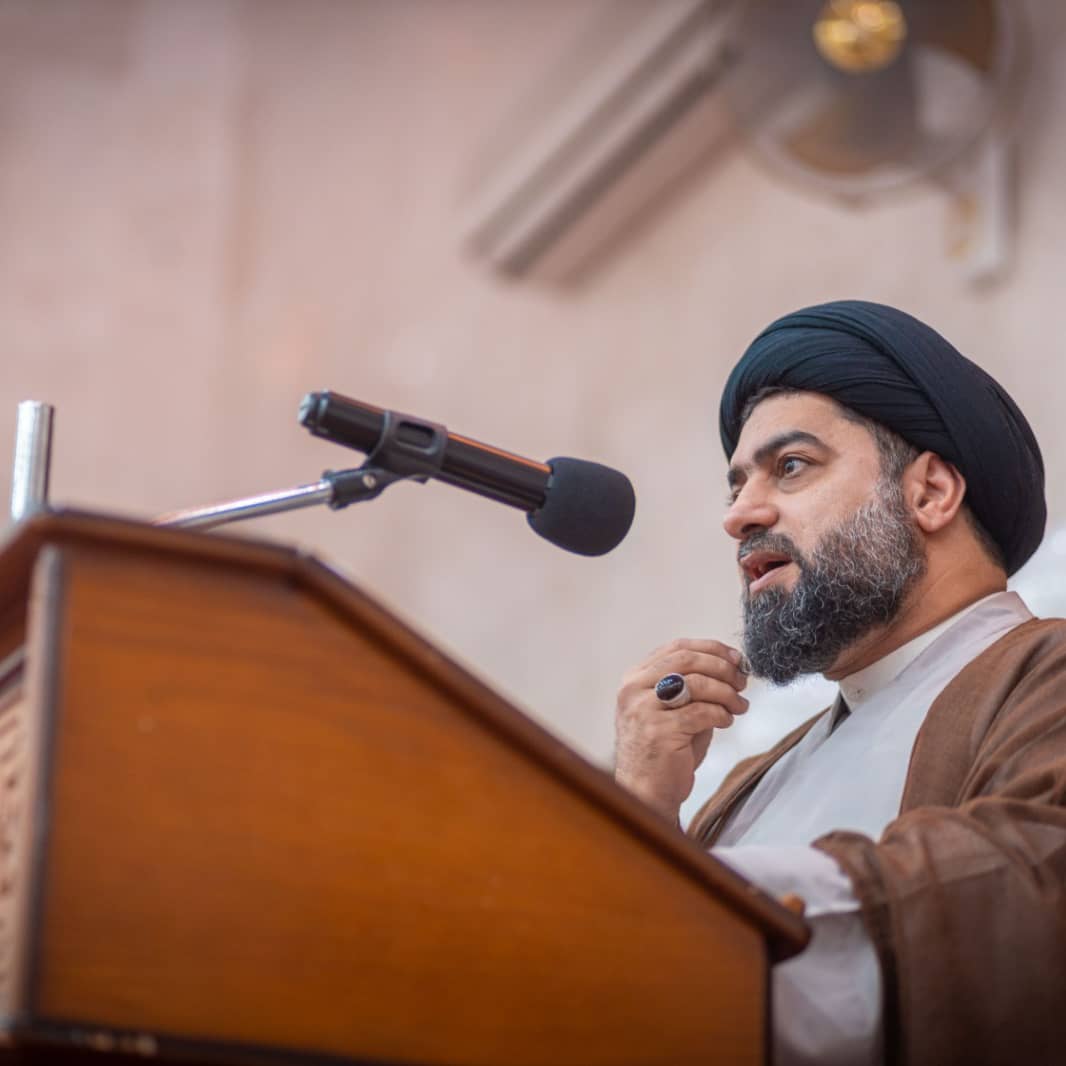
That was on the eve of Wednesday, 12/5/2010 CE, and here is a summary of the lecture
.
A Program in Social Influence
In the Name of Allah, the All-beneficent, the All-merciful
“Who has a better call than him who summons to Allah and acts righteously and says, ‘Indeed I am one of the Muslims’? Good and evil [conduct] are not equal. Repel [evil] with what is best. [If you do so,] he between whom and you was enmity, will then be as though he were a sympathetic friend. But none is granted it except those who are patient, and none is granted it except the greatly endowed.” (Qurʾan 41:33–35)
“The believer is not a believer until there are three traits in him: a sunna from his Lord, a sunna from his Prophet (s), and a sunna from his wali (a). As for the sunna from his Lord, it is concealing the secret; as for the sunna from his Prophet (s), it is dealing tactfully with people; and as for the sunna from his wali (a), it is patience in stress and distress” [Tuhaf al-ʿUqul/442].
Our talk is about the qualities of the believer and what he needs for mission-driven work in social work. The noble verse speaks of a program for the work of those who summon to Allah the Exalted, and it appears that the narration we mentioned from Imam al-Rida (a) corresponds to the verse’s program of work in one of its aspects.
For the speech of the Ahl al-Bayt (a) corresponds to the Noble Qurʾan; they are the counterpart of the Qurʾan, and with the Qurʾan, and they do not separate from it. At times they explain or interpret the Noble Qurʾan directly, as when they inform us of the meaning of a particular verse; and sometimes they deliver a hadith among the people and take note of the people’s need for it, and this category too corresponds to the Noble Qurʾan, even if the verses are not alluded to in it. That is why Imam ʿAli (a) says (All that we have is in the Qurʾan), and Imam al-Baqir (a) indicates to the people that they can ask him about any statement he makes, where it is in the Book of Allah.
This narration corresponds to the program of work of which the verse speaks, as we shall see, for we shall go over the meanings of the narration and the meanings of the verses, and by this we shall obtain a clear yield of knowledge concerning the Qurʾanic verses.
The narration points to the traits of (the true believer), (The believer is not a believer)..
We are thus before qualities and a program of work that is at the summit.. These traits are divided: a sunna from Allah, a sunna from the Prophet, and a sunna from the Legatee..
The verse says “Who has a better call than him who summons to Allah and acts righteously and says, ‘Indeed I am one of the Muslims’?” (Qurʾan 41:33), then goes on to mention the qualities and works to which he who has the better call adheres, and he is the one who submits, who translates his faith into righteous work..
“says, ‘Indeed I am one of the Muslims’” (Qurʾan 41:33) means that he is actually one of them. And Islam is submission, as Imam ʿAli (a) said: (I shall surely define Islam with a definition that no one before me has given it and no one after me will give it: Islam is submission, submission is certainty, certainty is assent, assent is acknowledgment, and acknowledgment is action)..
So true Islam is that which is translated into action.. and the true believer is the one in whom these traits exist in practice.. That is why Imam al-Rida (a) said (until there are three traits in him)..
· Three Sunnas
The true Muslim is the one who follows the sunnas of Allah, of the Prophet and of the wali alike.. “Your guardian is only Allah, His Apostle, and the faithful who maintain the prayer and give the zakat while bowing down.” (Qurʾan 5:55) Concealing the Secret
The word sunna, in general, means conduct and way.. And in technical usage it at times comes in the sense of the sunna as opposed to the Book (that is, the rulings that the Prophet (s) brought in general and that are not in the Book). It appears that the most suitable definition here is the rulings that were taken from the Prophet and were not taken from the Qurʾan, because the Qurʾan contains everything..
And at other times it comes in the sense of commendable and recommended acts, as opposed to obligatory acts and mandatory duties..
Here it has its most general meaning, that is, conduct and way ..
And we conclude from the correspondence of the verse with the narration that the Muslim is the one who submits to Allah, the Messenger and the Imam alike.
The first of the traits is concealing the secret.. This is a sunna from his Lord, that is, from Allah the Exalted, because He is the One aware of the deeds and works of His servants, and He is the Knower of all that is Unseen; yet He is the Veiler of His servants. So it is fitting for us to take on the manners of Allah (Take on the character traits of Allah).. The Exalted says: “Knower of the Unseen, He does not disclose His [knowledge of the] Unseen to anyone” (Qurʾan 72:26)
Concealing the secret: at times it is the secret of the servant himself, so he should not broadcast his secrets or let others know of them, because they constitute points of weakness that enemies come to know. Imam ʿAli (a) says: (Your secret is your captive; if you disclose it, you become its captive).
And because it is considered abasement of the self, and al-Sadiq (a) said: “Indeed Allah has entrusted everything to the believer except abasing himself).
From the Messenger (s): (Seek help for your needs through concealment)..
The Marjaʿ al-Modarresi relates of his father that he used to say that one of the snares of Satan is that he informs the unbelievers and the hypocrites of the secrets of the believers. For that reason he would often seek refuge in Allah from Satan, and would pronounce the basmala whenever he wanted to utter speech, in order to drive Satan away.
The counterpart of this trait in the verse is the saying of Allah the Exalted: “Good and evil [conduct] are not equal” (Qurʾan 41:34). Imam al-Sadiq says about this verse: (Good is taqiyya, and evil is divulging. He said: What is best is taqiyya). al-Kafi, vol. 2, p. 217
The second of the traits of the true believer is dealing tactfully with people. It is a sunna from the Prophet (s), because he (s) was known for it, and it was among the most important mechanisms he used in his blessed movement, to the point that he said: (My Lord has commanded me to deal tactfully with people just as He has commanded me to perform the obligatory duties).
But what is dealing tactfully? Is it flattering compromise and endorsing the wrongdoer in his wrongdoing and the one in error in his error?.. Here precision is indispensable.. because moral qualities are a reflection of values, and not destroyers of values; so the tactful dealing that has been commanded cannot be endorsing the wrongdoer in his wrongdoing.. Rather, tactful dealing is a tool for the person of the Mission in his work, in order to reach his divine goals of change and reform..
From Imam ʿAli (a): (Deal tactfully with people and you will be safe from their calamities and secure from their schemes) This is a benefit: it enables the person of the Mission to perform his work, and so that he may be safe from the evil of the wicked .
And from him (a): (The soundness of religion and of this world lies in dealing tactfully with people). For soundness is not in this world alone but in religion, and here lies the meaning of being mission-driven and the benefit of tactful dealing in it.
So tactful dealing is that you do a deed or express an opinion that agrees with and is pleasing to the other party, without its contradicting religion and values; and here kindness to others becomes manifest, and this is what the noble verse has brought..
The part corresponding to this trait in the verse is the saying of Allah the Exalted: “Repel [evil] with what is best. [If you do so,] he between whom and you was enmity, will then be as though he were a sympathetic friend” (Qurʾan 41:34). This explains to us how this tactful dealing is kindness to others for the sake of a mission and a mission-driven goal.
And even if the other party does not actually turn into a sympathetic friend (that is, he does not change), the verse says “as though he were a sympathetic friend” (Qurʾan 41:34), meaning that he resembles one; and this too is useful for those who summon to Allah, in warding off harm.. as Imam ʿAli (a) did in being kind to the person who used to harm the Messenger (s), after the Messenger had commanded him to cut out his tongue, and he meant: cut out his harmful tongue by being kind to him.
The third trait of the true believer is his being adorned with patience in stress and distress, and it is a sunna from his wali (that is, from the Imam), and it appears that it refers to Imam ʿAli (a).. for the title of his movement is patience.. (Among the incidents that are mentioned is that the Messenger (s), in his testamentary instructions to Imam ʿAli (a), said to him: Will you be patient with what will befall you after me? Imam ʿAli would say: I will be patient, O Messenger of Allah (s), as he enumerated the calamities to him, except for the calamity of the striking of al-Zahraʾ (a), which the Imam could not bear. So the Messenger (s) said to him: Gabriel says that Allah commands you to be patient. And the Imam (a) said: I will be patient.
Patience is that a person remains upright in the state he is in. This trait is among the important traits in mission-driven work, because its loss means lack of endurance and means retreat. For that reason Allah the Exalted has set a great reward for patience. Al-Sadiq (a) said: Whoever among the believers is afflicted with an affliction and is patient with it shall have the like of the reward of a thousand martyrs. al-Kafi: 2/75.
And we see that the counterpart of this meaning of the narration in the verse is the saying of Allah the Exalted: “But none is granted it except those who are patient, and none is granted it except the greatly endowed” (Qurʾan 41:35).
1/ A real, objective relation: tactful dealing rests on the basis of concealing the secret, and tactful dealing needs the fuel of patience.
2/ That they are a program for work and for summoning to Allah in society. “Who has a better call than him who summons to Allah” (Qurʾan 41:33).
So he mentioned only patience in stress and distress, while there is a verse that mentions patience in three situations, “and those who are patient in stress and distress, and in the heat of battle” (Qurʾan 2:177), the third being war.. Here he did not mention it, because the setting is work in society. Likewise, concealing the secret is from an opposing party, tactful dealing is toward an opposing party, and so is patience with harm.
3/ That these traits address the situation of those who summon to Allah in the harshest of circumstances, where they need uprightness and patience.. as Sayed al-Modarresi says in the exegesis Min Huda al-Qurʾan al-Karim.