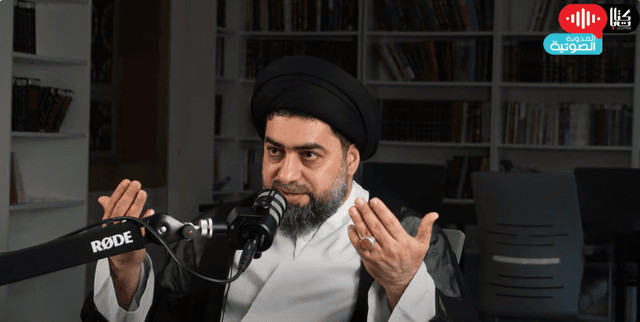
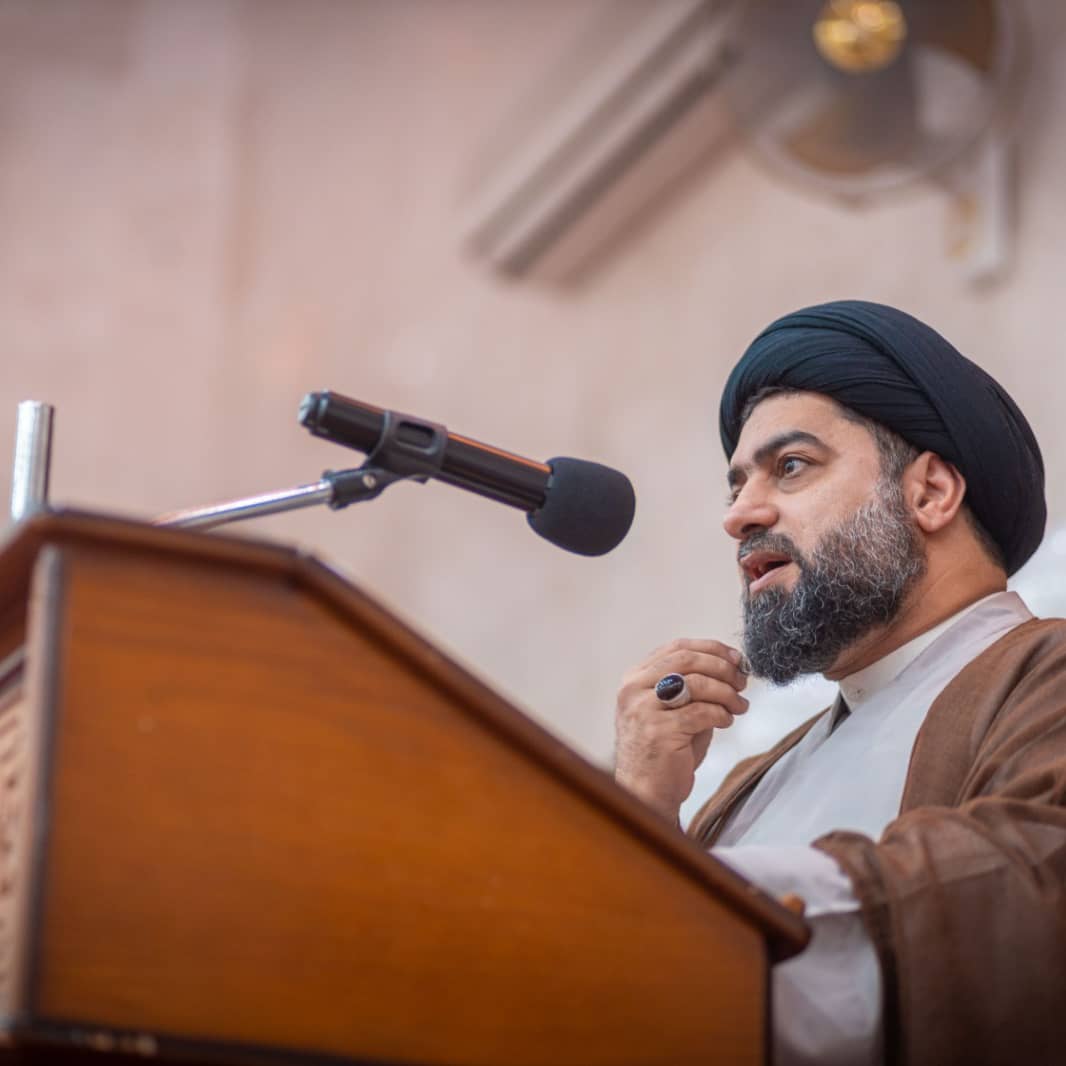
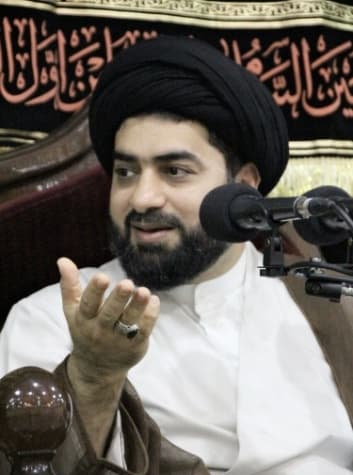
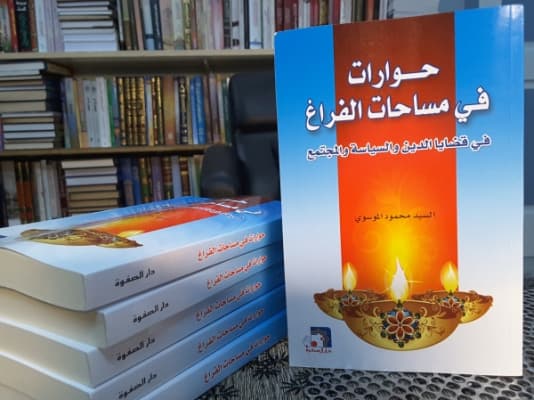
The Ahl al-Bayt (a) satellite channel broadcast an interview with Sayed Mahmoud Al-Mosawi on the sidelines of the Holy Qurʾan Conference that was held in Bahrain for the year 2010 CE. In the interview, answering a question on whether or not there are solutions in the Holy Qurʾan to political problems, he pointed out that there are two types of problems: .
The first: those problems that political performance and political action treat. These emergent problems are treated by performance, commitment and the degree of conformity between deed and word.. This treatment is outward and external.
The second type: the problems particular to values and principles, and these problems are the real ones. The Holy Qurʾan has proclaimed a set of values and principles whose clearest form is in political performance; for example: “and to judge with fairness when you judge between people” (Qurʾan 4:58), and the saying of Allah the Exalted: “Indeed Allah enjoins justice and kindness” (Qurʾan 16:90). For the Qurʾan does not proclaim justice only; rather, it supports justice with kindness, so that politicians are not merely people of justice, but must be among the doers of kindness, that is, their performance in the process of justice excels and reaches the degree of kindness, and this ensures performance of higher quality.
Yes, if the basic values such as justice, security and dignity are acted upon, such basic values in the Qurʾan as are in the field of politics, if they are acted upon, then without doubt all the political problems of man will be solved.
Regarding a question on the possibility of adopting some Qurʾanic theories in the political process and in political action, he answered that there is no doubt that the Holy Qurʾan has set down the great values that the followers and the Muslims should act upon; it has put down the shackles as an expression of freedom: “and relieves them of their burdens and the shackles that were upon them” (Qurʾan 7:157); it has commanded justice and kindness, and dignity: “Certainly We have honoured the Children of Adam” (Qurʾan 17:70). These values must be taken in their totality; but if we take some of them, then here the saying of Allah, Almighty, applies to us: “who represented the Quran as magic” (Qurʾan 15:91).. This is a problem: that one takes what serves his policy and leaves what he believes is not in his interest, and here the clash between claims occurs.
He noted in his talk that the political condition is the apex of the pyramid by which the nation is shaped; therefore politics is tied to society and tied to people's economy, to their livelihood, so if a defect occurs in politics it spreads to all the other aspects..