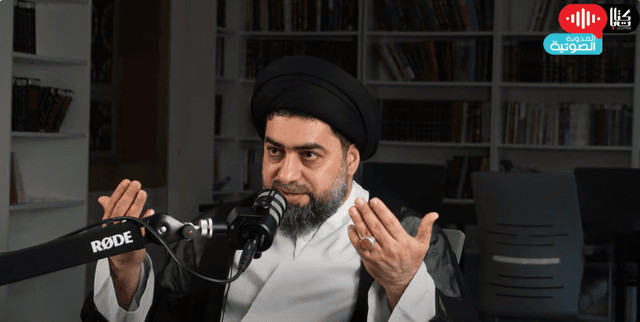
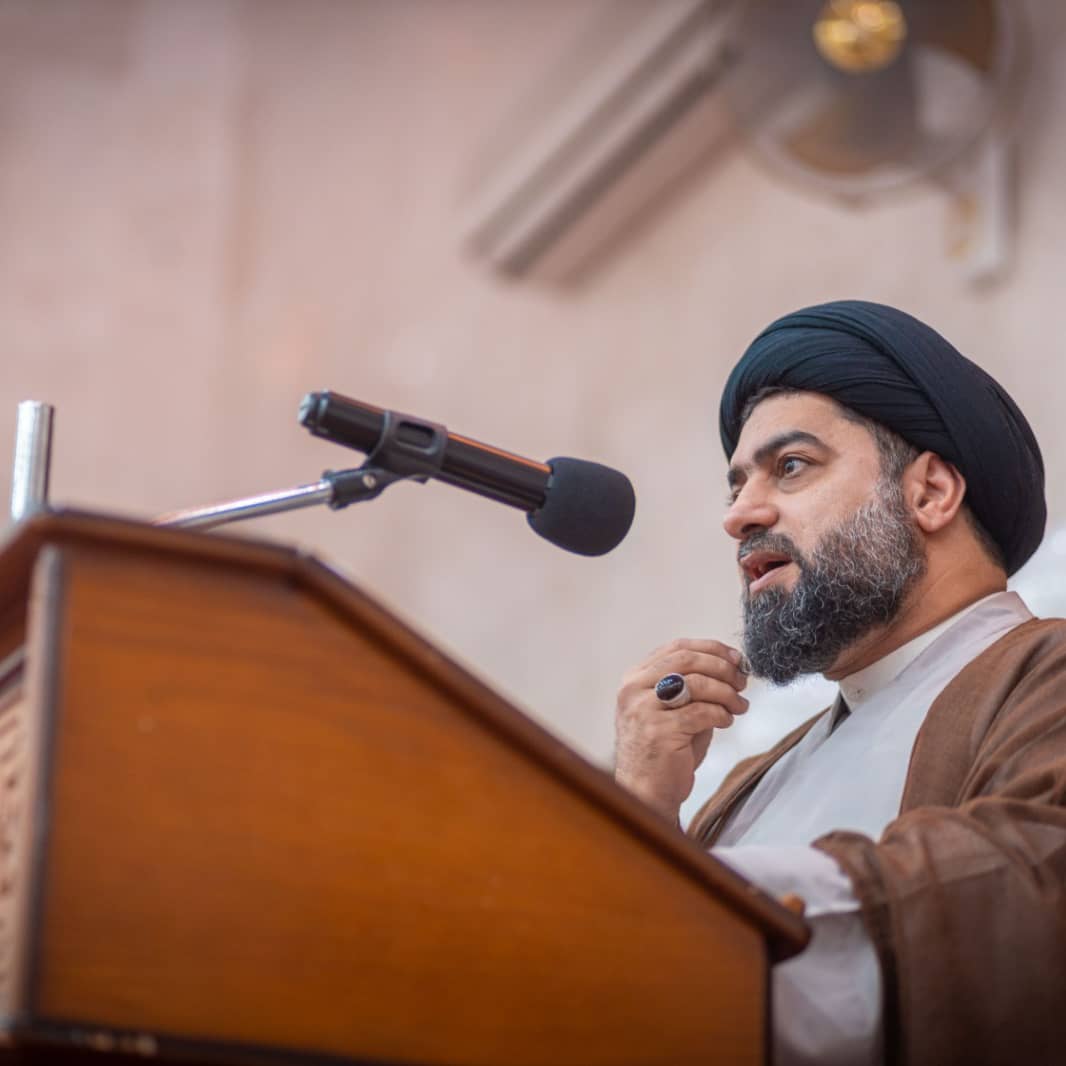
Sayed Mahmoud Al-Mosawi delivered a lecture on the occasion of the birth of Fatimah al-Zahraʾ (a) at the Grand Maʾtam of Madinat ʿIsa, on the eve of Saturday, the day of the noble birth; it was on the topic “The Name of Fatimah al-Zahraʾ: Interpretation and Significations”..
Here is a summary of the lecture..
.
In the Name of Allah, the All-beneficent, the All-merciful
The Name of Fatimah
Interpretation and Significations
Sayed Mahmoud Al-Mosawi
www.mosawy.org
“When your Lord said to the angels, ‘Indeed I am going to set a viceroy on the earth,’ they said, ‘Will You set in it someone who will cause corruption in it and shed blood, while we celebrate Your praise and proclaim Your sanctity?’ He said, ‘Indeed I know what you do not know.’ And He taught Adam the Names, all of them; then presented them to the angels and said, ‘Tell me the names of these, if you are truthful.’ They said, ‘Immaculate are You! We have no knowledge except what You have taught us. Indeed You are the All-knowing, the All-wise.’ He said, ‘O Adam, inform them of their names,’ and when he had informed them of their names, He said, ‘Did I not tell you that I know the Unseen of the heavens and the earth, and that I know whatever you disclose and whatever you conceal?’” (Qurʾan 2:30–33)
Preliminaries
1/ The name Fatimah came from heaven, from Allah the Exalted (even if it had come from the Messenger (s), then “Nor does he speak out of [his own] desire: it is just a revelation that is revealed [to him]” (Qurʾan 53:3–4); but the narrations have come to confirm that Allah named her Fatimah
Abu al-Hasan (a) said: (... When Fatimah was born, Allah, Blessed and Exalted is He, named her Fatimah).
We see that Allah the Exalted takes care in naming the great ones among the prophets and the truthful..
As in His saying, the Exalted: “When the angels said, ‘O Mary, Allah gives you the good news of a Word from Him whose name is Messiah, Jesus son of Mary, distinguished in the world and the Hereafter and one of those brought near [to Allah].” (Qurʾan 3:45)
And His saying, the Exalted: “‘O Zechariah! Indeed We give you the good news of a son, whose name is ‘‘John.’’ Never before have We made anyone his namesake.’” (Qurʾan 19:7)
2/ The coming of the name of Fatimah (a) from heaven means that there are secrets in it; this care has its aims and its significations, because Allah the Exalted is the All-wise, the All-knowing.
There is a difference between the naming that a person gives to his children and the naming that Allah the Exalted gives. We know that a name has an effect, and that a person must name his children well; Islam has made this one of the rights of children (that he give him a good name)..
If we assume that the one giving the name is a person of reason, the name will have a good signification in one respect or another, such as its meaning being positive and encouraging, or its resembling the name of a great personality, and the like.. But we stop at that only, and do not give the matter more than these limits..
As for the divine naming, it is a naming that is good for the person and for others, because of the wisdom in the choice that it contains, so its effect is general.. (and this suits the one named), for he is not like just anyone: he is a proof over creation and he is the exemplar for all people..
The divine naming conveys correspondence between the name and the one named, unlike what we sometimes see of someone whose name contradicts his attribute (his name is “Brave” while he is a coward), for example..
So the name is an emblem and a sign that tells of the inner reality, the content, the substance and the mettle, in truth, not by way of wishful thinking..
3/ In the names that Allah the Exalted gives there are secrets, and we may understand nothing of them, unless a report comes to us about the secret of this naming from Allah the Exalted on the tongue of His Prophet (s) or his Ahl al-Bayt (a). Many narrations have been reported that tell of the naming of al-Zahraʾ and her titles.. And we find care given to the matter of divine naming, and this is evidence of importance..
4/ The point of benefit in studying the name is:
a/ That through it we may perceive the stations of al-Zahraʾ (a), on the one hand, by virtue of the correspondence between the name and the one named, as we mentioned earlier.
b/ And on the other hand, so that the name may be a window for us to enter the world of meaning and to strive to attain some of the aims to which the All-wise, the All-aware has given care.
For al-Zahraʾ (a), according to the narrations, has nine names, as reported from Imam al-Sadiq; some have said twenty names; and many titles and kunyas..
We select the name (Fatimah) in order to study it and try to come to know it, so as to see what insights and knowledge it opens before us..
Meanings and Significations
First: the general meaning. Fatimah, and fatim—on the pattern of karim—in the language, is one whose period of nursing has ended; it is said: “fatamtu al-radiʿ”, that is, I separated the nursling from nursing. (Majmaʿ al-Bahrayn). And “fatamahu” means he separated him; and as in the Revelation: “his weaning takes two years” (Qurʾan 31:14); so the newborn is separated completely from nursing, without return..
Second: the derivation of the noble name from the name of Allah (al-Fatir), as reported from the Prophet (s) in a hadith: (.. and Allah is al-Fatir, and this is Fatimah)..
And derivation, which is divided into three kinds, of which are the minor, the major and the greatest: this is the greatest derivation, because the letters are different.. However, there is a discussion on the relationship between Allah's name al-Fatir and the name Fatimah..
And here there is a discussion ... which we leave until its time.
Third: the interpretation of the name Fatimah and its significations through the narrations (and this is the focus of our study)..
1/ She was weaned from (polytheism)
Abu ʿAbd Allah (a) said: Fatimah (a) has nine names with Allah Almighty: Fatimah, al-Siddiqa, al-Mubaraka, al-Tahira, al-Zakiyya, al-Radiya, al-Mardiyya, al-Muhaddatha and al-Zahraʾ. Then he (a) said: Do you know what the interpretation of Fatimah is? I said: Tell me, my master. He said: She was weaned from polytheism. He said: Then he said: Were it not that the Commander of the Faithful (a) married her, there would have been no match for her until the Day of Resurrection on the face of the earth, Adam and whoever is below him. al-Bihar, vol. 43, p. 11
And in one narration: from evil.. It is possible that the two are one, because the questioner and the one questioned in the two narrations are the same..
· Polytheism is the basis of every evil; that is why we see that al-Zahraʾ, when she wished to deliver her great sermon in which she addressed the conditions of the Muslims at that time and set out the landmarks of the religion, began her sermon by laying the foundation of monotheism, after praising and extolling Allah the Exalted: (And I bear witness that there is no god but Allah, alone, without partner: a word whose inner interpretation He made sincerity, whose connection He made the hearts contain, and whose intelligible meaning He illuminated in reflection; the One whose being seen is barred from the eyes, His description from the tongues, and His modality from the imaginations. He originated things not from anything that was before them, and brought them into being without imitating models that He followed; He formed them by His power, and created them by His will, without any need on His part to form them ...).
Then she mentioned the purposes of the Sharia (concerning prayer, fasting, the hajj and zakah), and she began them with monotheism to show the aim of it, saying: (So Allah made faith a purification for you from polytheism).
· There is a connection between polytheism and deviation, for the view of monotheism is the basis of faith; that is why it has come in the narrations that the noblest knowledge is the knowledge of Allah (a narration)..
For this reason al-Zahraʾ (a) began by explaining monotheism and explaining polytheism, from which she is weaned.. This is the methodology of the Noble Qurʾan; here are verses that present a set of obligations and acts of obedience..
1/ “When We took a pledge from the Children of Israel, [saying]: ‘Worship no one but Allah, do good to your parents, relatives, orphans, and the needy, speak kindly to people, maintain the prayer, and give the zakat,’ you turned away, except a few of you, and you were disregardful.” (Qurʾan 2:83)
2/ “Worship Allah and do not ascribe any partners to Him, and be good to parents, the relatives, the orphans, the needy, the near neighbour and the distant neighbour, the companion at your side, the traveller, and your slaves. Indeed Allah does not like those who are arrogant and boastful.” (Qurʾan 4:36)
3/ “Say, ‘Come, I will recount what your Lord has forbidden you. That you shall not ascribe any partners to Him, and you shall be good to the parents, you shall not kill your children due to penury—We will provide for you and for them—you shall not approach indecencies, the outward among them and the inward ones, and you shall not kill a soul [whose life] Allah has made inviolable, except with due cause. This is what He has enjoined upon you so that you may exercise your reason.” (Qurʾan 6:151)
4/ “Your Lord has decreed that you shall not worship anyone except Him, and [He has enjoined] kindness to parents. Should any of them or both reach old age at your side, do not say to them, ‘Fie!’ And do not chide them, but speak to them noble words.” (Qurʾan 17:23)
And there are many verses—among them in Surat al-Israʾ, from verse 34 to 44—that speak of responsibilities and then speak of polytheism; al-Modarresi has explained, in vol. 4, p. 434, the reason for this concomitance, and spoke of historical, natural and other determinisms, all of which come from the polytheistic self that distances itself from responsibility..
So recourse to the Taghut for judgment and loyalty to it is considered polytheism..
“Among the people are those who set up compeers besides Allah, loving them as if loving Allah” (Qurʾan 2:165)
The Lowest Degree of Polytheism
From Abu al-ʿAbbas, who said: I asked Abu ʿAbd Allah (a) about the least by which a person becomes a polytheist. He said: So he said: Whoever innovates an opinion, then loves on its account or hates on its account. (al-Kafi, vol. 2, p. 398)
A number of our companions, from Sahl ibn Ziyad, from Yahya ibn al-Mubarak, from ʿAbd Allah ibn Jabala, from Samaʿa, from Abu Basir and Ishaq ibn ʿAmmar, from Abu ʿAbd Allah (a), concerning the saying of Allah Almighty: “And most of them do not believe in Allah without ascribing partners to Him” (Qurʾan 12:106): He said: He obeys Satan without knowing it, and so he commits polytheism. (al-Kafi, vol. 2, p. 398). And in another narration he said: (He said: It is the polytheism of obedience, not the polytheism of worship).
(Here we know the greatness of al-Zahraʾ and the meaning of her being weaned from polytheism).. That is, it is not a simple meaning.. It is infallibility and pure obedience, untainted by the slightest thing.. So it befits us to take her as our exemplar and follow her path..
· ʿAli ibn Ibrahim, from his father, from Ahmad ibn Muhammad ibn Abi Nasr, from ʿAbd Allah ibn Yahya al-Kahili, who said: Abu ʿAbd Allah (a) said: If a people worshipped Allah alone, without partner, established the prayer, gave the zakah, performed the hajj to the House and fasted the month of Ramadan, and then said of something that Allah did or that the Prophet (s) did: Why did he not do other than what he did? Or felt that in their hearts, they would thereby be polytheists. Then he recited this verse: “But no, by your Lord! They will not believe until they make you a judge in their disputes, then do not find within their hearts any dissent to your verdict and submit in full submission” (Qurʾan 4:65). Then Abu ʿAbd Allah (a) said: So hold fast to submission. al-Kafi, vol. 2, p. 399
· From here we know that, as for the claims of those who call for renewal in order to go beyond the texts, the religious rulings and the values of religion, they are only treading in the polytheistic footsteps of Satan.. Likewise, we should not object to the rulings concerning obligations and prohibitions, nor to cosmic occurrences such as fluctuations of the weather, earthquakes and storms.. For what is required of us is to beware of them and guard against them, but not to object to them..
2/ She was weaned, by means of knowledge, from ignorance..
Muhammad ibn Yahya, from Muhammad ibn al-Husayn, from Muhammad ibn Ismaʿil, from Salih ibn ʿUqba, from ʿAbd Allah ibn Muhammad al-Juʿfi, from Abu Jaʿfar and Abu ʿAbd Allah (a), who both said:
When Fatimah (a) was born, Allah revealed to an angel, who made the tongue of Muhammad (s) utter it, and so he named her Fatimah. Then he said: I have weaned you with knowledge and weaned you from menstruation. Then Abu Jaʿfar (a) said: By Allah, Allah weaned her with knowledge and from menstruation at the Covenant. al-Kafi, vol. 1, p. 461
Al-Majlisi said: “I have weaned you with knowledge” means: I nursed you with knowledge until you became self-sufficient and were weaned. Or: I cut you off from ignorance by means of knowledge.
So she is the knowing one, and her knowledge is from Allah the Exalted..
· Umm Salama, the wife of the Messenger of Allah (s), says: The Messenger of Allah married me and entrusted the affair of his daughter to me, so I used to teach her manners and guide her; but she was, by Allah, more diligent than I and more knowledgeable of all things. al-Siddiqa al-Tahira, p. 96, from Dalaʾil al-Imama, p. 12
· Among what Fatimah said about herself: (.. Allah, Glorified is He, deposited me in the loins of my father, then deposited me in Khadija bint Khuwaylid, and she bore me while I was of that light; I know what has been, what will be and what has not been..).
· A story that shows the knowledge of Fatimah (a) and explains the station of the scholars:
Abu Muhammad al-ʿAskari (a) said: A woman came to al-Siddiqa Fatimah al-Zahraʾ (a) and said: I have a frail mother, and something in the matter of her prayer has become confused for her, and she has sent me to you to ask you. Fatimah (a) answered her about that; then she asked a second time and she answered, then a third time, until she reached ten, and she answered. Then she felt embarrassed at the great number and said: I will not cause you hardship, O daughter of the Messenger of Allah. Fatimah said: Come, ask about whatever occurs to you. Do you think that one who is hired for a day to carry a heavy load up to a roof, his hire being a hundred thousand dinars, would find it burdensome? She said: No. She said: I have been hired, for every question, for more than the fill of what is between the ground and the Throne in pearls; so it is all the more fitting that it not be burdensome to me. I heard my father (s) say: The scholars of our Shiʿa will be gathered, and robes of honor will be bestowed upon them according to the abundance of their knowledge and their earnest effort in guiding the servants of Allah, until a thousand thousand garments of light are bestowed upon one of them. Then the caller of our Lord, Almighty, will call out: O you who took charge of the orphans of the family of Muhammad (s), who revived them when they were cut off from their fathers, who are their Imams! These are your students and the orphans whom you took charge of and revived; so bestow upon them the robes of knowledge in the world. So they bestow upon each one of those orphans according to the amount of knowledge they took from them, so that among them—meaning among the orphans—there is one upon whom a hundred thousand robes are bestowed; and likewise these orphans bestow upon those who learned from them. Then Allah the Exalted says: Give back to these scholars who took charge of the orphans until you complete their robes for them, and double them for them. So what they had before they bestowed upon them is completed for them, and it is doubled for them; and likewise those who come after them, of those who bestowed upon those who come after them. And Fatimah (a) said: O handmaid of Allah, a single thread of those robes is better than that upon which the sun rises a thousand thousand times; and that which it excels is tainted with vexation and turbidity. al-Bihar, vol. 2, p. 3
This is the scholarly station of al-Zahraʾ; that is, her knowledge is from Allah the Exalted: He weaned her and separated her from ignorance by knowledge, and she rose high through knowledge; and her knowledge being from Allah means that she knows what has been, what will be and what has not been, as she (a) said about herself..
Knowledge Is the Measure of Superiority
“Say, ‘Are those who know equal to those who do not know?’” (Qurʾan 39:9).
“Allah will raise in rank those of you who have faith and those who have been given knowledge” (Qurʾan 58:11).
Imam ʿAli says: (The head of the virtues is knowledge). And: (There is no honor like knowledge).
The Messenger of Allah (s) said: (The people of greatest worth are those of most knowledge, and the people of least worth are those of least knowledge).
Knowledge and the Fear of Allah
“And of humans and beasts and cattle there are likewise diverse hues. Only those of Allah’s servants having knowledge fear Him. Indeed Allah is all-mighty, all-forgiving.” (Qurʾan 35:28)
Seek Knowledge
The Messenger of Allah (s) said: (Seek knowledge, even in China, for knowledge is an obligation upon every Muslim).
And al-Sadiq (a) said: (Seek knowledge, even by plunging into the depths of the sea and the shedding of hearts' blood).
So we must not make knowledge one stage among the stages of our life; rather, it is from the cradle to the grave, and we must expend all that is within our capacity in order to continue learning and to be guided by the guidance of the Ahl al-Bayt (a)..
Work in the Field of Knowledge
Therefore we ought to set out into the expanses of knowledge and learn, and also work for the revival of knowledge; for the reviving of the cause of the Ahl al-Bayt (a): those for whom Imam al-Sadiq (a) prayed, saying (May Allah have mercy on whoever revives our cause), are those who spread the sciences of the Ahl al-Bayt (a) in all fields of life, as he said: (That you learn our sciences and teach them to the people)..
· Here there is an observation prevalent in society: we see that service in the field of cleaning in the husayniyyas, for example, is something all people eagerly take up because it is connected with Imam al-Husayn (a)—and there is no doubt that it has great value—yet we find, by contrast, that some disdain working to spread knowledge in reviving the cause of the Ahl al-Bayt (a): one does not want to distribute leaflets, books and similar cultural materials.. So it is left to the young, while the adults crowd into the cleaning campaigns.. All of that is because the value of knowledge and learning has declined among us..
Whereas the stations that the Ahl al-Bayt (a) attained are from knowledge, for they are its mine.. And when we work in this way, we spread that knowledge..
3/ She, her Shiʿa and those who love her were weaned from the Fire
Al-Tabari narrated from ʿAli (a), who said: (The Messenger of Allah (s) said to Fatimah: O Fatimah, do you know why you were named Fatimah? ʿAli (a) said: O Messenger of Allah, why was she named Fatimah? He said: Because Allah, Almighty, has weaned her and her offspring from the Fire on the Day of Resurrection).
And it is narrated from ʿAli, from the Messenger of Allah (s), who said: (My daughter was named Fatimah only because Allah, Almighty, has weaned her and whoever loves her from the Fire).
And in a narration: (and she weaned her enemies from loving her) — Hayat al-Siddiqa Fatimah, p. 18, from al-Kawkab al-Durri, p. 127
The Intercession of Fatimah
Among the important truths that open up to us from the outpouring of the noble name is the truth of intercession and the raising of the degrees of hope of winning Paradise through her grace (a). Here we must be aware of some points:
1/ That our entering Paradise is not because of our deeds, because a person's deeds, however many they may be, are considered deficient in what is due to Allah the Exalted; for this reason we should not be struck by vanity about our deeds, lest they be nullified..
2/ Intercession does not mean that you abandon deeds and rely on it idly; rather, you must tie it and then trust, for “nothing belongs to man except what he strives for” (Qurʾan 53:39); rather, it means that we are able to recover, to mend what has passed, to repair the error and to wipe away the sin, always, by the grace and blessings of the Ahl al-Bayt (a).. So if a person becomes diligent and intent on righteousness, Allah grants him success..
It has come in the hadith: (Our intercession is of benefit, except that you veil it with your sins)..
The Exalted said: “It is the same for them whether you plead for forgiveness for them, or do not plead for forgiveness for them: Allah will never forgive them. Indeed Allah does not guide the transgressing lot.” (Qurʾan 63:6)
So there is a stage at which intercession is of no benefit.. and we seek refuge with Allah from it; for this reason a person ought always to live between fear and hope..
That is why it has been reported that she (weaned her enemies from loving her).. This is an important and subtle matter..
There is a story narrated that one of the opponents of the Ahl al-Bayt (a) was seen eating lunch during the daytime of the month of Ramadan, and when he was asked the reason, he said that he would not starve himself while knowing that he is one of the people of the Fire, and that he is not prepared to believe in the wilayah, because his heart does not accept love of the Ahl al-Bayt (a) at all..
A person sent me a message—and he is a loyal follower of the Ahl al-Bayt (a)—in which he said: My sins have distanced me from the gatherings for reviving [the cause of] the Ahl al-Bayt, until I came to feel no desire to attend, and I have reached, in the end, the point where my heart does not turn toward the remembrance of the Ahl al-Bayt (a).. He explained that by saying that perhaps a jinn had possessed him.. But the truth is that sins do their work.. We seek refuge with Allah from that..
“They impugned them, wrongfully and out of arrogance, though they were convinced in their hearts [of their veracity]. So observe how the fate of the agents of corruption was!” (Qurʾan 27:14)
Through reflecting on this noble verse, we become aware that there is one who believes in the truth with his intellect, yet he is a denier and an opponent, because he has moved from the stage of corruption to the stage of spreading corruption; that is, his sins have moved from the individual phase to the societal one, so he has come to wrong people, spread indecency, tear down society, spy, and the like..
Knowing Fatimah through Intercession
Some know Lady Fatimah in this world, so they hold allegiance to her and obtain her intercession; and some are deprived of this knowledge, so they do not know her except on the Day of Resurrection, because she stands at the gate of Hell and picks out those who love her ..
It has come in a narration from the Messenger (s): (She leads the believing women of my community to Paradise; so any woman who prays five prayers in the day and night, fasts the month of Ramadan, performs the hajj to the Sacred House of Allah, pays the zakah on her wealth, obeys her husband and is loyal to ʿAli after me, will enter Paradise through the intercession of my daughter Fatimah; and she is indeed the Mistress of the Women of the Worlds).
So the noble name of Fatimah opens before us the door to attaining this great honor.
And we must come to know the love and affection of which the Noble Qurʾan spoke: “Such is the good news that Allah gives to His servants who have faith and do righteous deeds! Say, ‘I do not ask you any reward for it except the love of [my] relatives.’ Whoever performs a good deed, We shall enhance its goodness for him. Indeed Allah is all-forgiving, all-appreciative.” (Qurʾan 42:23)
4/ Because creation were weaned from knowing her
From Abu ʿAbd Allah (a), that he said: “Indeed We sent it down on the Night of Ordainment” (Qurʾan 97:1): the Night is Fatimah, and the Ordainment is Allah; so whoever knows Fatimah with the true knowledge of her has attained the Night of Ordainment. She was named Fatimah only because creation were weaned from knowing her. al-Bihar, vol. 43, p. 65
It is narrated from Imam al-Sadiq (a): (And she is al-Siddiqa al-Kubra, and around knowing her the first generations revolved.)
It seems that what is meant is complete knowledge, and knowledge of her essence and reality, because our intellects do not reach the perfections that Lady Fatimah attained.. We know her as a human being with attributes that appeared plainly, as history has narrated some of them, but we do not know the reality of her being (a houri), nor the reality of (luminosity). These attributes point to the origin of creation and to a lofty station .. This is the utmost of what we know.. That is why the comparison with the Night of Ordainment came..
But on the other hand, it is obligatory for us to know al-Zahraʾ (a) in terms of recognizing her right and what it entails, and our knowledge of her person is according to the measure of our intellects, according to her own measure..
· Here we should not belittle the station of al-Zahraʾ (a), like one who says that she was an ordinary woman and attained what she attained because she was the daughter of the Messenger of Allah (s)..
· Likewise the Ahl al-Sunna, who have preferred some women over her; yet here is al-Bukhari narrating from the Prophet (that Fatimah is the Mistress of the women of the people of Paradise), and it is the sacred book for them after the Qurʾan. And Muslim narrates that she is the Mistress of the believing women).. So this means that she is the Mistress of all women without exception..
· However, they wronged her, because they did not mention of her virtues as they mention for others, and they did not transmit from her narrations from her father, though she is the one who lived and strove alongside her father for many years and was the closest of people to him.. Al-Bukhari mentions two narrations on her merit, and Muslim mentions eight narrations, most of them fabricated.. (The extra ones are because they impugn ʿAli and bring narrations of the claim that Imam ʿAli proposed to the daughter of Abu Jahl—we seek refuge with Allah)..
In the end.. the name Fatimah pours upon us (the correct foundation (through monotheism).. guidance in life (through knowledge).. and triumph in the Hereafter (through love and intercession).