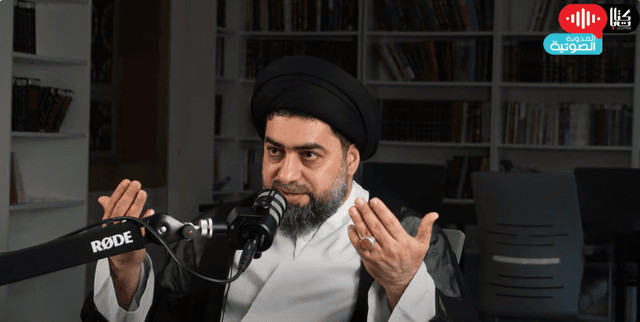
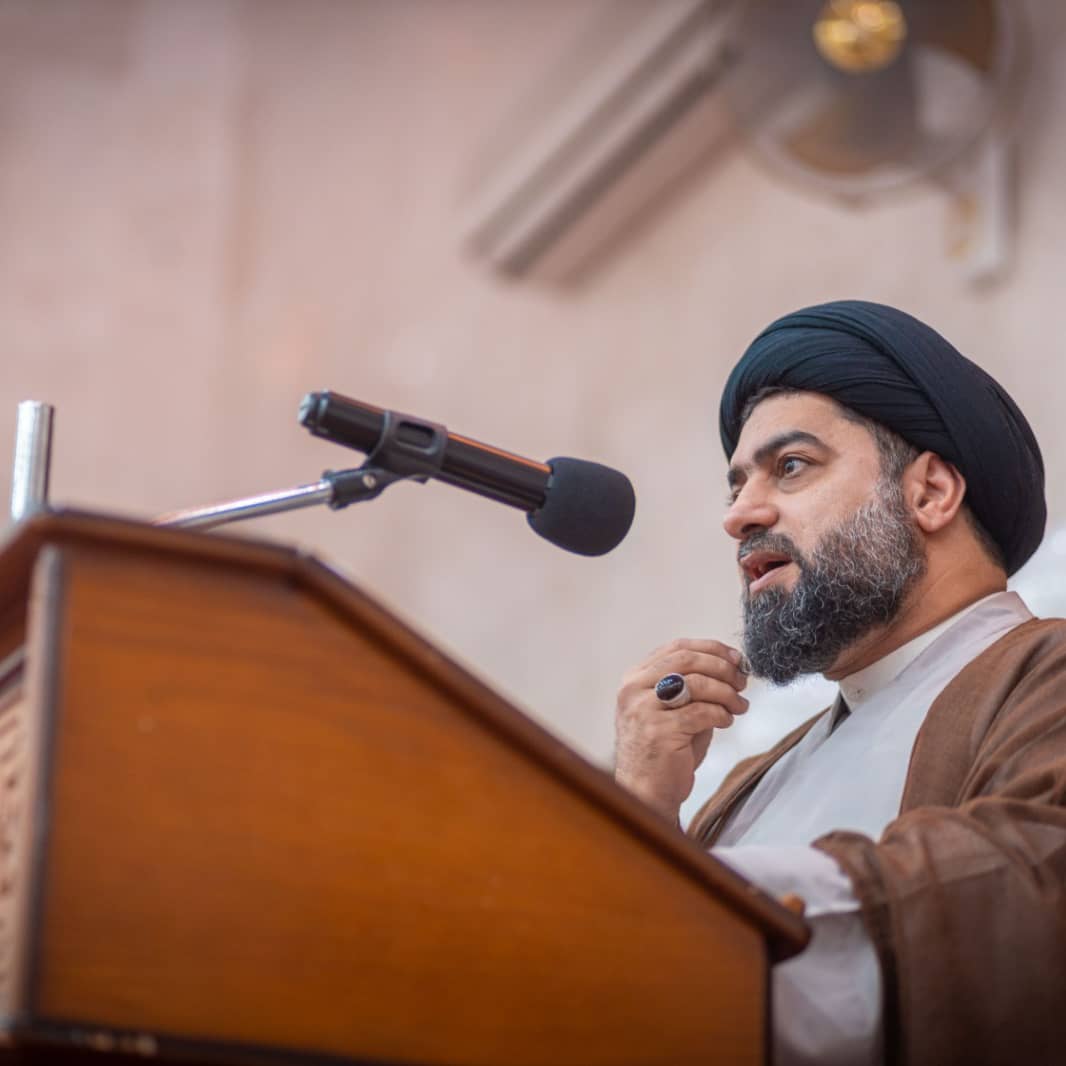
Sayed Mahmoud Al-Mosawi participated in the Return to the Qurʾan Conference as chair of the platform in the two sessions of the conference, and he participated in drafting the speech of the organizing committee and the final statement of the conference.. He also had an opening speech for the second night..
This is the report of the conference. The First Session
.
The Return to the Holy Qurʾan Conference opened its tenth session in Damascus of al-Sham on Tuesday 28/ Rajab/ 1427, corresponding to 22/8/2006, in the vicinity of al-ʿAqila Zaynab al-Kubra (a).. under the slogan
(The Qurʾanic Question in Contemporary Islamic Thought..)
This was under the patronage and organization of the Center for Islamic Studies and Research at the Hawza of Imam al-Qaʾim (aj), and the conference consists of two sessions on two consecutive days.
Its first session began with the recitation of verses of the Wise Reminder, recited to those present by His Eminence Shaykh Amid Baqirov
Then His Eminence Sayed Mahmoud Al-Mosawi, the director of the sessions, began the opening session
Sayed Mahmoud Al-Mosawi, the director of the sessions — by offering a greeting to the Islamic Resistance in the Lebanon of steadfastness, represented by Hezbollah, and he called on those present to recite al-Fatiha for the souls of the righteous martyrs.
Then he offered congratulations to the Islamic Ummah on the great victory in Lebanon, and felicitations on the occasion of the noble Prophetic Mission..,
Then Sayed Al-Mosawi read the speech of the organizing committee, in which it was stated: In the midst of the American-Zionist aggression on the Lebanon of the Islamic Resistance, the honorable believers inscribed a heroic epic with which the falsehood of the myth of the invincible army collapsed, and with which the cultures of submissiveness and political domestication were laid bare, just as through it regard was restored to the culture of reliance, patience and steadfastness.
Then the speech touched on the difficulties that faced the brothers, the organizers, under the bad circumstances of the repercussions of the Zionist aggression on Lebanon, and it gave special thanks to His Eminence Shaykh Shafiq Jaradi, who insisted on participating in the conference with an important paper that he presented in the first session.
The speech touched on the reasons that led the brothers, the organizers, to choose this slogan this year, and in it was stated:
— The Qurʾan is the axis of the life of the Ummah and the sole source of its legislation, its culture and the form of its life.. It is the message that has supremacy over all the messages of Allah, and it is the firm rope of Allah connecting heaven and earth,
— The necessity of consolidating Qurʾanic culture and restoring regard for consulting the Qurʾan is strongly manifest in this circumstance, where the arrogant nations and their partisans among the hypocrites and the misguided have banded together against the believers who are patient in the truth.. This necessity consists in:
1— The Qurʾan is the mediating act of the Ummah and its unifying identity..
2— The re-sending-down of the Qurʾan through its renewed interpretation is the path to reviving the Ummah..
Thus the renewed sending-down of the Qurʾan through its interpretation requires critical reviews of the customary methods, which contributes to the development and refinement of the methods and of the Qurʾanic sciences that are the foundation of the exegetical methods..
From here the conference had three tracks, which are:
1— Renewed reading (rooting and contemporaneity)
2— A critical review of the experiences of modern readings.
3— Prospects for developing Qurʾanic study in the hawza sciences.
Then Sayed Al-Mosawi gave a brief introduction to those present on the first night, namely..
1— His Eminence Shaykh ʿAli Hilal al-Suyud from Saudi Arabia.
2 His Eminence Shaykh Shakib Badira from Tunisia.
3— His Eminence Shaykh Shafiq Jaradi from the steadfast land of Lebanon.
Then the brothers present listened to an audio address by telephone from His Eminence
the Sayed, the marjaʿ, Grand Ayatollah Sayed Muhammad Taqi al-Modarresi (may his noble shadow endure).
Then the sessions of the conference began with the paper of Shaykh Shafiq Jaradi, which was titled:
Shaykh Shafiq Jaradi — The Religious Text between Sanctity and the Historicity of Knowledge..
After returning the Lebanese greeting, he said:
The connection of the religious text with sanctity or with historicist knowledge, as a purely human knowledge, raises a problem with multiple aspects, among them:
1— The association of sanctity with human reality..
2— Raising a kind of contradiction between what is sacred and what is human
3— The turning away from the origin and the governing consideration between the abstract and the temporal..
He defined the text by the various statements of the scholars and divided the text into three directions
1— The informational text.
2— The scientific text.
3— The literary text.
He pointed to what (Muhammad Ahmad Khalafallah) took up concerning the literary text and Qurʾanic stories..
He criticized him because he rejected any truthfulness in the historicity of the Qurʾanic story because, for him, it...
He pointed to the poisons of the Orientalists in this idea, since he conveyed the words and ideas of (al-Sayyid Raski, Ghadah and Lamfis)..
Then His Eminence the Shaykh, the researcher, turned to some Eastern calls influenced by Orientalism, such as Mohammed Arkoun and others.
His Eminence Shaykh Jaradi arrives at the end of the course and says: those confident in the sanctity that is neutral toward reality and history will remain before an exceptional task that reconciles and builds the relationship between the vision based on language's probing of the realities of existence and the levels of the religious text...
especially since this approach goes so far as to say: the Qurʾan is renewed in its sending-down upon the hearts of those who recite it.
The renewal of the sending-down means movement, with all that it requires of consideration for time, place and conditions, without impairing the sanctity of the truth and its authenticity...
Then came the speech of Shaykh ʿAli al-Suyud, and his paper was titled The Methodological Additions of the Tafsir Min Huda al-Qurʾan (by the Sayed, the marjaʿ al-Modarresi)..
He pointed to several issues as an introduction to the study:
Shaykh ʿAli al-Suyud delivering his paper. 1— The necessity of distinguishing between exegetical additions and methodological additions..
2— Tafsir Min Huda al-Qurʾan shares some tools with certain exegeses, but it differs from them in employing some of the tools relied on in exegesis, such as the noble narrations—
for the Sayed in his exegesis relied on the Sunna in deriving several things:
1— In the aims of the surahs, where he pointed to a number of factors after establishing the mechanism of induction — from the openings and endings of the surahs, the spaces that ideas occupy and the importance highlighted in the styles of expression — he paused at the hadiths on merits and showed the singularity of His Eminence the Sayed in this derivation.
2— Deriving the real intended meaning (that is, the final — functional one) in some instances, especially in cases of ambiguity..
3— Starting from the interpretive narrations, to study correspondence (as interpretive examples) and to prepare for reading the present age.
This last matter serves as an answer to the question of how to read the Qurʾanic verses and apply them to new variables and events, so that we are not content with the models mentioned.
In speaking of the methodological additions, the Shaykh pointed to two issues, which are:
The first: establishing the meanings of the Qurʾan: he asked about the way to come to know the meanings of the Qurʾan: is it language only.. or are there other fields and other places for knowing the meaning of words such as (fitna).. and (mawla).. So what is the real meaning of the word.. and where do we find it..?
He mentioned that the Sayed, the marjaʿ al-Modarresi, returns us to three sources for knowing the meaning of the word through the books of language..
1— Searching for the instances of the word's use in the Holy Qurʾan.
2— The Qurʾanic context.
3— The noble narrations and hadiths..
The second: the aims of the surahs.. and this Sayed al-Modarresi treated with new mechanisms for contemporary Qurʾanic exegesis..
That was followed by a study by His Eminence Shaykh Shakib Badira of Tunisia, titled:
Shaykh Shakib Badira delivering his paper (Thematic Exegesis and Modern Kalam according to the Martyr al-Sadr the First
In it the researcher approached the methodological mechanism of thematic exegesis, whose features the Martyr al-Sadr contributed to establishing, in a manner that made of it the epistemic roots for building a pattern of thinking that lays the foundation for modern kalam, after the propositions of old kalam had become unable to encompass the problems of the new reality, which interacts with broad arenas of intellectual and cultural systems. This gave this study the benefit of this epistemic discovery, whose features circumstances did not permit the Martyr al-Sadr to complete. The researcher pointed out that he is not the first to point to the Martyr's contribution to building the new kalam, but what is new in his study is the link between the methodological founding of thematic exegesis and the new kalam in the Martyr's thought, while pointing out that it is the path through which the Martyr tried to present a new understanding of the text, one that lays the foundation for constructive approaches with which a number of modern doubts and problems are repelled.
Having relied on this understanding, the Shaykh set out from it to explain the thematic method and its characteristics, showing the differences between atomistic exegesis, of a passive character, which deals with a verse or a passage without any prior assumptions that create a dialectical relationship between the external and internal subject in the texts, whether negatively or positively, and thematic exegesis, which attempts a Qurʾanic study of a subject from the subjects of doctrinal, social or cosmic life; this is the way that enables creative ijtihad to reach what lies beyond the linguistic and verbal signification. The Shaykh said here: ( Thus exegesis, according to the thematic method, takes on a clear theological aim: words and verbal compounds no longer have merely linguistic significations; rather, gathering them within a small system centered on one subject will give them new theological significations ). This way is accomplished only through dialogue with the Qurʾan rather than listening to it, in order to discover the Qurʾan's position on the subject under discussion and the theory that he can draw from the text. The Shaykh considered this way as the addition of a strong synthetic dimension to the textual-rational method relied on in the science of kalam
The Shaykh pointed out that in this founding it is necessary to attend to the doubt concerning interpretation, which can make thematic exegesis a thing prohibited by the Sharia, standing as a barrier to this founding; this is the ideologizing of texts with the epistemic presuppositions carried by the exegete. He repelled this through the Martyr's exclusion of any attempt that subjects the Qurʾan to human experience, rather unifying it with the text in a single context so that extracting the Qurʾanic concept becomes possible. The Shaykh paused at this, making its completion lie in the practical test
Then he surveyed the Martyr's experience in thematic exegesis with some assessment and criticism, beginning with the Martyr's first attempts in some of his studies, such as the Qurʾanic concept of freedom and his book Iqtisaduna, from which the Shaykh took up a number of directions in which the Martyr founded the social structure in the light of thematic exegesis, dealing in them with multiple headings and models in a way that deserves review and study.
After the last paper, Sayed Al-Mosawi, the director of the session, excused himself from the interventions of the brothers present due to the shortness of time, and promised them to make up for that in the second session.
The Second Session
The second session of the Return to the Holy Qurʾan Conference, in its tenth session, convened on Wednesday evening
29/ Rajab/ 1427 AH, at the Safir al-Sayyida Zaynab Hotel in Damascus, where it opened with a blessed recitation of the Holy Qurʾan, recited to the hearing of those present by His Eminence Shaykh Amid Baqirov,
The Qurʾan reciter Shaykh Amid Baqirov
The First Paper
After that, the chair of the platform, His Eminence Sayed Mahmoud Al-Mosawi, welcomed those present and introduced to them the researchers participating that night, and apologized for the absence of Ustadh Mutawakkil Muhammad ʿAli, the lawyer, whose circumstances prevented him from participating in the conference.
He presented the first researcher, Dr. ʿAbd al-Karim al-Shibli, whose study came under the title (The Method of Recent Orientalist Qurʾanic Studies)
At the beginning of his study he pointed to the necessity of acknowledging that Orientalist research and its copious studies are what today determine the West's view of Muslims, and consequently shape, with their enormous means, global public opinion toward
Dr. ʿAbd al-Karim al-Shibli from Tunisia delivering his paper on the second night of the Return to the Holy Qurʾan Conference in its tenth session — Islam, Muslims and their heritage. He affirmed that these studies, despite their claims to being scientific, harbor political and ideological motives. He pointed to the success of Orientalism in establishing venerable and very active research centers in various Western countries, which have their radiance and global weight, and have their followers even from Islamic universities. He pointed out that his study aims to unveil the most dangerous of these schools and the most hostile to Islam and its most important figures, while attempting to review their methods and the most important topics that absorbed their interests, and while drawing out the real motives behind these studies and their relationship with the Zionist movement
The researcher pointed out that the European schools of Orientalism gave rise to two groups that summed up the position of the West:
— A group of open haters, who are prejudiced against Islam and its civilization and incline to the claim that the Holy Qurʾan is adapted and copied from the Bible.. At their head are Hirschfeld, Horovitz and Speyer.
A more moderate and fair group that claims objectivity, but whose conclusions conflict.. This current was represented by Goldziher, Nöldeke, Schwally and Margoliouth..
He mentioned that the most active centers in the field of Islamic studies today are Leiden, London, the Israeli entity and the American states. Then the researcher took up examples of the Orientalists' research, among them their attempt to search for the antiquity of an Arabic Bible (the Torah and the Gospel), dating back to before Islam, so that they would have the right to attribute the Holy Qurʾan to those books and accuse the Greatest Messenger of having been an Arab author who composed the Qurʾan, in their false claim, from those ancient books. In this context he took up the verses that negate this, and he mentioned that these claims made by the Orientalists in this age are the very ones with which the Arab polytheists accused the Greatest Messenger, but the Holy Qurʾan confounded and silenced them.
The researcher pointed to some Orientalist studies that examine the possibility of the Messenger's knowing ancient languages such as Greek, Syriac and others, thereby rejecting the Messenger's being unlettered as mentioned in the Holy Qurʾan, tracing it back to the Western Jewish root that applies the term “the nations” to non-Jews, so that “al-ummi” is an attribution to “the nations”; and this is a preliminary to denying the Messenger's knowledge of writing and reading, which means that he was able to read and learn from the Torah during his trading journeys. He pointed out that if this attribution is sound, it only means that Allah sent a messenger from other than the Children of Israel to them and to all the nations. In this context the researcher pointed to a set of Qurʾanic words that Orientalism claims are Hebrew words and Jewish terms, ignoring the Semitic root of both the Arabic and Hebrew languages.
The Doctor also pointed to Orientalist research on the distortion of the Holy Qurʾan, based on their research into the differences of readings.
The Second Paper
After that, His Eminence Shaykh ʿAbd al-Ghani ʿAbbas from Saudi Arabia came forward with his paper
Shaykh ʿAbd al-Ghani ʿAbbas delivering his paper. on the second night of the Return to the Holy Qurʾan Conference in its tenth session — which came under the title (Qurʾanic Knowledge and the Tafkik Reading), at the beginning of which he affirmed that the noblest of sciences is that connected with the Holy Qurʾan and the sayings of the Infallibles, because the nobility of a science derives from the nobility of its source, and Allah, Glorified and Exalted is He, is the source of the Holy Qurʾan and the purified Sunna. No two Muslims differ on the authority of the Holy Qurʾan and the purified Sunna; the difference is rather in the method of dealing with them. His Eminence gave examples of some methods of dealing with the Holy Qurʾan that have no connection to the Qurʾan and the purified Sunna, mentioning the attempt of one of the brothers to gather the verses of existence in the Holy Qurʾan and apply them to a study by an American woman doctor, in which she divides existence into six stages. The researcher also took up the philosophical method and gave two examples of philosophical exegesis in what Ibn Sina and al-Farabi singularly held in their exegesis of some verses.
Then the researcher took up the statements of the Tafkiki school, which is the school attributed to Mirza al-Isfahani and which summed up the sources of human knowledge in three sources: revelation, reason and unveiling. He faulted it for limiting its exegesis of the Qurʾan to the purified Sunna as a reaction against the philosophical methods. The researcher mentioned several things that he said help in understanding the Qurʾan and its exegesis:
1— Exegesis of the Qurʾan by the Qurʾan.
2— Exegesis of the Qurʾan by the narrations transmitted from the Messenger of Allah and the Ahl al-Bayt.
The researcher affirmed that exegesis of the Qurʾan by the Qurʾan — if we attain it — is the best of the types and forms of exegesis. It has found acceptance among most scholars.. The researcher pointed to three indispensable axes:
1— Referring the metaphorical to the definitive in the Holy Qurʾan..
2— Understanding the contextual role of the Qurʾan..
3— Harmonizing the Qurʾanic verses.
3— Not interpreting the Qurʾan by personal opinion and ijtihad.
The researcher pointed to the slowness of Qurʾanic studies compared to the other sciences such as jurisprudence and usul, and he called for separating the verses of rulings from their Qurʾanic context.
After Shaykh ʿAbd al-Ghani ʿAbbas finished delivering his paper, the floor was opened for interventions:
His Eminence Sayed ʿIzz al-Din al-Faʾizi came forward with two interventions, one of them for Dr. al-Shibli, whose valuable paper he praised, describing it as civilizational and contemporary, touching the contemporary work of the Jews and the circles of global arrogance. He said that my remarks to the honorable
Sayed ʿIzz al-Din al-Faʾizi delivering his intervention to Dr. al-Shibli on the second night of the Return to the Holy Qurʾan Conference in its tenth session.
Doctor concern our defining a position toward these incursions, and the question is: are there proposals and remedies for what confronts us.
The Doctor answered that the paper was drafted to draw attention to these proposals and did not propose solutions; but we call for dedicating research centers to follow what is being plotted against the Islamic Ummah, at the level of the Orientalist research centers, materially and morally.
Then Sayed al-Faʾizi objected to Shaykh ʿAbd al-Ghani ʿAbbas for his rejection of the philosophical and hikmi methods in the exegesis of the Qurʾan. Shaykh ʿAbbas answered him that the objection is not directed at the philosopher personally, for a person of any specialization has the right to take up the Qurʾanic verses on condition that he does not impose his opinion on the Qurʾan.
Then Engineer Muhammad ʿAli al-Dayri came forward, after praising Shaykh ʿAbd al-Ghani ʿAbbas and his paper, asking about this return to the Holy Qurʾan amid the sectarian conflict raging between the sects and schools of thought: where are we in relation to applying the Qurʾan and to the Qurʾanic sciences, where are we in relation to the movement of the Qurʾanic sciences, which call for unity and harmony.
Engineer Muhammad ʿAli al-Dayri delivering his intervention to Shaykh ʿAbd al-Ghani ʿAbbas on the second night of the Return to the Holy Qurʾan Conference in its tenth session
Shaykh ʿAbbas answered, saying:
I agree with the brother that there is a real methodological flaw in our hawza life.. with regard to Qurʾanic studies.. But I observe on the horizon that Qurʾanic studies have begun to expand to address many legal, political and scientific problems..
We are all called to study the Qurʾan in order to benefit from it.
Then Shaykh Hani al-Hakim recited the final statement of the tenth conference and read the recommendations it produced this year.