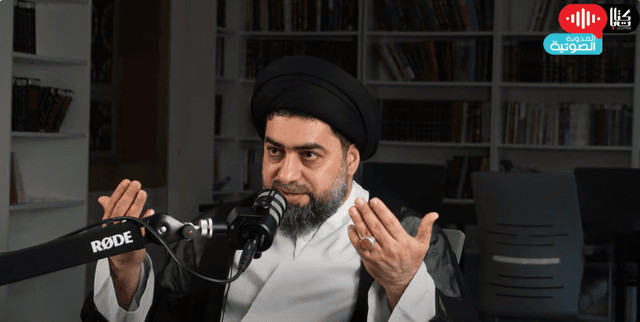
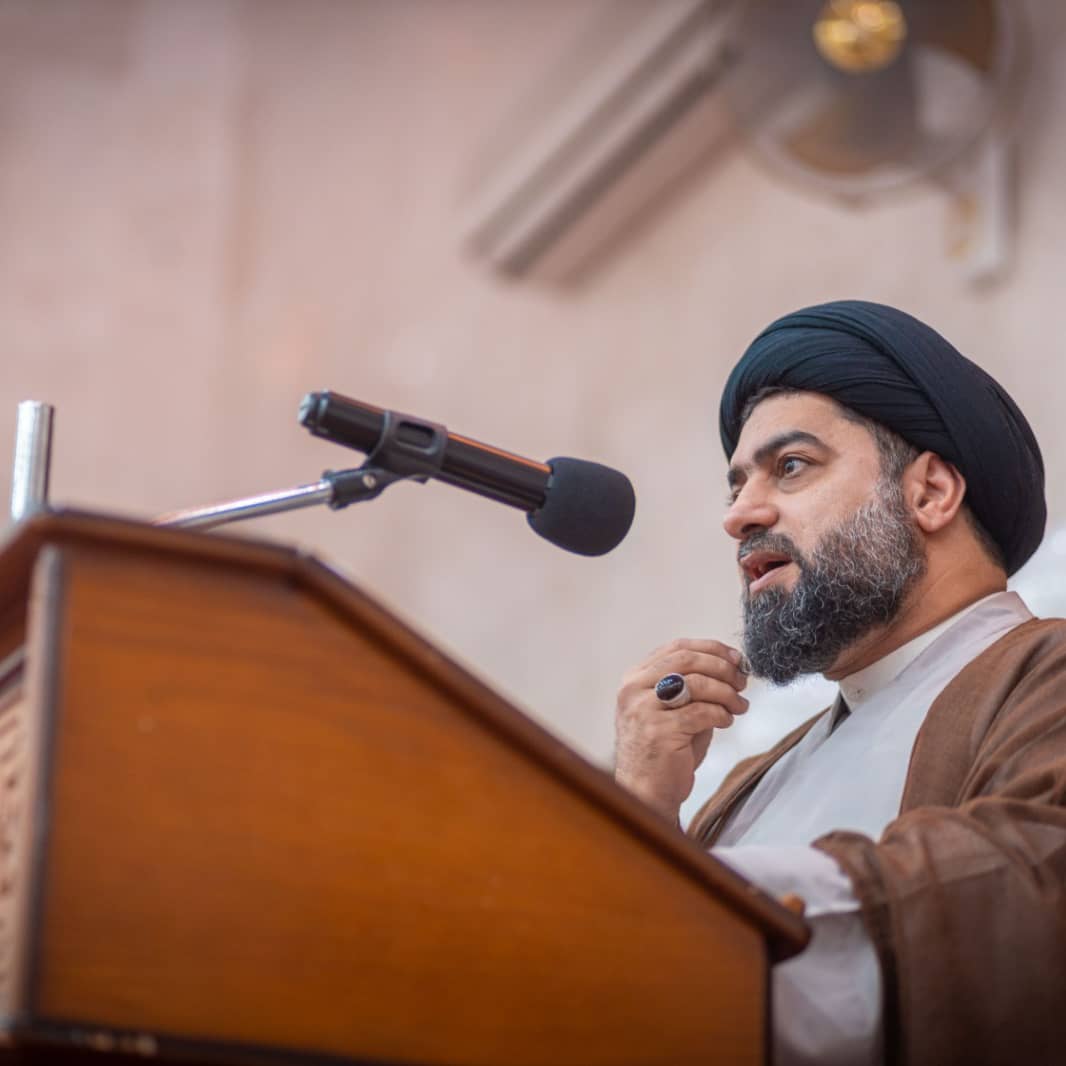
In the lecture, which lasted an hour and a quarter, Sayed Al-Mosawi spoke about eleven points concerning the factors and secrets of success in marital relationships, drawn as inspiration from the passage in which al-Zahraʾ (a) spoke of Imam ʿAli (a) approaching the house and entering it, in the text of Hadith al-Kisaʾ, whose narration is reported from al-Zahraʾ (a)..
.
Here is the text of the written lecture.. (with some of the pictures)..
It will be made available in audio on the website soon, if Allah the Exalted wills..
(Hadith al-Kisaʾ and the Secrets of Success in Marital Relationships)
When Fatimah reached womanhood, the nobles of the people and those who believed themselves to be among the eminent came forward for her. Abu Bakr and ʿUmar came forward to seek her hand, and the reply of the Messenger of Allah (s) was that he was awaiting the command of Allah concerning her.. until the people, among them the latter two, felt that the Messenger of Allah was reserving her for ʿAli (a), and they informed ʿAli of the matter.. So he set off to ask for her, for the shortness of his means had been holding him back.. He came in a state of modesty before the Messenger of Allah (s).. and came forward to seek the hand of Fatimah (a)..
The face of the Messenger (s) lit up with joy,.. and he said to the Imam: Allah married you to Fatimah (a) in heaven before I married you to her on earth.. for Gabriel informed me that Allah called the angels to assemble in the fourth heaven, and Paradise, the wide-eyed houris and the Tuba tree were adorned.. The angel Rahil delivered a sermon upon a pulpit of light (and it is the pulpit on which Adam had been), he delivered the marriage sermon.. Then Allah commanded Gabriel to conduct the marriage contract, and he wrote it on a white piece of silk and called all the angels to witness it.. The heavens and the earth shook with joy.. and the Tuba tree quivered with delight and scattered the robes and ornaments that were on it.. The angels and the houris caught them, giving them to one another as gifts and taking pride in them until the Day of Resurrection..
Then the Prophet (s) went out to the mosque and announced the blessed marriage before all witnesses..
· For this reason, we take from the marriage of ʿAli and al-Zahraʾ a model to follow in life..
The Messenger of Allah (s) bore witness to this blessed marriage on the blessed wedding night, when he said to ʿAli (a): O ʿAli, what an excellent wife your wife is, and he said to Fatimah: O Fatimah, what an excellent husband your husband is)..
· Hadith al-Kisaʾ is nothing but a single event, yet you recognize the merit in the people of merit, even from a single situation in which many meanings are condensed..
· Because the words of the Ahl al-Bayt (a) are precise and expressive, we draw from Hadith al-Kisaʾ the secrets of success in marital relationships, since it is the act of an Infallible in the narration of an Infallible.. (It is reported from Imam al-Rida (a): (Indeed, in our reports there is the definitive, like the definitive of the Qurʾan, and the metaphorical, like the metaphorical of the Qurʾan; so refer their metaphorical to their definitive).
Let us now come to drawing inspiration from the insights of Hadith al-Kisaʾ, which al-Zahraʾ (a) narrated, and devote the discussion to the passage that contains the approach of Imam ʿAli (a) and al-Zahraʾ's account of it..
Woman and Managing the Home
1/ Hadith al-Kisaʾ makes clear that it was al-Zahraʾ (a) who received them one after another; the father, the husband and the children were outside, while she (a) was in the house. This indicates that the responsibility of al-Zahraʾ (a) was her home in the first degree..
For this reason the discussion comes to the ideal situation for the wife, as the Exalted said: “Stay in your houses” (Qurʾan 33:33), which is settling in the home and managing the home, as an ideal state and a basic responsibility. This does not mean confinement, but rather settling, and there is a difference between the two meanings (confinement is holding back, and it is the opposite of setting free, whereas settling..
The Messenger (s) drew for the house of al-Zahraʾ and ʿAli the limits of their responsibilities .. (ʿAli outside and Fatimah inside the home)..
As for the wife going out to work, that is, having another concern besides the home, this takes four forms:
a/ That she goes out out of necessity (such as having no one to support her, or her husband not meeting the requirements of the home or being unable to).. So she is striving in something necessary, and that may be obligatory..
b/ That she goes out out of need, but one that does not reach necessity, such as expanding and raising the standard of living and providing suitable education for the children, or in order to live like those of her level among people, and the like.. This may fall within what is recommended..
c/ That she goes out only for the desire to work and obtain money, while having no need of it. This is permissible..
d/ That her going out is a danger to her, or that she causes danger (that is, she is a temptation to people, or she is tempted). This is forbidden..
In all of these forms, she has in the end added another responsibility to herself, because she must balance home and work, and this requires three things of her:
a/ More effort. (Because it is additional effort).
b/ And more culture. (So that she is able to manage the home in her circumstances).
c/ And more protection.. (adherence to the hijab and covering, and avoiding forbidden mixing).
2/ Family News and the Marital Relationship
The one who narrated Hadith al-Kisaʾ is al-Zahraʾ (a), and she narrates what happened in her home and to the members of her family.. She narrated it to Jabir ibn ʿAbd Allah al-Ansari, and he in turn conveyed it to the people, and the generations have passed it on, generation after generation..
Is it then proper to relate news of the marital relationship?
We must take into account the question of how much benefit there is, or whether there is none.. Not every piece of news is to be told, nor is there to be the concealment that leads to misery..
One must mention the good qualities, not the faults
There are secrets in the marital relationship that should not be mentioned, among them covering a fault (she covers his fault), and also mentioning the private sexual life.. (Imam ʿAli (a) says: (The cause of harmony is fidelity). Part of fidelity is not spreading the fault of the husband or the wife..
Allah says “Righteous women are obedient and watchful in the absence [of their husbands] in guarding what Allah has enjoined [them] to guard” (Qurʾan 4:34), meaning that wives should also guard themselves in the absence of their husbands, because the woman's standing is part of the man's standing, for she is his honor; so she should guard herself from cheapening herself before others..
Mentioning faults without a plan for finding a solution causes psychological displeasure..
(A story: the young women who would mention their husbands and their negative points, and they felt weary and that life was constricted. After that they were told: Come, let each one mention her husband and only his positive points. When they mentioned them, they felt joy and happiness)..
Even after divorce, some divorced men and women err in disclosing secrets. You see the wife and her family talking about the husband's faults, and likewise the husband and his family. They mention this in order to say that we are not the cause of the divorce, and in order to cast blame on the other party; but in doing so they act contrary to the commanded responsibility of covering if they are in the right, and they wrong, transgress and practice calumny if they are not truthful.. (A man divorced his wife, who was from a country other than his own, then he proposed to another woman from the same country. They asked the first wife about him, and she praised his character and advised them to marry her to him, because he is a good and well-mannered man)..
Likewise, concealment in some cases may cause deprivation of happiness and of finding solutions.. (speaking with one who can find you a solution, for a word may be the key to solving problems).. For this reason, emphasis has been reported on consulting the person of intellect..
Hadith al-Kisaʾ Contains a Supreme Benefit..
Hadith al-Kisaʾ, which al-Zahraʾ (a) conveyed, contains a supreme benefit for the generations; thus she conveys what is beneficial.. So one must distinguish how much benefit there is, or whether there is none, when mentioning this private matter..
3/ The Greeting of Peace Is the Beginning of the Meeting (so that it may govern the meeting). The first of speech is the greeting of peace. Imam ʿAli (a) said upon his coming: (Peace be upon you, O daughter of the Messenger of Allah..) The recommendedness of initiating the greeting of peace..
(In order to show the intention of good; thus it casts an atmosphere of peace over the home throughout one's presence, because you entered with this intention, and a person is by his intention, and (Deeds are only by intentions).. (so it is like an air freshener)..
The greeting of peace works like magic in marital relationships.. (The story of the man who came to the scholar and said that tension governs my home with my wife, and he advised him to give the greeting of peace)..
Coming in silently.. what does it mean?
b/ The person arriving has no importance (he wants to come in and go out without anyone feeling his presence, and after that he says: You do not give me attention!!). Whoever wants attention must create the preliminaries of attention..
Other Benefits of the Greeting of Peace in Homes
· The greeting of peace in homes is a blessing for them (continuous good) “So when you enter houses, greet yourselves with a salutation from Allah, blessed and good.” (Qurʾan 24:61), and the Messenger (s) says: (Greet whomever you meet with peace, and Allah will increase your good deeds; and give the greeting of peace in your home, and Allah will increase your blessing).. A benefit from the unseen.
Even if no one is present in the home you give the greeting of peace, because it is a blessing in itself (from Imam al-Sadiq (a): (When a man among you enters his home, if there is someone in it, he greets them with peace; and if there is no one in it, let him say: Peace be upon us from our Lord. Allah says “a salutation from Allah, blessed and good” (Qurʾan 24:61).
· The greeting of peace in homes is for preserving privacy and security.. Imam al-Sadiq (a) said: (A man gives the greeting of peace when he enters upon his family, and when he enters he strikes with his sandals and clears his throat; he does that so as to notify them that he has come, so that he does not see anything he dislikes).
Al-Zahraʾ (a) says in Hadith al-Kisaʾ.. (Thereupon Abu al-Hasan, ʿAli ibn Abi Talib (a), approached).
“The difference between (aqbala), (jaʾa) and (ata): the first indicates a kind of iqbal, unlike (jaʾa). Likewise, (ata) has the meaning of giving infused in it, and that is why there has been reported “and give the zakat” (Qurʾan 2:43)”. Min Fiqh al-Zahraʾ (a), vol. 1, p. 164, al-Shirazi.
And good receiving.. has two aspects:
The first aspect: the reaction (interacting with the husband). Speech is directed toward some direction, so its echo must come back; otherwise it is as though it went to nothing.. The one who gets no answer or interaction is undoubtedly displeased, and this is a sign of marginalization..
(Listening attentively and listening well..)..
The second aspect: taking care in receiving, by returning the greeting of peace, by a cheerful face and by good speech (returning the greeting of peace). This is a good response.. It has come in Hadith al-Kisaʾ, the saying of the Commander of the Faithful (: Peace be upon you, O daughter of the Messenger of Allah; so I said: And upon you be peace), so al-Zahraʾ (a) returned the greeting of peace..
(Not that she starts him off with demands, or that he says: Peace, and she says: What peace, when you have not done this thing and that.. What peace, when this son of yours has been giving us trouble..)..
(The saying of Imam ʿAli (a): I would look at her, and griefs and sorrows would clear away from me by my looking at her)..
Imagine that you are weighed down by worries, debts and problems, and you are told that all of that has been solved.. The worries clear away from your heart and you feel complete ease.. This is the effect of cheerfulness and good receiving.. Worry affects a person, so it is important that he live at ease and face worries..
The type of receiving determines the type of relationship and its beginning.. A positive response will prepare the psyche even for requests, but everything in its time and in its manner.. A negative response unsettles the psyche, and likewise no interaction can be hoped for from it..
5/ Respect in Addressing and Calling.
Imam ʿAli (a) said: (: Peace be upon you, O daughter of the Messenger of Allah)
And al-Zahraʾ (a) said And upon you be peace, O Abu al-Hasan and O Commander of the Faithful).
The Imam also said (O Fatimah, I smell at your place..).
It is recommended to address by the most beloved of names, and it is recommended to address by kunya (Abu al-Hasan, especially if the person is present..
The problem of epithets and coarseness in speech (Don't you hear? O mother of so-and-so.. or with the names of animals)..
What is strange is that I have seen some magazines claiming to specialize in marital relationships publishing a booklet on how a husband should address his wife, presenting some ways familiar to some people, among them: O my dog, O my pig, ..
“O you who have faith! Let not any people ridicule another people: it may be that they are better than they are; nor let women [ridicule] women: it may be that they are better than they are. And do not defame one another, nor insult one another by [calling] nicknames. How evil are profane names subsequent to faith!” (Qurʾan 49:11).
6/ Mentioning the Good Qualities of the Spouse
And al-Zahraʾ (a) said: And upon you be peace, O Abu al-Hasan and O Commander of the Faithful).
The phrase Commander of the Faithful is an important attribute of Imam ʿAli (a); it is a positive attribute and a rank he attained from Allah the Exalted and from the Messenger (s), so she mentions this attribute in him..
The phrase (daughter of the Messenger of Allah) is an honoring of her standing and a statement of her connection to her father.. Therefore, when she wanted to teach the people her standing in her sermon, she said (You will find him to be my father, not that of your women)..
From this is derived the importance of the spouses' mentioning each other's good qualities, and not neglecting this aspect.. So he should not say that she knows that I am aware of her standing, nor should she say that he knows that I value him; it must be shown from time to time.. Al-Zahraʾ (a) knows that Imam ʿAli knows that, yet he shows it.. Likewise, the Imam knows that al-Zahraʾ (a) knows that he is the Commander of the Faithful, yet she shows that..
For this reason it is necessary that a person speak and utter what he knows and what he feels.. (The Messenger (s) says that a man's saying to a woman “I love you” never leaves her heart)..
Therefore it is of great importance that each of the spouses mention the good qualities of the other. The benefit of mentioning good qualities:
c/ And encouraging continuing in them and in the like of them),
When the husband is persevering and diligent.. this trait becomes firmly established, because he insists on it..
The role of the woman in her husband's success is very important (the story of the inventor of the Ford)..
(In the late twentieth century, a young man in Detroit in America was working for a company making lamps. He would finish his work and begin work at home on manufacturing a new type of engine.. His father was not convinced by his work, and the neighbors were not convinced.. Only his wife stood with him.. After three years, people heard a strange sound.. and there was this young man, whose name was (Henry Ford), riding with his wife in a carriage moving along with them without a horse.. This was the beginning of the invention of the car.. After Ford was asked what he would wish to be if he lived a second time in this world, he said: (It does not matter to me what I would be; what matters is that my wife be at my side)..
7/ Expressing a Positive Opinion
(. He said: O Fatimah, I smell at your place a pleasant fragrance as though it were the fragrance of my brother and cousin, the Messenger of Allah ),
Expressing a positive opinion about what you find in your wife or in your home (because the home is the woman's kingdom), for when you praise it you praise her..) (I smell at your place a pleasant fragrance).. (That is why it is said that backbiting a riding animal is considered backbiting its owner) (the car and its owner are the same thing)..
We notice two things in this piece of Hadith al-Kisaʾ:
First: the Imam said: (I smell at your place a pleasant fragrance), meaning noticing and expressing an opinion.. for the wife works and tidies, and finds no appreciation.. She needs a kind word..
Imam ʿAli (a) says: (Gratitude is greater in worth than the favor, because gratitude remains, and the favor perishes)..
Some pay no attention to thanking their wife for offering a glass of juice or tea, and likewise the wife.. This is an unhealthy condition..
Second: the Imam attributed the place to al-Zahraʾ (I smell at your place)..
Some always speak in terms of private ownership (he does not say our home, but rather my home.. I do not want in my home..), so he makes the other party feel a constant estrangement.. This is contrary to partnership.. It causes a state of separation..
8/ Respecting the Family of the Wife and the Husband
(I smell at your place a pleasant fragrance as though it were the fragrance of my brother and cousin, the Messenger of Allah)..
From this passage we can derive the importance of respecting the wife's family; although the father of al-Zahraʾ (a) is the Messenger (s), and it is obligatory to respect him and mention his good qualities, we can nevertheless also derive this aspect,
The Imam's mention of the bond of brotherhood, lineage and the Message.. makes evident the concern to show the degree of closeness..
Likewise al-Zahraʾ's saying at the beginning of the matter (Thereupon Abu al-Hasan, ʿAli ibn Abi Talib, approached).
She mentioned that he is the son of Abu Talib, who defended the Messenger of Allah (s) and kept harm away from him..
Each of the spouses must respect the family of the other, not like the customs current in some countries, where they bring up the mother-in-law as though she were the bogeyman..
And if someone arrives during a meal they say: Your mother-in-law loves you.. as though the mother-in-law must not love, or does not usually love..
9/ Children Are an Axis of Good for the Spouses.
Al-Hasan and al-Husayn are now with the Messenger of Allah under the cloak; they are in a lofty place and a blessed place, and they are now doing something good.. So here al-Zahraʾ (a) attributed the children, while they were in this positive state, to Imam ʿAli..
There is an important Qurʾanic rule that says “neither the mother shall be made to suffer harm on her child’s account, nor the father on account of his child” (Qurʾan 2:233).. That is, the presence of children should not be a factor of harm to the spouses.
The better state is for the children to be a positive factor in the family and the axis of good in it..
It has come in the hadith: (When we were all complete under the cloak, my father, the Messenger of Allah, took the two ends of the cloak and gestured with his right hand toward the sky and said: O Allah, these are the people of my household, my special ones and my intimates; their flesh is my flesh and their blood is my blood; what pains them pains me and what saddens them saddens me; I am at war with whoever wars against them, at peace with whoever is at peace with them, an enemy to whoever is hostile to them, and a lover of whoever loves them. Indeed, they are from me and I am from them; so make Your blessings, Your benedictions, Your mercy, Your forgiveness and Your good pleasure upon me and upon them, and repel impurity from them and purify them with a thorough purification).
The first: the very gathering of the family physically in one place is a favored and recommended thing, because the nearness of bodies helps the nearness of hearts; if bodies are dispersed and people are absent from one another, distance of hearts begins ..
It is necessary that the family gather together, so that it be affectionate and cohesive, attending to its affairs, discussing its concerns and getting to know one another..
Imam Abu Jaʿfar (a) says (Maintaining ties of kinship purifies deeds, repels affliction, increases wealth, extends one's life, broadens one's sustenance and endears one to the people of his household; so let him be wary of Allah and maintain his ties of kinship).
Most regrettably, in some families you do not see them gather; therefore a brother hears news of his brother outside the home, and indeed the wife hears some news about her husband from others..
The second: gathering at the table of remembrance
The whole family gathered at the table of remembrance and supplication..
Indeed Allah the Exalted says: “But whoever disregards My remembrance, his shall be a wretched life, and We shall raise him blind on the Day of Resurrection.” (Qurʾan 20:124))..
Living with remembrance and the places of remembrance (the holy shrines) and the family's gathering in them.. brings about a state of happiness, success and blessing..
“Behold! The hearts find rest in Allah’s remembrance!” (Qurʾan 13:28)..
Here, then, is the necessity and importance that a person attend to his children with regard to their gathering in places of remembrance..
Imam al-Sadiq (a) said: When the verse was revealed “O you who have faith! Save yourselves and your families from a Fire whose fuel will be people and stones, over which are [assigned] severe and mighty angels, who do not disobey whatever Allah commands them and carry out what they are commanded.” (Qurʾan 66:6)
A man from among the Muslims sat down weeping and said: I am incapable regarding myself, and I have been made responsible for my family.
The Messenger of Allah (s) said: It suffices you to command them with what you command yourself, and to forbid them what you forbid yourself) Makarim al-Akhlaq, p. 217
Imam ʿAli (a) said on the morning after the blessed marriage, when the Prophet asked him about Fatimah, How did you find your wife? Imam ʿAli (a) said: An excellent help toward obedience to Allah.
Relations with Deviant Families
As for relations with families that are deviant and far from Allah, this is liable to bring down wrath (gathering with those upon whom mercy descends entails being included in the mercy, whereas gathering with those upon whom the curse descends is a cause of being included in the curse as well) ..
Perhaps some speak in the name of freedom and openness to families.. and go about inviting to their home those far from Allah and those who do not refrain from indecencies and obscene speech).. Yet everything has effects, (educational effects and unseen effects)..