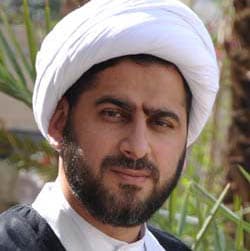
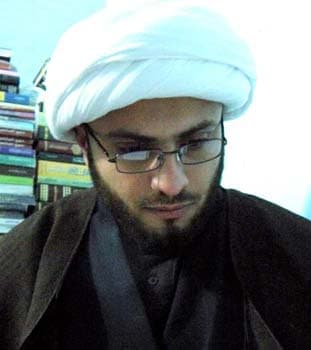
His Eminence Shaykh Muhammad Hasan Al Ibrahim
Many of us search for some effective role in the greatest religious, cultural, social and political demonstration that the Islamic world—especially the Shiʿi world—lives through; this demonstration is (the ʿAshura of al-Husayn (a)),
.
in which the Husayni youth, ablaze with the vigor of Karbala, form a volcano of activity and tireless work; for the Husayni values melt down spirits and souls and recast and remold them, and indeed employ them on a course such that, were it destined to continue beyond the time frame of the Husayni season, many realities on the ground would be transformed—but with its condition and its conditions; because this great demonstration, with the movement it teems with, expresses an unbridled desire for giving, and reveals latent energies through whose direction and guidance it is possible to advance many great projects.
The Concept of Giving and Its Source:
The shades of the meaning of giving, in the general sense, do not go beyond the meaning of generosity in its breadth and measure; but as soon as one says (Husayni giving), this confers upon its meaning the continuous act of giving, indeed the sustainable development of the springs and sources of this giving. Here we ought to realize that (Husayni giving) is a divine giving in every sense of the word.. Is not everything that al-Husayn (a) has the inheritance of the prophets, the truthful and the martyrs?
Yes indeed, we read in Ziyarat Warith about the greatest inheritance since Allah created the heavens and whoever is in them and the earths and whoever is upon them; this divine inheritance is the source of Husayni giving; is not (al-Husayn a lamp of guidance), like the sun, rising upon all creatures and existents every day and over every land and encompassing them with his light? And whether they believe in the existence of this light or do not believe, likewise Allah, Glorified and Exalted is He, supplies all creatures with existence, blessings and bounties.
Al-Husayn (a), as the inheritor of the messages of Allah—which are among the greatest gifts of the Lord to humankind—represents a continuous divine giving; and accordingly, the giving of “your Lord” is “an endless bounty” (Qurʾan 11:108)[1] and “To these and to those—to all We extend the bounty of your Lord, and the bounty of your Lord is not confined” (Qurʾan 17:20)[2]
Thus Husayni giving is a giving that is unlimited and endless, that is, it is:
1- A giving for all human beings. 2- A continuous giving for every time and place.
A Scene Drawn upon the Throne:
The scene of loftiness that our master Abu ʿAbd Allah al-Husayn (a) displayed in the face of falsehood made him (the adornment of the heavens and the earth), as a supreme exemplar of truthfulness, sincerity, patience and steadfastness, and consequently of the qualitative, unparalleled giving that astonished the angels of heaven and earth, made them weep, and won the badge of good pleasure and acceptance—indeed, of pride—from the Lord of the worlds, as there was engraved on the right of His Throne, Glorified is He: (al-Husayn is a lamp of guidance and an ark of salvation).
From al-Husayn ibn ʿAli ibn Abi Talib (a), who said: I entered upon the Messenger of Allah (s), and Ubayy ibn Kaʿb was with him, and the Messenger of Allah said to me: Welcome to you, O Abu ʿAbd Allah, O adornment of the heavens and the earths. Ubayy said to him: And how can anyone other than you be the adornment of the heavens and the earths, O Messenger of Allah? He said: O Ubayy, by the One who sent me with the truth as a prophet, al-Husayn ibn ʿAli is greater in heaven than he is on earth, and indeed it is written on the right of the Throne of Allah, Almighty: A lamp of guidance and an ark of salvation, and an Imam of goodness and auspiciousness, and might and pride, and knowledge and treasure ...)[3]
Therefore, the Husayni scene that took place in Karbala is a reflection from the glimmerings of the pavilions of the Throne.
And so that this radiant divine Husayni scene may be complete, the narration testifies that Allah, Almighty, is the One who took the soul of our master al-Husayn (a), without the mediation of ʿAzraʾil, by His words, Exalted is He: “‘O soul at peace! Return to your Lord, pleased and pleasing! Then enter among My servants, and enter My paradise!’” (Qurʾan 89:27–30)[4].
And for that reason Imam al-Sadiq says: (Whoever visits the grave of al-Husayn (a) on the day of ʿAshura, knowing his right, is like one who has visited Allah upon His Throne)[5]
So let us contemplate this great station that the All-wise Lord has marked out for Imam al-Husayn (a), as a pride in his giving and as an honoring and glorification of him, in order that we may conceive the magnitude of this great self-giving.
One of the gnostics says: (Al-Husayn (a) gave everything to Allah, so Allah gave him everything).
Giving.. Life:
As for bringing to light the greatness of Husayni giving, we ought not to calcify before it or freeze it like a still scene held behind a thin pane of glass and bounded by a thick golden frame!, but rather this outward bringing to light ought to be matched by an inward movement in every heart and mind, so that the lessons of Karbala turn into a practical reality and into a culture of life that rises anew every day and in every land, so that it becomes (every land is Karbala, and every day is ʿAshura).
The culture of giving that our master Abu ʿAbd Allah al-Husayn (a) carved into the Umma is considered one of the treasures—indeed, one of the secrets of its civilizational rise.
We ought not merely to describe this culture; rather, we ought to be certain of its wondrous capacity to work miracles—where what is meant here is not its capacity to manage the unseen in reality and then to change it, but rather its capacity to bring about qualitative change and leaps in lived reality, which many schools and intellectual currents of various orientations are unable to bring about; and this is the meaning of its working miracles.
The Islamic Resistance in Lebanon (as an Example):
The Islamic Resistance in Lebanon, through its old and its young, has been able to achieve historic victories at the level of the Israeli conflict and to defeat the forces of misguidance and global arrogance psychologically and on the battlefield; and that was nothing but one of the fruits of Karbala, of living interaction with the Husayni cause, and of an advanced and elevated understanding of the techniques of victory according to the divine Husayni concept.
Early on, the Resistance realized that the battle begins from creed, principles and culture; therefore it set about inaugurating infrastructures for education, awareness-raising and upbringing, in order to build the mission-bearing personality, capable of plunging into psychological and intellectual battles, and then battles in the field if need be. Giving has turned, for them, into a culture of life that they breathe every morning, so they have become masterful in their forms of giving (with blood, education, health, construction, and urban planning).
Mission-Driven Giving Is a Footing of Truthfulness with al-Husayn (a):
And because al-Husayn (a) is for every time and place, let us be Husaynis even outside the Husayni season, and let all the seasons of the year be Husayni seasons—and, in an equivalent sense, (seasons of the Mission). For our societies to rise and change for the better, giving must be sustained, and our giving must be proportionate, in quantity and quality, to the sacred Husayni giving.
We read in Ziyarat ʿAshura (O Allah, make for me a footing of truthfulness with You, with al-Husayn and the companions of al-Husayn, who gave up their lifeblood in defense of al-Husayn (a)). In this passage there is a clear indication of action and giving: in order for you to advance and draw near to the station of al-Husayn (a), you must love the action of al-Husayn and his giving, and this love requires that you prove the truthfulness of your claim to it, by the contextual indication of (make for me). For certainly what is meant is not that He make me love al-Husayn and his companions, since heartfelt love is already present; rather, what is intended is that Allah make for me and for you a righteous deed that is a confirmation of this love, and consequently this deed contributes to advancing toward al-Husayn and drawing near to his lofty station—in this world, where we take his noble stands, and in the Hereafter, in the gardens of bliss. And in this passage (who gave up their lifeblood in defense of al-Husayn (a)) there is another hint and allusion: that some people asked Allah for a footing of truthfulness with Him for them with al-Husayn, and so their footing of truthfulness became their being slaughtered and their women's being widowed; and thereby they deserved the companionship of al-Husayn (a) in this world and the Hereafter. So we must answer the following pressing question: Are you ready to give up your lifeblood in the way of Allah and in the footsteps of al-Husayn (a)?
Thus mere love is not enough to attain the station of bearing witness over the Umma, for the footing of truthfulness with al-Husayn (a) means acting, and not merely being moved.
Awareness of Giving:
The qualitative giving of Imam al-Husayn (a) is matched only by a qualitative giving from the aware youth of the Mission; therefore it behooves us to search for the quality of giving: what shall I give, where, when and how—and, more important than that, knowing (why), which means the goal and the aim of all that, and which ensures the consistency of the means with the goal.
The Fruit of Sincerity Is Giving:
In one of the masterpieces among the wise sayings of the Commander of the Faithful ʿAli (a), he likens sincerity to a living, productive and fruit-bearing tree, but (the fruit of sincerity is action); so if you want to be granted success in a work of the Mission, strip yourself, within your own self, for Allah, of all the idols of the heart, and you will see that you are granted success in action as an inevitable result.
We see many scenes in Karbala that represent the summit and peak of sincerity—indeed, in every one of its episodes there is a witness to that—especially the scene of al-Husayn (a) as he falls, struck down, upon the soft dust of Karbala, saying: (In the Name of Allah, and by Allah, and upon the creed of the Messenger of Allah..), and chanting, in a scene of passionate love and sincerity toward Allah, these well-known verses: (My God, I have left all creation entirely out of love for You ...). And as a result of this sincerity, Karbala has extended as a vast giving until this day of ours.
Patience Is the Fuel of Giving:
Among the most important elements of the radiance of Karbala as an instance—indeed, as a school—of giving is the presence of the value of patience in it in an unlimited way; because in every work you need a certain energy to do it, amounting to 20% of your daily effort, for example, but in order to be able to persist in it, you need multiples of this percentage; and if we look at the sacrifices of Karbala, which surpass all conception, we will realize that the patience in it and over it exceeded the bounds of imagination.
And when Imam al-Husayn (a) commanded his sister Zaynab (a) to have graceful patience, this was another giving that he (a) presented to us as a great lesson; and likewise it means continuity and steadfastness upon the very same Husayni line, because patience is a great part of the battle of truth against falsehood.
Therefore we find that the patience of Zaynab (a) turned into action, and so became a mission-driven extension of the battle of Karbala, more than its being a media and psychological war against the tyrant (ṭāghūt).
The Supporters Are the Spirit of Renewed Giving:
The supporters of Imam al-Husayn (a) set the most splendid examples of the warmth of the spirit of giving, its blaze and its burning. You find that clearly in their address to al-Husayn (a) when he tested them on the night of the tenth: each of them rose as a speaker, setting forth his certainty in jihad, his resolve and his steadfastness in self-giving and sacrifice, until one of them said (... If I knew that I would be killed for your sake, then brought back to life, then burned alive, then scattered, and that this would be done to me seventy times, I would not part from you until I meet my death in defense of you ...)[6].
This resolve to give is a true resolve and a serious and responsible will that expresses an aware perception of the value of giving in life and of the value of life through giving; therefore their spirits are ablaze with energy and vitality.. The Commander of the Faithful ʿAli ibn Abi Talib (a) says, in a sermon of his in which he describes the Godwary: (.. And were it not for the term that Allah has written for them, their spirits would not have settled in their bodies for the blink of an eye, out of longing for the reward and fear of the punishment...)[7].
And thus we ought to be in a renewed resolve for self-giving, giving and sacrifice of all kinds.
Giving Is Complementarity and Building:
Many are the lessons that we learn from this great season.. If we paid attention to the (dynamism) of the work taking place in this season and how the roles in it complement one another spontaneously, proceeding from each of us adopting some role that fills an ʿAshura need—if we contemplated this collective spirit –regardless of the shortcomings– we would find that a great civilizational edifice, of which we are worthy, awaits us, on condition that we work for it throughout the year. So if the cause of al-Husayn (a), (the dismembered body), is one for which we demonstrate 10 days of every year, then his other cause, (the squandered right), is one for which we ought to work all year long.
Muhammad Hasan Al Ibrahim
[1] -[Hud: 108]
[2] - [al-Israʾ: 20]
[3] - al-Haqq al-Mubin fi Maʿrifat al-Maʿsumin (a) - Shaykh ʿAli al-Kurani al-ʿAmili - p. 328
[4] - From Surat al-Fajr
[5] - Misbah al-Mutahajjid - Shaykh al-Tusi - p. 771
[6] - Adab al-Husayn wa Hamasatuh, p. 152
[7] - al-Muʿjam al-Mufahras li-Alfaz Nahj al-Balagha, p. 72