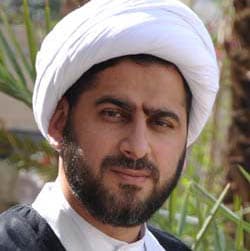
By: His Eminence Shaykh Muhammad Hasan Al Ibrahim
The orators of the Husayni pulpit are the chanters who drive the caravans of the believers, and the pioneers of the beacons of the awareness of the wayfarers.
The ayah, the word, the phrase, the half-line of poetry, the story, the proverb and the wise saying: these are the composition of their effective salves. They follow the example of a physician who goes about with his medicine, who has perfected his salves.
On them the rising generations rely in churning the waterskin of knowledge and in regulating the rhythm of refined feelings, in accordance with the aims of religion and the law of the Master of the Messengers (s).
For the Husayni majlis takes shape as a unique compound, rich in the arts of eloquence and influence, making its way to slipping, stealing and flowing into the depths of the listener, so as to pierce the barriers of awareness, penetrate to the core of the individual, enter into a person's character, and settle firmly in the depth of the soul ..
Perhaps among the most important components of the Husayni pulpit is what is known as the “nashid,” or the introduction or the qasid. By it I mean the Arabic verse that the orator recites at the beginning of the majlis from odes in classical Arabic.. The name was drawn from the narrations of the Ahl al-Bayt (a) that encouraged reciting poetry about Imam al-Husayn (a).
In its very being, this introduction approximates the vanguard of an army charged with tackling a battle!
Yes, a battle..
And what is more rugged than the battle of awareness?
It needs a vanguard that surveys its field from on high and prepares its arena for what follows it .. That is the function of the introduction of the Husayni majlis.
The openness of the soul to receiving kinds of guidance is prepared for in advance by the Husayni attraction, and its desire and passion are increased by that dewy melody, that plaintive mode, and the words of poetry overflowing with contemplation, reflection, tenderness, fervor, revolution, sorrow and lament ..
You will find the most effective discourse—sound in its idea—with one who has literary taste—and most of our orators, praise be to Allah, are so—as he takes elegant care in choosing verses that are eloquent, suitable, moving, and closest to representing ideas and bringing them down to the rank of the familiar and the tangible; so that you do not know:
Is he summoning you to the historical scene?
Or is he making the scene present with you, by his composing of a piece or pieces that he threads together with a dazzling link, until, when he has risen on his wave, emotion has reached its peak, the tear has stopped upon the lash, the heart has been humbled and has caught fire, the listener has grown at ease with his chanter and been drawn to his orator in his assembly, he begins persuading after delighting, and passes from poetry and chanting to preaching and guidance; then necks crane toward him, and the majlis falls into order for him in the fullest order.
His Eminence Shaykh Muhammad Hasan Al Ibrahim
2 Dhu al-Hijja 1442 AH