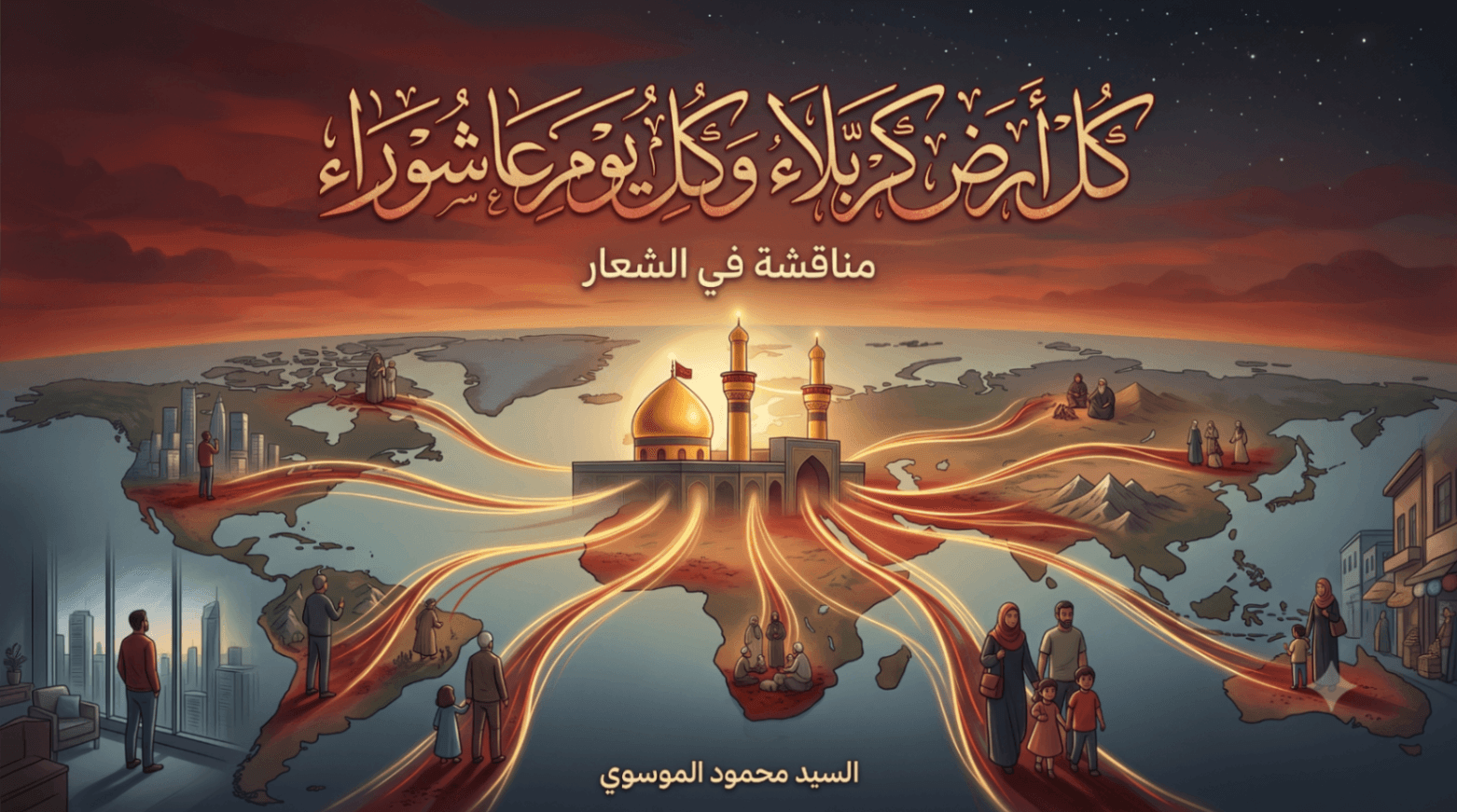
Al-Walaʾ magazine, issued by the Islamic Message Society, published an article by Sayed Mahmoud Al-Mosawi under the title: The Husayni Book.. Authorship, Publication, Reading and Support.
That was in its issue published on the occasion of ʿAshura of the year 1435 AH.
The Husayni Book
Authorship, Publication, Reading and Support
Sayed Mahmoud Al-Mosawi
Do we need three billion books for our progress?
And where is the place of the Husayni book in our reality?
Or, with a clearer question: where does our reality stand in relation to the Husayni book?
The closer we come to Imam al-Husayn (a) and to his blessed revolution—a genuine drawing near—the more convinced we become that our reality is still far from the spirit of the Husayni uprising and its values, and the more convinced we become that in our minds there are wide empty spaces of ignorance of Imam al-Husayn (a). Whoever claims complete knowledge of the Imam (a) and of his blessed uprising, that claim will be proof of a knowledge that is not heading in the right direction.
The Ahl al-Bayt (a) are the counterpart of the Noble Qurʾan, whose knowledge and wonders are never exhausted. Were the sea ink with which the virtues and knowledge of the Ahl al-Bayt (a) were written, the seas would be exhausted before their words (a) were exhausted. The Prophet (s) expressed this knowledge when he said: (O ʿAli, none knows you except Allah and me).
So whoever claims that knowledge of Imam al-Husayn (a) and of his blessed uprising has been completed, in all its chapters, in his mind because he has read one book or a thousand books has departed from what is right, deviated from the main road and strayed from the path..
Husayni knowledge has two tracks, according to the general classification of the direction of knowledge:
The first: The first track undertakes knowledge of the Imam himself and knowledge of his course, his uprising and his message—a knowledge that builds a person’s faith and creed, with the doors open for ascent in the expanses of faith and certainty; and likewise a knowledge that builds a person’s awareness of the course of Imam al-Husayn (a) through analytical and exploratory reading, the field also being open for discovering the subtleties of matters, their hidden aspects, their starting points and their outcomes.
The second: The second track of Husayni knowledge is the translation of Husayni values and contributions into reality in every time and every place and in various circumstances and situations. Abstract knowledge is not sufficient, because the truth must be realized in reality and translated into a lived reality. And if we know that life runs the course of the days that Allah the Exalted alternates among people, and that it does not come to an end, then the human being, in his various circumstances and eras, remains thirsting for the guidance of Imam al-Husayn (a).
ʿAshura, a Forum of Awareness
Imam al-Husayn (a) is the ember of thought, the beacon of guidance and the foundation of righteousness, and the season of ʿAshura is the season in which these aspects move and interact in a person’s life. Therefore the season of ʿAshura ought to be a forum of awareness at all its levels. The (book) is one of the important molds of giving in the human journey, and attention to the Husayni book and to reading is attention to the way of Imam al-Husayn (a), the consolidation of that way and its dissemination on the widest scale, so that it may endure for a longer time.
In order to do full justice to the discussion of the Husayni book, which carries Husayni thought within its folds, we will devote a special discussion to four basic dimensions of the book: (authorship), (publication), (reading) and (support). These four dimensions are complementary dimensions upon which the effectiveness of the book in reality rests. There is no meaning to a book that is written without being read and without being published, and no book can come out into the light without the necessary material support.
Authoring the Husayni Book
The state of authorship in Islamic affairs generally lags to a great degree behind the global state of affairs—or let us say it lags behind what the state of authorship ought to be. Perhaps some scholars and researchers content themselves with being aware of information, or with studying history, doctrine and thought, without setting that down on paper and turning it into a printed book; that concern has become remote from the minds of many scholars. Perhaps this is due to a lack of conviction in the influence of the book, or to scarce material resources; but that is no excuse for ceasing to author, given the importance that the book represents in shaping societies and their progress. Indeed, Islam gave the book otherworldly dimensions, such that the deeds of the son of Adam are cut off after his death, except that if he leaves behind a book from which benefit is derived in the world, that will be a source of continuous reward.
If we look at the quantity and number of books written about figures such as the playwright Shakespeare and compare them with what is written about Imam al-Husayn (a), we will realize the extent of our backwardness and of our lagging behind the caravan of knowledge production concerning the thought and creed we believe in. Statistics estimate that every year there appear, in studies and articles about Shakespeare, more than 5,000 books and articles, and some writers have said that the number of what has been written about him cannot be counted, as an expression of the enormous quantity of works about Shakespeare’s plays. Whereas if we tried to count the books that have been written about Imam al-Husayn (a), they would not reach a tenth of a tenth of a tenth of that—even though Shakespeare wrote plays that are not real, while Imam al-Husayn (a) inscribed with his blood a real story on the stage of life; and what Shakespeare wrote was inspired by his human thought, while what Imam al-Husayn (a) inscribed was inspired by heaven. The comparison is unjust to the Imam, but it shows the extent of our lagging behind and the extent of the resolve we need to author for the sake of Imam al-Husayn (a).
Many scholars have carried the concern of authoring about Imam al-Husayn (a) from his killing until now, but reality needs more in order to bring out the truths, discover the knowledge and apply it to reality—that is, for us to read Imam al-Husayn (a) and the event of Karbala with a reading commensurate with the position they were meant to occupy in the history and future of humanity until the Day of Resurrection.
Authorship of the Husayni book has not stopped, despite its scarcity. “The book (Maqtal al-Husayn) by Abu al-Qasim al-Asbagh ibn Nubata al-Mujashiʿi al-Tamimi al-Hanzali is considered the first book to treat the killing of al-Husayn, and he wrote it in the first century AH. Among the first who authored books on the martyrdom of Imam al-Husayn (a) were: Abu Ahmad ʿAbd al-ʿAziz ibn Yahya ibn Ahmad ibn ʿIsa al-Juludi and Abu al-Hasan ʿAli ibn Muhammad al-Madaʾini in the third century AH, and Abu al-Fadl Nasr ibn Muzahim al-Minqari al-ʿAttar, who died in 212 AH”[1].
The scholar al-Kalbasi, who authored the largest Husayni encyclopedia, under the title Daʾirat al-Maʿarif al-Husayniyya, comprising 600 volumes whose parts are still being printed, devoted thirty volumes of his valuable encyclopedia to cataloguing Husayni works, of which three volumes have been printed up to this time. In the first volume, after the introductory studies on authorship and its necessity, he catalogued 165 titles, and in the third volume he catalogued 221 Husayni books. It seems that the remaining volumes will follow this numerical pattern, that is, the number of books catalogued will be approximately 6,000 books, and this is close to what is written about Shakespeare’s plays in a single year.
Therefore the call for resolve on the part of scholars and researchers to write about Imam al-Husayn (a) is of the utmost importance, such that it develops into detailed analytical studies, and into the explanation and discovery of the various kinds of knowledge in the hadiths of the Imam (a), his speeches, his supplications and his life. We notice that the Husayni book has developed in its production compared with the past: a number of encyclopedias and detailed studies of the event, its genesis and its effects have been published, and some of them have taken the character of classification, compilation and arrangement, which facilitates the process of research for authors.
The making of the Husayni book begins with the authors, and that requires conviction of the necessity of presenting Imam al-Husayn (a) and his guidance to humanity—whether what benefits Muslim society, or what ought to reach non-Muslims, or for answering contemporary questions and problems.
We find that the field of Husayni oratory is abundant in number, so it is fitting that researcher-orators write down their Husayni addresses, to be issued in booklets, or collected and issued in the form of books from which benefit can be drawn.
Publishing the Husayni Book
Some statistics have been issued by the United Nations stating that the publication rate in the Arab world, for example, is one book for every 12,000 people; indeed, some have said that for every million people in the Arab countries there are 29 books, while by contrast we find that in the West there are 726 books for every million people—that is, the spread of the book in the West exceeds its spread in the Muslim Arab world by 25 times. This reveals to us the extent of the narrowness of the publishing process in our Islamic reality.
There is no doubt that the wider publication becomes, the greater the possibility of obtaining the book, the greater the opportunities for reading, and the more firmly the book’s survival is secured far into the future. One of the causes of not reading and of lack of awareness is the unavailability of material for awareness-raising and education. If the aware book is lost and its copies become few, its effect will be limited by the limits of its spread. The book is also meant to endure so as to form one of the links in the accumulation of knowledge together with its brothers among all the other books, because a single book cannot carry out the task of awareness-raising and education necessary for the progress of the community, or for introducing a particular subject. Here we are concerned with discussing the publication of the Husayni book, to which applies what applies to the state of publishing in reality.
Because Imam al-Husayn (a) is a lamp of guidance, we need that light to spread throughout all parts of the inhabited world, so that the Husayni book is present in every library, gathering and home and circulates in every hand. Merely publishing a thousand copies of the book is not enough, because the state of Islamic book publishing, for the most part, is that a single title is printed in about one or two thousand copies on average, whereas we find that in the West some books are printed in a million copies. Up to a billion copies of the books of the English writer (Agatha Christie) have been printed, and more than 28 million copies of her book (The Bloody Desert) have been sold. We possess an epic in a real bloody desert, at whose horror the heavens and the earth wept, and we have not risen to printing and publishing a single million of the books that have been written about it.
Imam al-Shirazi says: “I have read that when the Westerners wanted to rid themselves of the dukes and the deviant Church, they authored (twenty thousand) book titles in various languages, which brought about the Age of Enlightenment for them.” This shows that quantity has an effect on the spread of those books and on the possibility of their idea reaching others. We as Muslims are in urgent need of abundant publication, especially since we have Husayni seasons with enormous human density that can be made use of in the process of publication in a manner suited to the number and the subject. In the ziyarah of Imam al-Husayn (a) on the Arbaʿin, more than 18 million pilgrims attend, as the Governor of Karbala stated for the year 2012 CE—not to mention the other seasons of Husayni ziyarah, and the season of ʿAshura in all regions, which witnesses enormous human gatherings to revive the Husayni rites. It is therefore fitting that book fairs be established, and that the husayniyyas take it upon themselves to print books and distribute them, both free of charge and for sale.
Reading the Husayni Book
They have said that the average reading of the Arab citizen is 6 minutes a year, or two pages or a little more in a single year, whereas the American, English and Japanese citizen reads more than 12 books in a single year. The disparity is clear and evident, and it covers all dimensions of the state of the book and what is connected to it; the most important dimension is the dimension of inclination toward reading. The Islamic community is the community whose Message began with the command to read; it encouraged learning to read from its earliest days, and it made teaching Muslims to read the price for freeing captives from among the unbelievers. It is all the more fitting, then, for the Muslim to turn to reading and to give it attention that is not confined to one time rather than another, but continues with him until the end of his life, given that the seeking of knowledge and learning is from the cradle to the grave.
If there must be a need created, or a special atmosphere created, in order to turn to reading about a subject, then the Husayni book has all the elements for turning to read it. The need for Husayni thought and Husayni values is urgent, given that the Imam is one whose obedience is obligatory, and it is obligatory for Muslims to follow his example and to respond to what he says. The prepared atmosphere is also present: we do not need to designate a day such as Mother’s Day, Nutrition Day or Prisoners’ Day in order to read about that subject, for there are numerous seasons that charge the atmosphere, preparing it with the lofty Husayni spirit that motivates reading, such as the season of ʿAshura, the Arbaʿin and the seasons of the many ziyarahs.
A nation that throws the book behind it and pays it no attention cannot progress. Reading is a cognitive act of drawing knowledge continuously, at all times and in all circumstances. A nation that does not read will be inhabited by ignorance and will move away from the light of Husayni knowledge, which is a radiance for the life of the individual human being, society and civilization; and a nation that reads is a nation that cannot be duped by others. We are in a time in which concepts and methods are mixed up, and in which vice and deviation are marketed in glittering forms—a time that requires a person to be of penetrating insight, aware of matters, not confused by ambiguities. In addition, Husayni knowledge has no limit and no bound: in proportion to the knowledge a person acquires, his faith and his certainty increase, and indeed his station.
Let technological development not be an excuse for not reading the book, because technology serves the book and facilitates the process of obtaining it and reading it.
Supporting the Husayni Book
Finally, the dimension of support and of pushing toward the publication of the Husayni book. It stems from awareness of the necessity of Husayni knowledge and its station. The concept of participating in Husayni service includes service to, and care for, the Husayni book, whether through financial support for printing and publication or through work in the field of distribution and promotion. Just as one who pays money to build husayniyyas, or to revive the rites, or to provide food has merit, so too one who pays money to print and publish the Husayni book has merit—indeed, abundant and continuous merit, like an ongoing charity that is renewed with each renewal of benefit from the book, and according to the extent of benefit from it.
We need an aware reading of the hadith of the Messenger (s): “When the son of Adam dies, his deeds are cut off except for three: an ongoing charity, or books of knowledge from which benefit is derived, or a righteous child who prays for him”. Books of knowledge from which benefit is derived can be shared in by many people: the scholar with his knowledge and his ink, the person of wealth with his wealth and his spending, and the person of effort with his effort in distribution and other things, such as administration and media. All of them are truly described as having left behind books of knowledge from which benefit is derived.
The existence of the book and its spread is considered one of the contemporary challenges. The great powers, the unjust rulers and all the capitalist exploiters do not wish people to have a relationship with reading, so that their minds are not opened to the plans intended to make people mere consumers and enslaved; indeed, they fear all ideas and theories that challenge their own theories. Therefore supporting the book that promotes Husayni thought, and the thought of the Husayni uprising and its knowledge, is considered a priority; and the money spent in this way will be among the clearest instances of the way of Allah the Exalted.
So when we become aware of the importance of the Husayni book—in authorship, publication, reading and support—we will have begun qualitative steps toward conveying the voice of Imam al-Husayn (a) to every mind and heart, and this is among the most important duties of the believer.