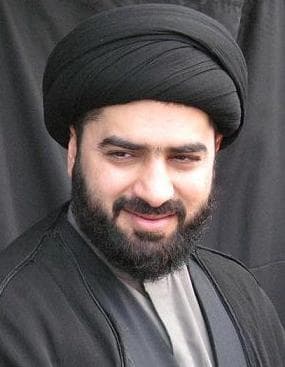
The pen stands helpless before a great personality such as that of the late jurist Ayatollah Sayed Muhammad Rida al-Shirazi (q), a personality that pained us with its early departure—very early... He was in the season of his giving and at its peak; he surprised us with his departure, and the pen is at a loss as to what it can write on this painful occasion... .

Relying on Allah, I mention some points that I found important in the personality of the late Sayed, reminding myself, the scholars and the believers of them, concerning the distinguishing features of the scholar of the mission—features I find in complete harmony with the directives of the Noble Qurʾan and the counsels of the Prophet (s) and his Ahl al-Bayt (a) concerning scholars...
Because reminding is important in this regard, given the sensitivity of the role of scholars in leading the community, building its character and defending its identity, these features must be recalled from time to time, so that the scholar remains mindful and society remains discerning of that role, in order to stand with the active scholars and to rouse the remiss among them...
Among the distinguishing features of the late Sayed (q):
1/ He was devoted to the service of the religion and committed to his role as one of the scholars in research, preaching, writing, founding, encouraging action, meeting people daily, guiding them, and discussing new developments and needs with them. He found no place for seclusion in his life despite the illness in his back; laziness found no justification with which to persuade him to slacken in giving; and material justifications did not defeat him into isolating himself from the work of the mission and devoting himself to amassing wealth and luxuriating in comfort.
2/ His being active and taking initiative did not mean that he would deny others work and success in work; rather, he went to great lengths in encouraging those who work, motivating scholars and rousing energies to proceed along the line of the work of the mission, because his concern and aspiration were confined to the goals and sprang from principles and values, and were not centered on himself and his person.
3/ The opinion of others did not, for him, constitute a war front against them. Whatever is a matter of opinion, its arena remains dialogue and the strength of argument, far from harshness, accusations of unbelief (takfīr) and repellent coarseness. He believed in this with a scholarly conviction, especially in what relates to differences and ijtihads within the Islamic scholarly community, and he put it into practice: he would present the opposing view with all courtesy, discuss it and establish the proof against it, without resorting to harshness and without taking shelter in the noise of a raised voice and agitation, in a blending of the strength of argument and gentleness of treatment, so that the way back would remain open to the other.
4/ He did not withhold himself from engaging with the contemporary problems of Muslims on the pretext of being occupied with certain scholarly issues. He firmly believed that it is obligatory for scholars of vision to display their knowledge in the places of trials, and that they must present the view of the religion on the problems that newly arise. For example, he addressed the question of takfir, pluralism and cultural assimilation, and treated the issues of family breakdown and building the virtuous family in the present time, and the like... So while he would address doctrinal issues because of their importance, he would address contemporary problems because of their importance as well, even if at times he gave one aspect precedence over another according to what he saw as more important.
5/ For some, scholarly occupation with advanced studies may be a barrier to engaging with society in a discourse that addresses their understanding. This barrier, created by certain customs, had no existence in the career of His Eminence the late Sayed: his direct meeting with people was readily available every day, and his educational lectures were continuous and varied. Scholars occupy themselves with knowledge only so that it may light the people’s path, because knowledge is light—not so that knowledge should occupy them away from the people and from guiding the people.
Conclusion
There is no doubt that the late Sayed had many distinguishing features other than what I have mentioned here, and many have mentioned them in the gatherings of condolence and consolation. But I set down these points, which I consider important for setting right the role of scholars and ensuring the continuity of giving and effectiveness, so that social disputes do not stop us from performing the role of the mission, nor does stubbornness in our own opinion keep us from engaging with others, and so that poverty does not hold us back from continuing, and so that fatigue does not make us sink into laziness and excuse-making...
We ask Allah for success and right guidance for the scholars and the believers...