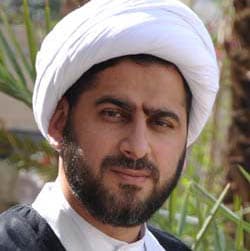
Shaykh Hasan al-Balushi*
Politics represents the superstructure of human interaction within the framework of society: political work and the political institutions of the state are a natural result of social movement; hence political practice has been considered the peak of human social activity. Political stability in a given state reflects the extent of social stability in it.
.
In the Arab–Islamic world, and since the fall of the Ottoman Caliphate, which was a political framework for the components and diversities of Islamic society, the political preoccupation has come to represent the priority of the elite's activities, especially since that fall was paralleled by colonialism and crowned by the implanting of the Zionist entity, which doubled the intensity and density of the political and military focus. It seems striking that the elites destined to lead and manage the Arab–Islamic world varied between currents of the right and the left at the level of intellectual reference, yet all of them in the final outcome—and in general—were unable to transcend the political–military preoccupation. This reflects the modesty of their intellectual contributions in fields other than those that theorize the political struggle, let alone social and developmental projects.
If we set aside the Iranian experience, what is striking to note is that from the heart of the Ottoman state a new experience began to grow and was crowned with success after a journey of two decades, where the awareness of the elite there changed toward beginning renaissance work from the first step of the stairs, not from the top—that is, from the infrastructures up to the summit—especially after the political horizon was blocked by the chains of the military and their rifles. This motivated intellectual and social energies to focus on the concepts of development and its dimensions, starting from humanitarian charitable work and reaching to social development projects, which made the project of the state, in the end, a natural result of the whole of this developmental activity.
But the most important issue in the matter is that these transformations cannot fail to be accompanied by transformations in awareness and thought that form a foundation and structure running parallel to the social journey and its development. This is what can be observed in the debate going on in intellectual circles among Islamic thinkers regarding juristic development in particular, and Islamic thought and discourse in general, in the direction of a contemporary vision of religion and a vital jurisprudence for new developments.
In reality, moving in the direction of a jurisprudence of development is not an easy matter, because of the intellectual efforts it requires, directed at areas of Islamic thought that are still considered virgin land, such as reviewing and developing the place of the Noble Qurʾan in the juristic process and developing the mechanisms of reflection upon it; accompanied by attempts to discover the spirit of the sharia and the cardinal values, in addition to studying the structures of inference and their mechanisms. All this coincides with the necessity of effective dialogue with the development proposals put forward in our world today, such as the United Nations Development Programme, or the experiences of the advanced states in the West and the developing state in East Asia.
But in the final outcome, activating the jurisprudence of development, developing it, rediscovering it and then turning it into a daily practice of Islamic work remains one of the best options that can develop the actual reality of the Muslims, especially under the present circumstances. On the other hand, it guarantees for the Islamic movements the survival of their social effectiveness should the project of political Islam commit suicide. In a phrase: it is the project of the nation and its development, not the project of power and its hegemony; states die, but nations remain through their development.
______________
* A religious scholar from Kuwait.