- Author:
- Sayed Mahmoud Al-Mosawi
- Pages:
- 426
- Price:
- Free
- Country of publication:
- Bahrain
- Publication date:
- 1429
- Book file:
About the book:
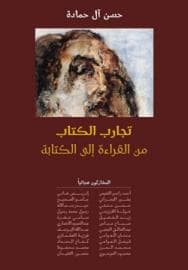
Dar al-Qariʾ in Lebanon published, in the month of Ramadan 1429 AH, the book (Writers' Experiences: From Reading to Writing) by the writer Ustadh Hasan Al Hamada, in which he invited 22 male and female writers from various countries, such as Lebanon, Morocco, Saudi Arabia, Egypt and Bahrain… to narrate their life-stories with reading and writing. The book runs to 436 pages in waziri format…
Here is the experience of Sayed Mahmoud Al-Mosawi as he narrated it in the book
The Project of Reading and the Mission of Writing
Birth Pangs and Experience
Mahmoud Al-Mosawi
When a person is born into a reading environment, or one with cultural activity, we can picture the beginning of his relationship with the book, in reading or in writing; for the most part it will be a classic, routine beginning with nothing of excitement or strangeness in it. He was born into a reading environment and inherited reading from it, and the expected outcome for the type of relationship is that it will be a relationship of familiarity and friendship with the book, or at the very least a relationship of neighborliness in which each of them is a good neighbor to the other by keeping in touch with one another, and the fare on the table between them is words and letters, and consequently meanings.
But in an environment like the one we lived in, in our country Bahrain, in the early eighties of the last century, the relationship is different, and somewhat difficult. At that time the habit of reading was not widespread among people; the elite monopolized it entirely, due to several factors, the most prominent of which was the low cultural and educational level of the general public, because of their preoccupation with pressing livelihood issues. Among the important factors, especially at the time we were opening up to life, was the security situation in the country, which was discouraging, indeed dangerous for anyone who carried a book in his hands, because it would be interpreted by the security authorities as a political act, a party affiliation or something similar…
So we were not used to seeing books in our daily lives, and likewise all our peers; any person who would come to have a good relationship with reading would certainly have an unusual story by which he enters the world of the exception.
I developed a relationship with the book that I consider good, for two reasons, which expressed two stages, namely:
The first stage:
The stage of innocence in reading, at the beginning of the eighties, when I was eight, nine and ten years old. I describe this stage as innocence because it formed my first relationship with reading other than rigid school reading; I developed a relationship with free and unfettered letters and words, and I learned then what worlds of meaning words can create, what feeling they pour out and what horizons they reveal, if they are arranged and set out in different forms.
The cause of this stage was my paternal uncle, who worked in the city of Manama and would bring us from there magazines that were not sold in our village; indeed, they were not sold in any of the villages at that time. So I and those with me in the house (my uncle lived with us in the large family house) would long for his coming home from work, and we would snatch up those magazines and devote ourselves to reading them.
The second stage:
The stage of opening up to the cultural and sports club in our village, where there was the arena of cultural and political work and the place of tug-of-war between the various currents: the Communists, the Baʿthists and the Islamic Risaliyyun, each working to win people over through ideas and through books, and some of them through other influences. Since I had a good relationship with reading, the easiest entry point through which they could reach me was the book, and indeed all of them tried that… However, it was the Islamic current that attracted me, and the book (Discussions with the Communists) by Imam al-Shirazi (q) influenced me in that period… It was the first book I read in full; the reason for that was the author's engaging style, and the other reason was the need for the topic itself in the arena of contention at that time…
As for how I obtained the book, it was thanks to small home libraries. We used to gather at the house of one of the brothers, who was among those who had a home library containing a collection of books and booklets; and during our long periods of being in that house, from time to time we would take some of them and read. Hence it can be said that this place had an effect in consolidating the relationship with reading.
After those two stages, I continued the journey of reading, and the book became a friend I searched for everywhere. In the preparatory (intermediate) school I regularly frequented the school library; after that I opened up to the public library of the Ministry of Education, one of whose branches was in an area a few (several) kilometers away from us, namely (Jidhafs Public Library). I began acquiring some books at home, which was considered strange by some of those around me. In the secondary stage, progress in the relationship with the book became evident, because the school was in the eastern part of Bahrain, right after Manama (al-Hoora Secondary School), and later Ahmad al-ʿUmran School, so I seized the opportunity of our being near Manama to buy books from the bookshops there. My plan, for many periods, was as follows:
I would save my entire daily allowance until, at the end of the week, I had an amount with which I could buy a book. On the last day of the week I would not board the school bus that took us to the village; instead I would walk on foot to Manama, to pass by the bookshops and buy a book or two depending on the amount available to me, and after that I would move on to the Manama bus station heading toward our village. At that time I formed a private library from a collection of books to which I had a close attachment… I still keep them, and seeing them takes me back to that time.
Reading came to occupy a greater share of my concern. Since the secondary school library did not have books that appealed to me at that time, I resorted to the idea of founding a secret mobile library in the classroom. The gist of the idea was that every day I would bring with me a number of small booklets for us to read in free time at school, and sometimes even during some unwanted lessons… And I had a group of regular patrons for this library…
The topics and fields of reading were many; however, comparative religious topics and social topics had the largest share, because of the multiplicity of orientations, tugs-of-war and dialogues at that time, and what that required of mixing with people and forming relationships with them in the social dimension. But after several years had passed, and especially after finishing the secondary stage, my readings began to diversify more and my openness widened in scope. I never felt any sensitivity toward a certain author or a certain book, as many of my generation did; the criterion and the axis were knowing ideas and benefiting from the sciences in general. But the stage of conviction and adoption must take its natural place, so as to build one's way of thinking and style of life more precisely than the personality had been before it.
The method of reading
Moving away from spontaneity in reading and scatter in choosing topics, for a specific period I followed a method of reading based on focusing on a particular topic for a specified period; after finishing it, I turn to another topic. I felt the benefit of this method, the credit for which goes to the directions of the seminary (the Hawza of Imam al-Sadiq (a) in Syria): I would choose a topic such as history, for example, and set a period of one month, specifying an important collection of history books that had to be finished in that period; and likewise in creed, hadith, politics, culture, sociology and others.
The benefit of this method is that it makes you focus on a specific topic, living with its subjects, so that thought is not scattered among other topics. It also gives complete fundamentals of a specific topic, so that the reader forms a general knowledge of that topic. There is also another benefit, which lies in the way those books are chosen for that period; the way to do so was by consulting one of the specialists in that topic to specify a collection of important books in that field…
As for now, what dictates the type of reading for me is the need required by the current stage, whether in discussing some modern propositions, knowing new treatments, filling intellectual gaps or scholarly benefit; this on the one hand. On the other hand, the motive is following what is new as far as possible.
Reading is a life project
Among the most important convictions I have come to hold about the habit of reading is that reading is not one of life's tasks that a person can accomplish and be done with so as to apply himself to another work after it; rather, it is a life project that should not leave a person, considering that reading is the most prominent instance of learning and seeking knowledge, which we have been commanded to continue until the end of our lives, as the Greatest Messenger (s) said: “Seek knowledge from the cradle to the grave”…
Building on that, I made the decision to be constantly engaged in reading throughout life. As for the method, I designate one book or more to read, and start another right after it without interruption; even if I am held back by not having time, the bookmark is there in the pages of the book, so that I may begin reading whenever I get the time… In this way I began to give others the good news of this and invite them to adopt it, and I put forward this method in a lecture titled “How to Invest Your Simple Energies”([1])
Therefore I believe that any person can find time, and how many are the times that slip away from our lives without being used! Just as others do with the habit of reading while waiting for the train, on a flight and the like, I decided to break the barrier and make the book my companion at many times, so as to seize opportunities for reading: while waiting for transactions at government ministries or the hospital, or when traveling. Indeed, I have finished reading many books in these times, which did not become wasted…
There is another method of reading that may impose itself on you: when you find a rare book with one of your friends, or come across a book that would be difficult to obtain again, and you wish to read it, the solution to seize the opportunity is to borrow it according to what is possible. You may be able to keep it for only one night, so you must read it in a quick, cursory way, even if only by way of a general overview; and there is no doubt that such opportunities come to a person often… I tried to apply this idea, especially as I know stories of great scholars who did it, such as al-ʿAllama Shaykh Husayn al-ʿUsfur and Imam al-Shirazi (q)… In this case the reader is required to cancel his engagements for this brief period, and afterward he will feel the elation of victory and achievement.
Writing and the birth pangs of publishing
If you live with the book, love of writing must form within you, since writing is the maker of reading: had it not been for writers who poured their ink onto paper in writing, there would have been no book, especially if you are convinced of the book's effect on a person's life and its importance. Thus I began the path of writing from a tender age, specifically in the preparatory (intermediate) school stage. The first attempts were that I produced a weekly magazine at school, entirely by my individual effort; then one of my relatives joined me. This magazine resembled children's magazines: it contained illustrated stories and information about scholars and about the sciences, and because I was fond of drawing I also drew all the magazine's material. I would distribute it to acquaintances and some teachers, and they would wait eagerly for it to come out at the beginning of every week.
As for the secondary stage, I used to write short articles inspired by the readings I was reading: if I read about friendship I wrote an article about it, and if I read about ethics I hastened to write down an article on that, and so on… The means of publication at that time were the wall magazines that were distributed in the mosques; perhaps this experience was the first experience of semi-public publishing, in that the mosque-goers could read what I wrote.
Readers' Mail
Publishing in the wall magazines encouraged me to take another step toward publishing in the press through (Readers' Mail), and indeed I resolved to do so, and I found
that what I wrote was indeed published. One of my friends was encouraged along with me and began writing as well. After that we felt that the Readers' Mail page was our real newspaper, because we wrote what we wished to write; indeed, its writers were known to us by their names only, to the point that we began replying to one another through this page. I remember that once I wrote criticizing our local newspapers that ran crosswords (that entertaining cultural game), criticizing their tendency to put superficial information of a kind that encourages young people to learn the names of male and female singers, with no concern other than that… in contrast to some Arab newspapers, which we see contain better topics. One of the female writers replied to me, supporting the approach of our press in this, and after that I resolved to reply; but I was surprised
by a reply from another pen from my village, one of the sisters in our neighborhood, replying in defense of
what I had written. So I knew that that press of ours had followers… And I still keep some of those clippings…
Toward the end of the secondary stage, I began studying the religious sciences in the evenings, beginning with the study of jurisprudence, grammar and logic. I felt then that I should write a book, even if a small one… especially since the small booklets by Sayed Hadi al-Modarresi (may Allah preserve him), which I kept reading, motivated me to write through their engaging style in presenting the idea, its realism and indeed its effect… So the beginning was that I imitated the writing style of Sayed al-Modarresi.
For writing techniques I drew on the book on research that we studied in secondary school, called (The Student's Guide to the Methodology of the Library and Research), which presents the importance of the book, the effect of research and its types, its method and its tools, treating that book as an outside book and not a school book, so that I would live in a freer atmosphere… Indeed, I wrote two small booklets, which I gave to His Eminence al-ʿAllama Shaykh ʿAbd al-Amir al-Jamri (rh), and he wrote two encouraging introductions for me. I still keep these two booklets, as I did not publish them, because they need reconsideration and correction.
The total that I wrote in the form of booklets in that period was three, under the titles (Islamic Majalis) or Majalis of Remembrance, (Imam al-Husayn (a), the Candle of the Heart) and (Reflecting on Water)… They were all in the year 1412 AH, when I was seventeen to eighteen years old.
In the same period, with a group of friends we founded a cultural committee in the village and issued a bulletin called (al-Manar), whose name later became (Dhikra). In it we practiced conscious and responsible writing about the various Islamic occasions, which honed my ability to write articles; and at that time I was keen to read what was written about the method of writing articles and their types.
After that I began writing in the press. The first newspaper I wrote in was the Kuwaiti (al-Raʾy al-ʿAm) in (1998 CE), on the Opinions and Issues page, side by side with the writer Muhammad al-Rumaihi, Maʿsuma al-Mubarak, Ahmad al-Dayyin and other well-known writers. This experience made me live in observation of the social, political and cultural situation in our homelands, so as to write about it, assessing and correcting… I also wrote in various newspapers intermittently, and for a year and a half I wrote regularly for the Bahraini newspaper (al-Mithaq), with a weekly article, in (2004 CE/2005 CE).
The first book printed
I wrote the first book that came out into the light in print in 1993 CE, and it was actually printed at the beginning of 1994 CE, when I was only 20 years old. The name of the book is (On Pulpits of Light), consisting of 94 pages in small pocket format. I had it printed in Lebanon, taking advantage of the international book fair held in Bahrain: I made an agreement with one of the publishing houses to print it. Its subject was doctrinal, proving the principle of wilayah from the Noble Qurʾan alone.
It was not familiar at that time for society to see a book by an author living among them, in addition to his age not exceeding twenty years; moreover, in society there were those of a higher scholarly level than me who had not undertaken any attempt at writing. Therefore I did not receive the encouragement that a writer needs in his beginnings in the world of publishing to push him toward more giving… rather, I met the opposite…
I was not negatively affected by the negative opinions that reached me, because I received some encouraging opinions indirectly: I noticed the book spreading in some circles without the author being known, and they liked it; and in the bookshops that displayed the book I would notice some people leafing through the book and then buying it. These observations encouraged me and gave me greater confidence to continue… However, after I had blazed the trail and published many books, I meet with much encouragement and following, especially from great scholars…
A session of consultation and discussion
At that time, in the first writing experience, I thought about actually developing my pen, for I was not satisfied with that level. So I invited a group of educated friends and students of the religious sciences to a session of tea and discussion. The agreement with them was that each
one of them would come with a set of remarks on the book, so that I might benefit from their opinions… The session took place, and the discussion ran from the title of the book to some words and ideas…
I resolved to continue, so I put my trust in Allah and wrote the next book under the title (The Methodology of Islamic Culture), then (A Cultural Meeting in the Damascus Countryside), a meeting with Grand Ayatollah Sayed Muhammad Taqi al-Modarresi (may his shadow endure)… And the other books followed, of which the printed ones have reached, up to the time of writing these lines, fifteen books and booklets…
Writing is a mission
I have never imagined myself stopping writing completely one day, because writing is not merely running the pen over the surface of paper; it is a real process of research through which the writer carries out the process of thinking, so as to come out with visions bearing a responsible message, which he then formulates in different molds to present to the reader as ready material. This is an embodiment of the principles of responsibility for change, contributing to reform, bringing truths to light, and participating in the development of society through injecting knowledge.
From this starting point, the type of writing I strive for can be formulated: it is of a responsible character, contributing to the enrichment and accumulation of knowledge, so as to create an atmosphere of awareness through which a person can raise his level and his reality to the better. Being a student of the religious sciences, with cultural and social interests, it is natural that my writings have a religious hue, be founded upon the foundations of religion, and be directed to society in its various segments.
The effect of writing
When you visit an international book fair, full of diverse publications from all countries, and with many styles, a worrying question comes to you: can your book take its place before this huge quantity of books and be distinctive so that the reader turns to it?… Will the visitors to the fair notice my book or books in this crowd of books?… And will I get real readers who can benefit from what I write?…
I do not hide that this feeling came to me from time to time at the beginning of the journey; however, by the grace of Allah the Exalted, I receive clear answers every time I think in this way, as if they were messages from the All-merciful addressed to me, saying: Write, for the effect is there, even if you do not see it with your own eyes… and if it has not happened today, it may happen tomorrow… for the book remains as long as people remain…
And just as its benefit may come even after a while, likewise its reward does not cease, even after the author's departure to the world of the Hereafter([2]); and this is a great blessing for authors…
The messages that reach me when those questions occur to my mind are sightings or testimonies showing that people are diverse in their cultural tastes and that a writer can find readers… For example, I would see one of my books at the fair displayed in large numbers, and the next day I would see that it had decreased greatly… Or messages would come to me by email or directly, telling me about people the course of whose lives one of my books had influenced, or who had benefited from it greatly… Even one of the newspapers published a full page about one of the books, and the journalist in charge called me to ask where the book was sold, because readers were calling him asking… and similar stories… These show that when a book is published and finds itself a place on the shelves of bookshops, it will necessarily find readers who will spend time alone with it…
What can I write?
The important question at which a writer should stop, being truthful with his Lord, with himself and with his society, is: What should I write? What is the topic and the aspect in which and about which I am driven to write?
Should I write what people turn to and what appeals to the whims of many of them, without regard to the importance and effect of that topic? And will the motive be to achieve a wide volume of sales, so that money pours in to the author?… There is no doubt that we have seen some authors who follow this approach, which distorts the course of writing and mars its mission for him… There are responsible dimensions that the writer ought to take into account. In my limited view, contributing to achieving some good in any field is the writer's first aim, coupled with sincerity to Allah the Exalted; then comes the role of detail in the topics and choosing their priorities; and there is no doubt that all of this is conditional upon the author's ability to write in the field he has chosen…
There are several motives that have prompted me to write what I have written: I usually look for the empty spaces in a topic, either in terms of the material and its scarcity, or in terms of a missing style of presentation… Also, observing reality and its needs has an effect in determining the type of writing, because that is an instance of bearing witness to the age and contributing to the development of awareness…
Nor should we overlook the creative side of the writer: he may have an idea, a theory, some ijtihad, a deduction or any intellectual and scholarly creativity in any aspect, and this calls him to present what he has arrived at in written form…
For example, I wrote the book (Love in Marital Relationships) because I
did not find a book devoted to this important field, and if it is researched in books on marriage, it is in brief form; and likewise the book (The Art of Apologizing and Accepting Apologies). I wrote the book (Fatimah al-Maʿsumah, the Promised Paradise) because of what I saw of the character of the books written about her: they were investigative works or collections of stories of wondrous graces (karamat), which do not give the reader a clear picture of her life; so I wrote the book as a complete presentation of her life from before birth until death, up to the building of her holy shrine… Likewise the book (The Path of Reform: A Reading of the Reformist Discourse of Imam al-Husayn (a)), in which I tried to make the reading of the Husayni march a cultural reading and to extract the values from which contemporary Islamic movements can benefit. I presented a new concept of awaiting (intiẓār) in the book (Imam al-Mahdi: The Unseen Witness); I tried to crystallize the Husayni march in the form of a culture in the book (Husayni Culture); and I tried to contribute to presenting intellectual and Qurʾanic treatments of contemporary and pressing issues in the book (Studies in the Paths of Society and Civilization)…
This does not mean that the motives are limited to that: the desire for reward in presenting something repeated may be a motive for writing; formulating a certain material in a new formulation may be another motive; or the motive for writing may be one thing and the motive for publishing another, like one who writes for himself in order to benefit from a subject, researching it and collecting materials, and then it occurs to him to publish it later so that the benefit may become general.
The writing workshop
The favorite place for writing is in the embrace of books in my humble library, far from noise; as for the time, I prefer the calm of late night, followed by early morning. I start the stages of writing, which begin with determining the topic, then general reading, then writing the main points, then detailed reading around the main points, then setting out questions and problems, then the process of dialogue with ideas, then searching for results and intellectual supports… Then another stage begins: presenting the material, formulating it and the style of presenting it to the reader. In all stages the pen must stay close to note-taking… indeed, the necessity of holding the pen continues at every moment and in every place when I am in the course of preparing a writing project, because ideas leap up from time to time so that you see them before you, and they must be written down before they are veiled again… They may leap up while you are driving your car, or in the first moments of sleep…
The computer has come to take its place in the world of writing, abolishing the draft copy that we used to prepare as an initial preparation. Thus the writer has come to have tools that help him in the writing process: he can send his book or article from his laptop to the publisher, the newspaper or the printing press directly, in the blink of an eye… However, the pen's role remains central in jotting on scraps of paper, drawing up the research plan and the like.
It is worth mentioning about the atmosphere of writing that the writer should not finalize his written material as soon as he has put its last full stop; rather, he should review it and read it with the mindset of a reader. It is better that he get up and leave his written material, then return at a different time to read what he wrote anew; for in this step a set of new points about his material usually appears to the writer, so that he changes what is necessary, and the written material will be more mature.
([1]) I put forward the idea in a lecture titled (Toward a Reading Society), and these lectures will be issued, with Allah's help, in written form.
([2]) A reference to the narration that says: “When the son of Adam dies, his deeds are cut off except for three: an ongoing charity, or knowledge from which benefit is derived, or a righteous child who prays for him.”