The Ziyarah Manual of Imam Zayn al-ʿAbidin (a)
Sayed Mahmoud Al-Mosawi

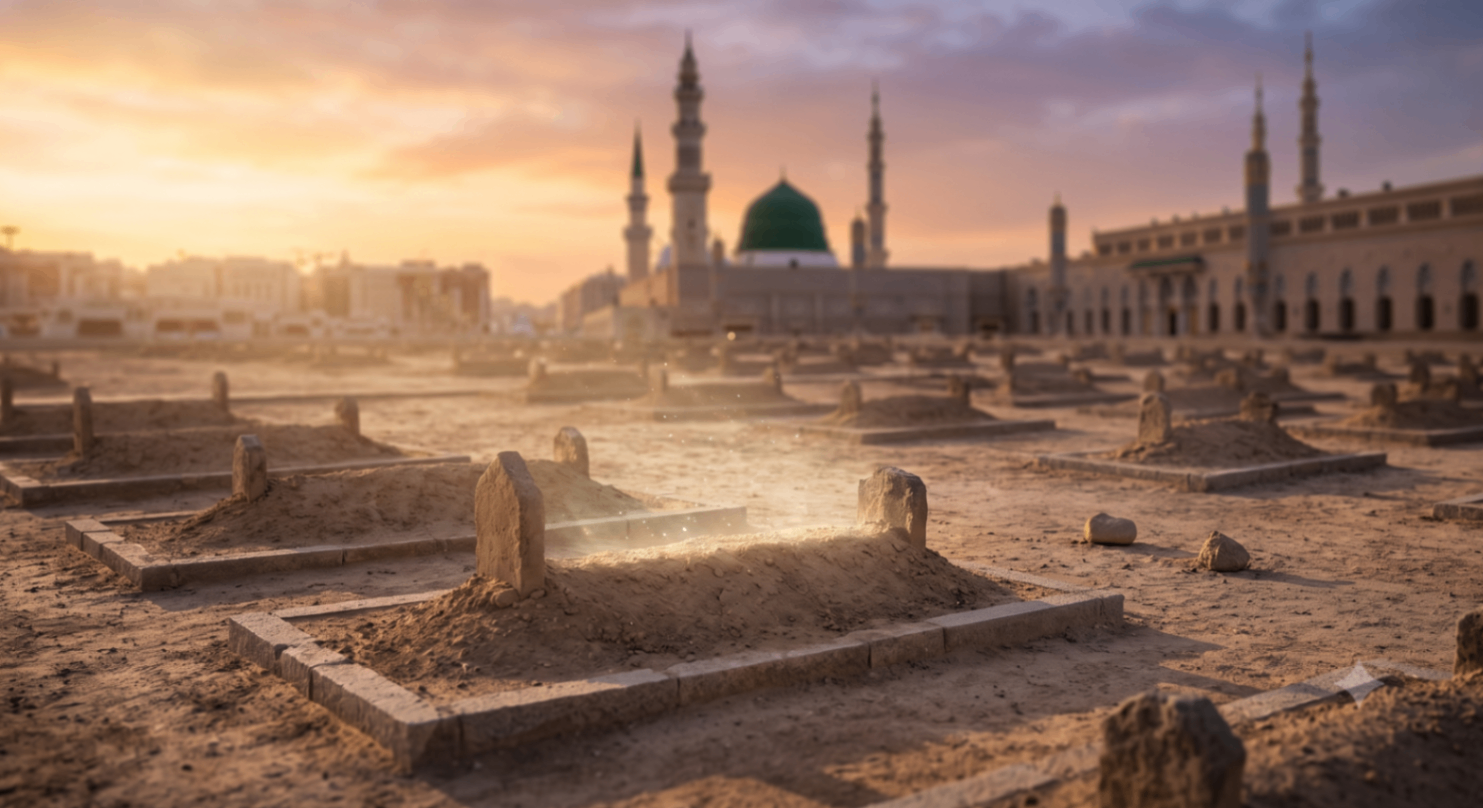
Imam ʿAli ibn al-Husayn (a) was born in Illuminated Medina on the fifth of Shaʿban in the year 38 of the Hijra, according to the well-known view, and he was martyred in the year 94 of the Hijra, on the twenty-fifth of Sacred Muharram, according to the well-known view. He was buried in the cemetery of al-Baqiʿ al-Gharqad, and his grave was a clear landmark for the Muslims; then a mosque was built over it, until the mosque and the dome were demolished, so that its trace remained without its building.
Visiting him, like visiting all the Infallibles (a), has a merit that cannot be counted or enumerated. It derives its greatness from the greatness of wilāyah, which is the foundation of Islam and its summit, because visiting him after his death is like visiting him in his life, and because it is a renewal of the covenant with the guardians of authority and the guides of humankind. It is a sacred rite for the revival of religion and its bounds, and for building the believer and his society; and with all that, it is a locus of Allah's mercy and a source of His provisions for His servants in their worldly life, and a treasure for them in their Hereafter.
So it pleases us to devote a ziyarah manual to the fourth of the Imams of the believers, ʿAli ibn al-Husayn ibn ʿAli ibn Abi Talib (a), the Master of those who prostrate and the Adornment of the worshippers (Zayn al-ʿAbidin), so that the manual may be present before the believers, to make it easy for them to visit him (a).
The Merit of Visiting Imam Zayn al-ʿAbidin (a)
1 – His noble grave is one of the plots of Paradise. The greatness of maintaining his grave and attending to it with veneration and visitation, as a means of drawing near to Allah, is manifested in the believer's attaining a special share in the intercession of the Prophet (s); and for his visitors there is bliss such as no eye has seen and no ear has heard.
It has been reported in al-Tahdhib: From Abu ʿAmir al-Saji, the preacher of the people of the Hijaz, who said: I came to Abu ʿAbd Allah Jaʿfar ibn Muhammad (a) and said to him... until he said, from Imam ʿAli (a): I said: O Messenger of Allah, what is there for one who visits our graves, maintains them and attends to them? He said to me: O Abu al-Hasan, Allah has made your grave and the graves of your descendants plots among the plots of Paradise and a courtyard among its courtyards; and Allah has made the hearts of noble ones among His creation and the elect among His servants yearn for you and bear humiliation and harm for your sake, so they maintain your graves and visit them frequently, seeking nearness to Allah and out of love for His Messenger. Those, O ʿAli, are the ones singled out for my intercession and those who will come to my Pond, and they are my visitors tomorrow in Paradise. O ʿAli, whoever maintains your graves and attends to them, it is as though he had helped Solomon son of David in building Bayt al-Maqdis; and whoever visits your graves, that equals for him the reward of seventy pilgrimages after the pilgrimage of Islam, and he comes out of his sins so that he returns from visiting you like the day his mother gave birth to him. So rejoice, and give glad tidings to your friends and those who love you, of bliss and delight of the eye such as no eye has seen, no ear has heard, and has not occurred to the heart of any human being... Vol. 6, p. 22
2 – In visiting him there is healing from every illness, through what is sought as healing from his noble soil.
It has come in Kamil al-Ziyarat: From Abu Hamza al-Thumali, from Abu ʿAbd Allah (a)—he said: I was in Mecca, and he mentioned in his account: I said: May I be made your ransom, I have seen our companions taking some of the clay of al-Haʾir in order to seek healing [seeking healing] with it; is there anything in that of the healing they speak of? He said: He said: Healing is sought with what lies between it and the grave, up to a distance of four miles; and likewise the grave of my grandfather, the Messenger of Allah (s), and likewise the clay of the grave of al-Hasan, ʿAli and Muhammad. So take from it, for it is a healing from every sickness and a shield against what you fear, and nothing among the things with which healing is sought equals it except supplication... P. 281
3 – Neglecting to visit him at the time of Hajj is estrangement, and in visiting him there are returns of provision.
In al-Khisal, from the Commander of the Faithful (a): Complete your Hajj with the Messenger of Allah (s) when you go out to the House of Allah, for neglecting it is estrangement, and with that you have been commanded; and complete [it] with the graves whose right and visitation Allah Almighty has made binding upon you, and seek provision at them. Vol. 2, p. 616
4 – Visiting him is the completion of the Hajj
It has been reported from Ismaʿil ibn Mihran, from Jaʿfar ibn Muhammad (a), who said: When one of you performs Hajj, let him conclude his Hajj with visiting us, for that is part of the completion of the Hajj. (ʿUyun Akhbar al-Rida, vol. 2, p. 262).
5 – Visiting Imam Zayn al-ʿAbidin (a) is like visiting the Messenger of Allah (s)
In al-Kafi: From Zayd al-Shahham, who said: I said to Abu ʿAbd Allah (a): What is there for one who visits one of you? He said: Like one who visits the Messenger of Allah (s). Vol. 4, p. 579
6 – Whoever visits him is like one who visited al-Husayn (a)
It has come in Thawab al-Aʿmal: Al-Sadiq (a) said: Whoever visits one of us is like one who has visited al-Husayn (a). P. 98
7 – Visiting him is like visiting all the Imams
It has come in Kamil al-Ziyarat, from ʿAbd al-Rahman ibn Muslim, who said: I entered upon al-Kazim (a) and said to him: Which is better: visiting al-Husayn ibn ʿAli, or the Commander of the Faithful (a), or so-and-so [so-and-so] and so-and-so?—and I named the Imams one by one. He said to me: O ʿAbd al-Rahman, whoever visits the first of us has visited the last of us, and whoever visits the last of us has visited the first of us; whoever is loyal to (tawallā) the first of us is loyal to the last of us, and whoever is loyal to the last of us is loyal to [is loyal to] the first of us... P. 336
On the Times of Visiting Him
Visiting Imam ʿAli ibn al-Husayn (a) is recommended (mustaḥabb) at all times; however, there are some particularities of the noble days on which visiting him (a) is especially emphasized, among them:
1 - Tuesday of every week
Sayed Ibn Tawus mentioned in Jamal al-Usbuʿ that it is recommended to visit Imam Zayn al-ʿAbidin, and likewise the two Imams Muhammad ibn ʿAli al-Baqir and Jaʿfar ibn Muhammad al-Sadiq (a), on Tuesday of every week, relying in that on the narration assigning the days to the Ahl al-Bayt (a), which Shaykh al-Saduq narrated in al-Khisal from Imam ʿAli al-Hadi (a) in a hadith, where he said:
The days are us, as long as the heavens and the earth stand. Saturday is the name of the Messenger of Allah (s); Sunday is an allusion to the Commander of the Faithful (a); Monday is al-Hasan and al-Husayn; Tuesday is ʿAli ibn al-Husayn, Muhammad ibn ʿAli and Jaʿfar ibn Muhammad; Wednesday is Musa ibn Jaʿfar, ʿAli ibn Musa, Muhammad ibn ʿAli and I; Thursday is my son al-Hasan ibn ʿAli; and Friday is my son's son, around whom the band of truth will gather, and he is the one who will fill it with equity and justice as it has been filled with injustice and oppression. This is the meaning of the days; so do not be hostile to them in this world, lest they be hostile to you in the Hereafter... Vol. 2, p. 395
2 – At all the noble times, such as Friday, al-Qadr and the ʿId, and on the days specific to him, such as the day of his birth, of his martyrdom, and of the wonders that appeared at his hands.
ʿAllama al-Majlisi mentioned this in Bihar al-Anwar, where he said: “Visiting them (a) at the noble times, the blessed days and the periods specific to them is preferable and more fitting... until he said: And the day of the birth of the Master of those who prostrate (a), which is the fifth of Shaʿban or its ninth, or the middle of Jumada al-Akhira, or the middle of Jumada al-Ula—which is the view of al-Mufid and the Shaykh (rh)—and it has been said the middle of Rajab; and the day of his death, which is the twenty-fifth of Muharram, or its twelfth, or the eighteenth; and the day of his succession, which is the day of the martyrdom of his father (a). Bihar al-Anwar, 97, p. 210
This can be argued for on the ground that on the noble days the recompense and reward for good deeds are multiplied, and ziyarah is among the best and most majestic of deeds; and by what is established in the narration about seeking out the noble days in visiting them (a), which includes the days specific to him. In addition to that, one can argue from the generality of the reminder of the Days of Allah in the Book of Allah, and there is no doubt that among them is every [day] in which a wonder or merit of the infallible Imam is known; and among the ways it is remembered is by visiting him and renewing the covenant with him through it.
3 - Visiting him in Dhu al-Hijja after the Hajj, and indeed after every ʿUmra.
It has been reported from Ismaʿil ibn Mihran, from Jaʿfar ibn Muhammad (a), who said: When one of you performs Hajj, let him conclude his Hajj with visiting us, for that is part of the completion of the Hajj. (ʿUyun Akhbar al-Rida, vol. 2, p. 262).
Perhaps it is after every visit to Venerated Mecca, i.e., after the ʿUmra as well; and this is covered by what is in al-Kafi from Sadir, from Abu Jaʿfar (a), who said: Begin with Mecca and conclude with us. Vol. 4, p. 550
The Manner of Visiting Imam Zayn al-ʿAbidin (a)
1 – Visiting him with free ziyarat, which are those the visitor composes out of his knowledge of his Imam: he greets him with the finest of greetings, bears witness for him to the merit befitting him, pledges in his presence what he is bound to pledge in his presence, seeks intercession through him with Allah the Exalted for the fulfillment of his needs, is loyal to his friends, and dissociates himself from his killers and from those who wronged him.
It has come in Kamil al-Ziyarat: From al-Hasan ibn ʿAtiyya, from Abu ʿAbd Allah (a), who said: You say at the grave of ʿAli ibn al-Husayn whatever you like. P. 55
2 – Visiting him with the general and comprehensive ziyarat with which all the Ahl al-Bayt (a) are visited, such as Ziyarat al-Jamiʿa al-Kabira and al-Saghira, and the Ziyarah of the Imams of the Believers.
3 – Visiting him with Ziyarat Amin Allah, with which, it has been reported, one visits at all the shrines.
4 – Visiting him with the ziyarat shared by the Imams of al-Baqiʿ, which we will mention at the end of the manual.
5 – The ziyarat specific to him. No ziyarah specific to Imam Zayn al-ʿAbidin (a) has been reported from the Imams (a), or we have not seen a text on that; so it is possible to compose a ziyarah specific to him, as Sayed Ibn Tawus did in his ziyarah on Tuesday. ʿAllama al-Majlisi mentioned in his Bihar a ziyarah from the book al-ʿAtiq al-Gharawi that is not attributed to an Imam.
The Texts of the Ziyarat
The First Ziyarah: A ziyarah that ʿAllama al-Majlisi cited in al-Bihar for all the Imams, from the book al-ʿAtiq al-Gharawi, not attributed to an Imam; the text of the ziyarah of Imam Zayn al-ʿAbidin is as follows:
Peace be upon the Adornment of the worshippers and the delight of the eye of the beholders, ʿAli ibn al-Husayn, the well-pleasing Imam and son of the well-pleasing Imams. Peace be upon you, O my master and my guardian, and the mercy of Allah and His blessings.
O Allah, bless the Imam of justice, the trustworthy, ʿAli ibn al-Husayn, the Imam of the Godwary, the guardian of the believers, the successor of the successors, the keeper of the testaments of the messengers, the inheritor of the knowledge of the prophets, the supreme proof of Allah, the loftiest exemplar of Allah and His firmest word.
O Allah, bless Muhammad and the family of Muhammad, and single him out among Your friends with the noblest of Your blessings and the most gracious of Your salutations. For he acted sincerely toward Your servants, was sincere in Your worship, was sincere in obeying You, hastened toward Your good pleasure, stood up against Your enemies, gave Your friends glad tidings of the great among Your rewards, worshipped You as You truly deserve to be worshipped, obeyed You as You truly deserve to be obeyed, and fulfilled what was incumbent upon him in his time until his time came to an end, his term expired and his death drew near. He was kind to his Shiʿa, merciful to his flock, a refuge for the people of guidance and a rescuer of them from all perdition, a guide for the people of Islam to the lawful and the unlawful, the pillar of religion, the beacon of the Muslims, and the proof of Allah over the worlds.
O Allah, bless Muhammad and the family of Muhammad, convey to him greetings from us, and return to us from him greetings and peace. And peace be upon him, and the mercy of Allah and His blessings. (Vol. 99, p. 223)
The Second Ziyarah: Sayed Ibn Tawus mentioned in Jamal al-Usbuʿ a ziyarah with which he is visited on Tuesday; it is shared between Imam Zayn al-ʿAbidin and the two Imams al-Baqir and al-Sadiq (a), and it is as follows:
Peace be upon you, O treasurers of the knowledge of Allah. Peace be upon you, O interpreters of the revelation of Allah. Peace be upon you, O Imams of guidance. Peace be upon you, O banners of Godwariness. Peace be upon you, O children of the Messenger of Allah. I know your right, I have insight into your standing, I am hostile to your enemies and loyal to your friends.
May my father and my mother be your ransom (a). O Allah, I am loyal to the last of them as I was loyal to the first of them, and I dissociate myself from every confidant apart from them, and I disbelieve in al-Jibt and al-Taghut, al-Lat and al-ʿUzza. The blessings of Allah be upon you, O my masters, and the mercy of Allah and His blessings.
Peace be upon you, O master of the worshippers and scion of the successors. Peace be upon you, O you who split open the knowledge of the prophets. Peace be upon you, O truthful one, confirmed as truthful in word and deed. O my masters, this is your day, and it is Tuesday, and on it I am your guest and one seeking refuge with you; so host me and grant me refuge, by the standing of Allah with you and of your good and pure household. P. 35
The Third Ziyarah: It is the ziyarah shared with the Imams of al-Baqiʿ; he mentioned it in al-Bihar.
From ʿAmr ibn Hashim, from a man among our companions, from one of them (a), who said: When you come to the graves at al-Baqiʿ, the graves of the Imams, stand by them and place the grave in front of you; then you say:
Peace be upon you, O people of Godwariness. Peace be upon you, O proofs over the people of the world. Peace be upon you, O you who uphold equity among creation. Peace be upon you, O people of the elect. Peace be upon you, O family of the Messenger of Allah. Peace be upon you, O people of intimate discourse (najwā). I bear witness that you conveyed [the message], gave sincere counsel and were patient for the sake of Allah; you were called liars and were mistreated, yet you forgave.
And I bear witness that you are the rightly guiding, rightly guided Imams; that obedience to you is obligatory; that your word is the truth; that you called and were not answered, and commanded and were not obeyed; and that you are the pillars of religion and the supports of the earth. You shall never cease to be under the eye of Allah, who transfers you from the loins of every purified man and moves you from the wombs of purified women. The utter ignorance of the Jahiliyya did not defile you, nor did the trials of caprices partake in you. You were pure, and pure was your origin. The Requiter of the Judgment favored us with you and placed you in houses Allah has allowed to be raised and wherein His Name is celebrated, and He made our invoking blessings upon you a mercy for us and an expiation for our sins, since Allah chose you for us and made our creation pure by what He bestowed upon us of your wilayah; and we were named before Him by your knowledge, acknowledging our affirmation of you.
This is the place of one who has been excessive and erred, who has humbled himself and confessed what he committed, and who hopes by his standing for deliverance, and that the Rescuer of those who perish may rescue him through you from perdition. So be intercessors for me, for I have come to you as a visitor when the people of the world turned away from you, took the signs of Allah in derision and disdained them.
O You who are ever-watchful and never inattentive, everlasting and never distracted, and encompassing all things: Yours is the favor for having granted me success and made known to me my Imams, and for that upon which You have kept me firm when Your servants turned away from it, were ignorant of knowing it, belittled its right and inclined to other than it. So the favor was from You upon me, along with peoples whom You singled out with what You singled me out with. So Yours is the praise, since I was, in this station of mine, mentioned and written before You. So do not deprive me of what I have hoped for, and do not disappoint me in what I have prayed for, by the sanctity of Muhammad and his pure family; and may Allah bless Muhammad and the family of Muhammad.
Then pray for yourself for whatever you like. (Bihar al-Anwar, vol. 97, p. 204).
The Fourth Ziyarah: It is his ziyarah together with the Imams of al-Baqiʿ; al-Kafʿami mentioned it in his Misbah without attribution, and it is as follows:
You say in the ziyarah of the Imams of al-Baqiʿ (a), after placing the grave in front of you, while you are in a state of ghusl:
Peace be upon you, O treasurers of the knowledge of Allah, guardians of His secret and interpreters of His revelation. I have come to you, O sons of the Messenger of Allah, knowing your right, having insight into your standing, hostile to your enemies, loyal to your friends. May my father and my mother be your ransom. May Allah bless your spirits and your bodies.
O Allah, I am loyal to the last of them as I was loyal to the first of them, and I dissociate myself from every confidant apart from them. I believe in Allah, and I disbelieve in al-Jibt and al-Taghut, al-Lat and al-ʿUzza, and every rival that is invoked besides Allah.
And you say in bidding them farewell: Peace be upon you, O Imams of guidance, and the mercy of Allah and His blessings. I entrust you to Allah and convey peace to you. We believe in Allah, in the Messenger, and in what you brought and guided to. O Allah, write us down among the witnesses, and do not make it the last time of visiting them. And peace be upon them, and the mercy of Allah and His blessings. (Bihar al-Anwar, vol. 97, p. 207).
